Mongolian oak
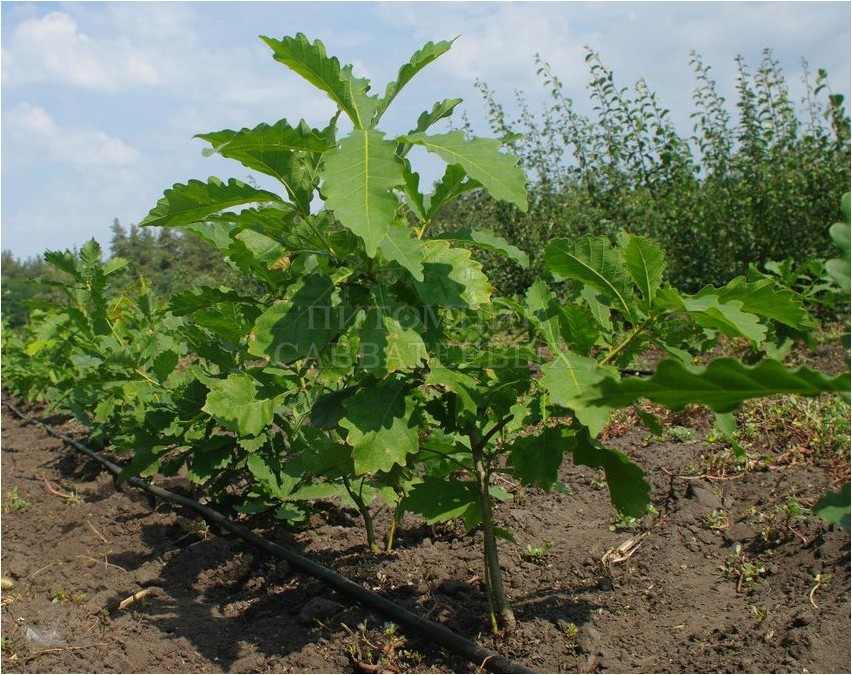
Mongolian oak is one of the plants of the family called beech; in Latin the name of this plant will be as follows: Quercus mongolica Fischex Ledeb. As for the name of the Mongolian oak family itself, in Latin it will be like this: Fagaceae Dumort.
Description of Mongolian oak
Mongolian oak is a tree whose height reaches sixteen meters, and its diameter will be equal to one meter. However, most often the height of such a plant is about ten to fifteen meters, and the diameter is approximately twenty to thirty centimeters. The bark of the plant is painted in dark gray tones, sometimes it is blackish, and there are also longitudinal cracks on such bark. The bark of the Mongolian oak will be quite thick. The mirror-like bark of the young branches of this plant is painted in dark gray tones. One-year-old branches will be shiny, bare and light brown in color. Almost quite large, elongated oval in shape, and their length is approximately one meter. The leaf petioles will be short, their length is three to four centimeters. The leaves are clustered at the ends of the shoots, adult leaves will be dense and almost leathery, they can be either elongated or obovate. These leaves become very narrow towards the base and are equipped with irregularly spaced and blunt teeth. The leaves can be of completely different sizes, from eight to fifteen centimeters in length or even up to twenty centimeters, while the width will vary between seven and fifteen centimeters.
Mongolian oak blooms in the second half of May, and acorns ripen at the very beginning of September. The length of the wide-cylindrical acorns will be about one and a half to two centimeters, and the width will not exceed one and a half centimeters.
Under natural conditions, this plant can be found in Eastern Siberia and the Far East: in Primorye, Amur region, in the Okhotsk region and on Sakhalin. As for the general distribution, Mongolian oak can be found in Korea and China.
Description of the medicinal properties of Mongolian oak
Mongolian oak is endowed with very valuable healing properties, and it is recommended to use acorns and bark of this plant for medicinal purposes. The presence of such valuable healing properties is explained by the content of tannins in the wood and bark of the Mongolian oak; the leaves of this plant contain carbohydrates.
As for traditional medicine, a decoction of the bark of this plant is used to treat abscesses and ulcers, stomach diseases, mushroom poisoning and internal bleeding. This remedy is also effective for rinsing during inflammatory processes occurring in the mouth, pharynx, larynx and for healing burns.

An infusion of acorns can be used for douching for various female diseases, and also as an astringent. A decoction of Mongolian oak acorns is used as a fixative for chronic and acute colitis; such a decoction can also be used as a coffee substitute and food for various poultry and animals. It is noteworthy that the leaves of this plant can be used for pickling vegetables.
For diarrhea, stomach ulcers, chronic enterocolitis, hemorrhoidal and internal bleeding, as well as for diseases of the spleen and liver, and in addition for mushroom poisoning, it is recommended to use a remedy based on this plant. To prepare this product, take ten grams of Mongolian oak bark per glass of boiling water, infuse the resulting mixture for two hours, and then filter thoroughly. Take this remedy one to two tablespoons three to four times a day before meals.





