Macleya
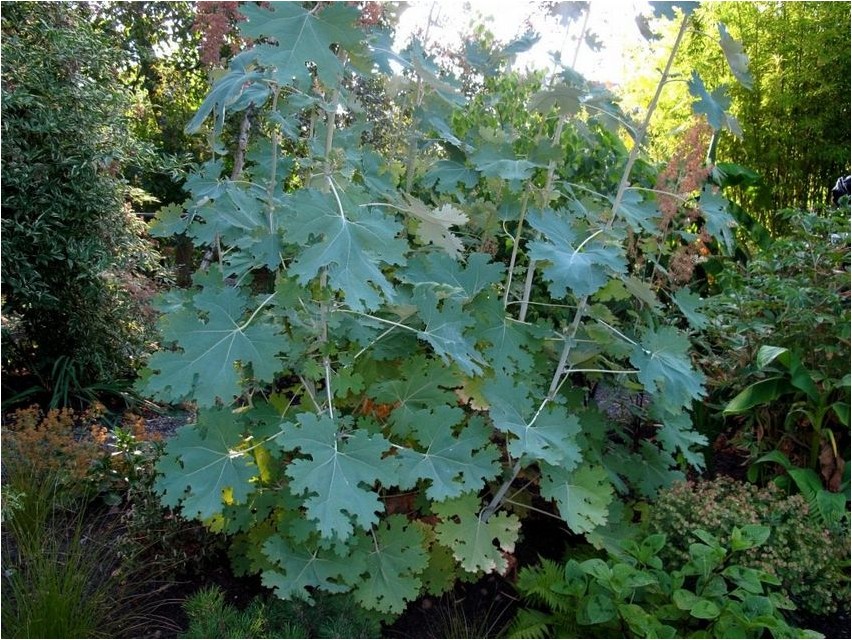
Macleya (Latin: Macleya) is a sun-loving perennial plant belonging to the Poppy family.
Description
Macleya is a fairly large rhizomatous, ornamental-leaved perennial capable of forming thickets up to two meters tall. Macleya”s shoots are densely covered along their entire length with a characteristic waxy coating, and the large, heart-shaped, alternate petiolate leaves of this plant can reach twenty centimeters in diameter. The upper surfaces of these leaflets are usually smooth and green with a slight bluish tint, while the undersides are always densely pubescent and usually white. Incidentally, this plant is characterized by its ability to grow very quickly.
Macleya”s small flowers are collected in lacy paniculate inflorescences. They can be either white or pink. The flowering period usually lasts about thirty-five days and invariably occurs in July-August. Macleaya, growing in the wild, almost always bears fruit—its fruits are generously filled with seedpods.
There are five species in the Macleaya genus.
Where it grows
Macleaya grows primarily in the Japanese, Chinese, and American tropics. It is also grown in central Russia, where the species commonly used are Macleaya cordata and Macleaya microcarpa.
Uses

Macleaya is a wonderful plant for decorating gardens and parks. This plant not only successfully serves as an ornamental plant, but also as a “camouflage” plant—its large leaves, combined with tall stems and distinctive flowers, beautifully conceal virtually any unsightly area. They can also form stunningly beautiful hedges! Macleaya doesn”t need any other plants in its vicinity—it grows so quickly that it gradually displaces all living things around it. Macleaya is also perfect for decorating ponds—its leaves look especially striking in windy weather, revealing their luxurious “silver” underside. And the lacy clouds of flowers will always attract attention!
Macleaya is also quite actively used in folk medicine—its infusions are considered excellent for treating stomatitis and various skin ailments. Perhaps this is why macleaya is often found in anti-acne lotions.
Cultivation and Care
Macleya should ideally be planted in areas with soils enriched with all kinds of organic matter, which are characterized by moderate moisture. Soils should ideally be sufficiently nutritious and loose, as well as well-drained.
In the autumn, it is recommended to mulch this plant with humus, but if there is no humus at hand, it’s okay — macleia is quite capable of overwintering safely even without any shelter. It usually grows in the first half of May, and if young sprouts are damaged by frost, new ones will simply grow in their place.
Macleay does not like transplants and does not tolerate transplants, but it is very responsive to various organic fertilizers and fertilizing. And it is completely unaffected by any pests or diseases!
Macleya reproduces with the onset of May by root suckers. Also, if desired, at the beginning of summer or at the end of spring, you can propagate it by dividing the bushes. As for the frequency of planting, you should try to maintain a distance of thirty to forty centimeters between plants.
MACLEAYA, or BOCCONIA MACLEAYA (BOCCONIA) family. Poppy
Macleya Macleya





