Dandelion horned
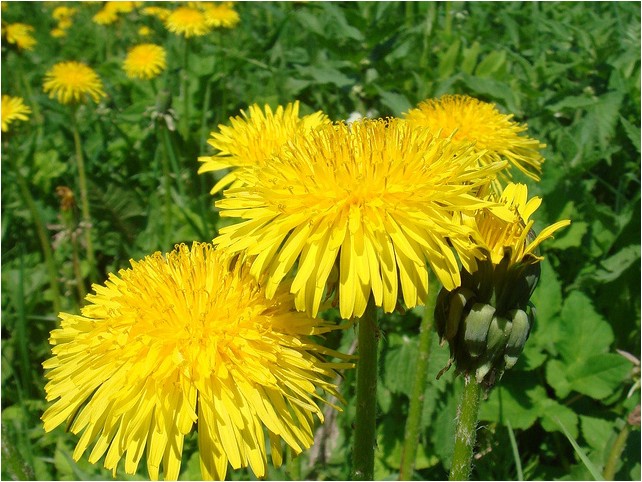
Horned dandelion is one of the plants of the family called Asteraceae or Asteraceae; in Latin the name of this plant will be as follows: Taraxacum ceratophorum (Ledeb.) DC.
As for the name of the horned dandelion family itself, in Latin it will be like this: Asteraceae Dumort. (Compositae Giseke).
Description of horned dandelion
Horned dandelion is a perennial herbaceous plant whose height will vary between seven and twenty centimeters. Such a plant will be endowed with a relatively thick root, and its root collar will be covered with brownish remains of dead leaves. The leaves of the horned dandelion are glabrous, their length will be about five to fifteen centimeters, and the width will be equal to one to two and a half centimeters, most often such leaves will be whole, and also more or less notched-toothed. Flower arrows can be either single or several pieces. During flowering, such arrows will be almost equal in length to the leaves, but under the baskets they will be more or less covered with loose cobwebby felt. The flowers of the horned dandelion are yellow in color, and the achenes will be light brown.
This plant blooms from June to August. Under natural conditions, this plant is found in the Far East, the Arctic and Eastern Siberia. For growth, this plant prefers places near roads, pebbles, meadows and grassy slopes.
Description of the medicinal properties of horned dandelion
Horned dandelion is endowed with very valuable healing properties, and it is recommended to use the leaves, inflorescences, roots and aerial parts of this plant for medicinal purposes. The presence of such valuable healing properties should be explained by the content of rubber and resin in the roots and leaves of this plant, while the leaves contain vitamin C.
As for traditional medicine, horned dandelion is very widespread here. An infusion prepared from the roots of this plant is recommended to drink for various liver diseases. In addition, this decoction is used externally for rheumatism. An infusion and decoction prepared from the aerial part of the horned dandelion and its inflorescences is used in Transbaikalia for malaria and gastroenteritis. For sinusitis, it is recommended to inhale the powder based on the leaves of this plant. The leaves of horned dandelion themselves are used as a very effective lactogenic agent.

For hepatitis and cholecystitis, it is recommended to use the following very effective remedy based on this plant: to prepare such a remedy you will need to take eight grams of crushed horned dandelion roots per two hundred milliliters of water. The resulting mixture should be infused for about three to four hours, and then it is recommended to strain this mixture very carefully. Take the resulting healing remedy based on horned dandelion three to four times a day, one third of this glass.
In the form of compresses for rheumatism, it is recommended to use the following healing remedy: to prepare such a remedy, you will need to take twelve grams of crushed roots per two hundred milliliters of water. The resulting mixture should be boiled for about five to six minutes, and then this mixture is left to infuse for about two hours, after which this healing mixture is filtered very carefully.
For malaria and gastroenteritis, it is recommended to take two tablespoons of dry crushed herb of this plant per three hundred milliliters of boiling water. This mixture is infused for two hours and filtered thoroughly. Take this remedy three times a day, one third of a glass.





