Patrinia scabiofolia
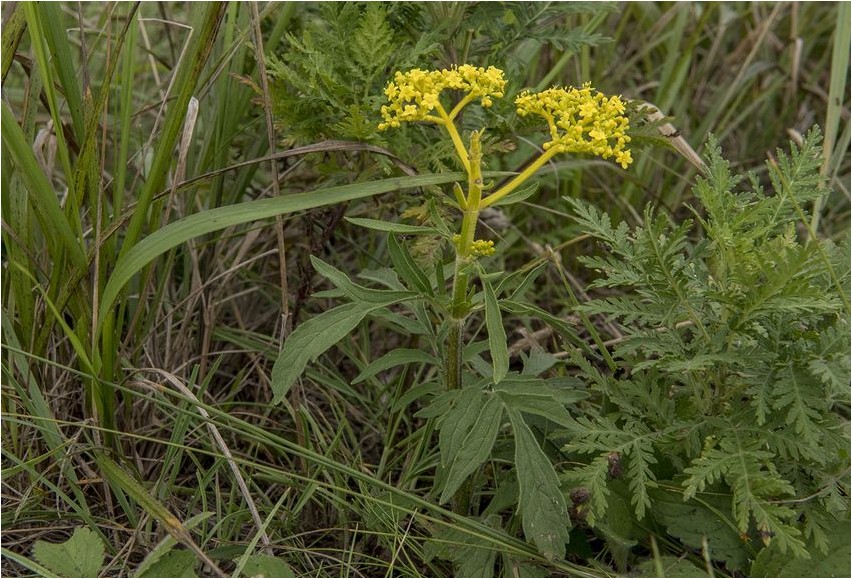
Patrinia scabiosifolia is one of the plants of the family called Valerian; in Latin the name of this plant will be as follows: Patrinia scabiosifolia Fisch. ex Link.
As for the name of the patrinia scabiosa family itself, in Latin it will be: Valerianaceae Batsch.
Description of Patrinia scabiosa
Patrinia scabiosa is a perennial herbaceous plant whose height will vary between sixty and one hundred and sixty centimeters. The stem of this plant will be erect at the very base, it is quite thick, and its size in diameter will be about four to seven millimeters. The leaves of this plant are entire, sessile and lyre-pinnately dissected. The inflorescence of Patrinia scabiosa will be loose and corymbose. The corolla of this plant is funnel-shaped and painted in pale yellow tones, it will have five lobes, and there are only four stamens.
For growth, this plant prefers flood, subalpine and steppe meadows, as well as oak, pine, and birch forests on both clay and sandy soil. Under natural conditions, Patrinia scabiosa can be found in the Far East and Eastern Siberia.
Description of the medicinal properties of Patrinia scabiosa
Patrinia scabiosa is endowed with very valuable healing properties, and it is recommended to use the herb of this plant for medicinal purposes. The term grass includes leaves, stems and flowers.
The presence of such valuable healing properties should be explained by the content of flavonoids, terpenoids, saponins, fatty oils, coumarins, phenolcarboxylic acids, chlorogenic acid, iridoid patrinoside and tannins in this plant. Patrinia scabiosa will be endowed with very effective anti-inflammatory, sedative, analgesic and hemostatic effects.

It is noteworthy that the experiment proved that preparations based on this plant are endowed with effective anti-Trichomonas activity, and will also have a sedative effect. The extract of the rhizomes of Patrinia scabiosa in the experiment showed an improvement in heart function and inhibition of reflex activity.
As for traditional medicine, here this plant is also quite widespread. Traditional medicine uses patrinia scabiosa as an anti-inflammatory and sedative, and is also used for scrofula in children. A decoction prepared from this plant is recommended to be drunk for hemoptysis, fever, jaundice and bleeding, and is also used as an emetic and used as a lotion for freckles.
Patrinia scabiosa is also used in Tibetan medicine: here this plant is used for cystitis, malaria, thrombosis, superficial tumors, constipation, carbuncles, and also as a painkiller for hepatic and renal colic.
Korean medicine recommends using both an infusion and a decoction prepared from herbs, roots and rhizomes for abscesses, enteritis, endometritis, enterocolitis and conjunctivitis.
For jaundice, the following remedy is used: two tablespoons of dry crushed grass in two glasses of boiling water, infused for two hours, and then filtered thoroughly. Take this medicinal remedy based on Patrinia scabiosis folia three times a day, one-third of a glass. It is worth noting that this remedy is very effective if properly prepared and used correctly.


