Pseudotsuga
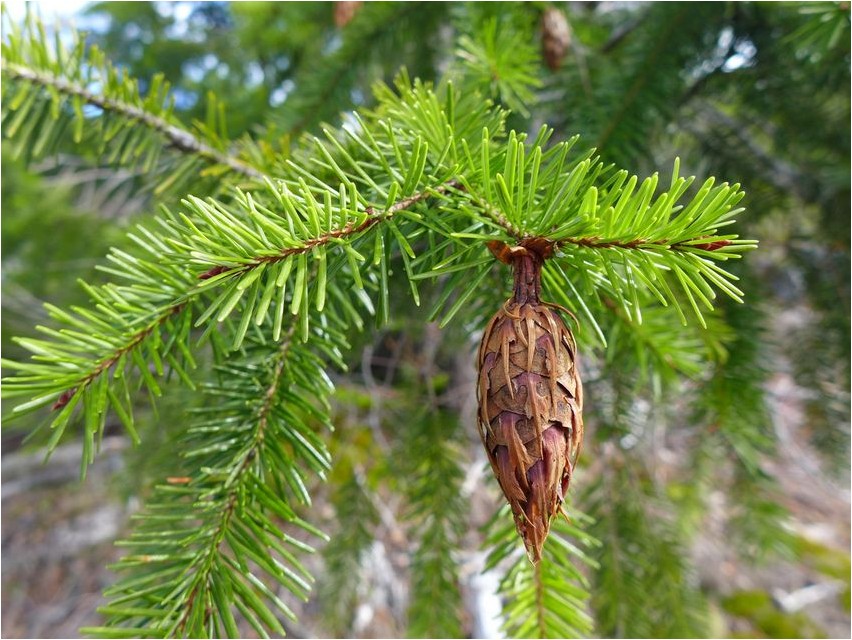
Pseudotsuga (lat. Pseudotsuga) is a light-loving woody coniferous plant from the Pine family. Other names are Douglas fir, falsesuga or Douglas fir.
Description
Pseudotsuga is a fairly tall and large evergreen coniferous tree, the height of which often ranges from twenty-five to fifty meters. Initially, the crowns of these trees have a cone-shaped shape, and when they reach maturity, they become flat-topped. And pseudo-tsuga grows very, very quickly! And her life expectancy can reach as much as seven hundred years and even more!
The thick, slightly cracked bark of pseudo-hemlock is colored in dark brownish-gray shades, while in very young trees the bark is usually grayish-greenish. And the branches of this plant extend from the trunks almost at right angles. In general, these trees simultaneously resemble both spruce and fir. At the same time, the main specific characteristics of pseudo-tsuga usually include long, sharp buds, as well as needles sticking out in all directions, which are attached to the branches without the help of leaf pads and without special “suckers”. By the way, needles can survive on shiny yellowish-brown shoots for up to eight years! Moreover, its length can vary from one and a half to two and a half centimeters (a little less often — up to three and a half centimeters), and its width can reach one and a half millimeters.
The length of the elongated, ovoid, pendulous cones of pseudotsuga usually ranges from seven to twelve centimeters, and the width — from three to four and a half centimeters. These trees begin to bear fruit only at the age of seven to twelve years.
In total, the pseudotsuga genus includes from four to six species, that is, it is very few in number.
Where does it grow
Pseudo-tsuga is quite widespread in Japan, China and North America. It can be seen especially often in mountainous areas. And in Russia this plant was introduced only more than a hundred years ago.

Usage
Pseudotsuga has long ago gained fame as a rather promising decorative breed, so it is very actively used throughout almost the entire central zone of Russia, even reaching the Urals! You can plant these spectacular trees individually, or you can no less successfully combine them with some other trees or shrubs, both coniferous and deciduous. And dwarf varieties of pseudo-hemlock will look very cool in heather gardens or rocky gardens!
Growing and care
Pseudo hemlock is a more light-loving plant than its relatives, fir or spruce, and this fact must be taken into account when planting it. As for soils, pseudo-hemlock will grow best on fairly thick and well-drained loams, characterized by a neutral reaction of the environment. But pseudotuga categorically cannot tolerate over-compacted soils. In addition, this plant does not tolerate winds and prolonged drought very well. But the pseudo-tsuga is very loyal to cuttings!
In order to enhance the growth of pseudo-hemlock, as well as to give it the opportunity to overwinter much better (in the conditions of the middle zone, these conifers often suffer even from spring frosts), with the onset of spring it is recommended to feed it with high-quality mineral fertilizers. When the dry season is established, the plant should not only be watered two, three or even four times, but also pampered with regular sprinkling. And the soil under the trees must be loosened.
Pseudo-tsuga is propagated by seeds, cuttings, and also by grafting at a young age.