Big bedrenets
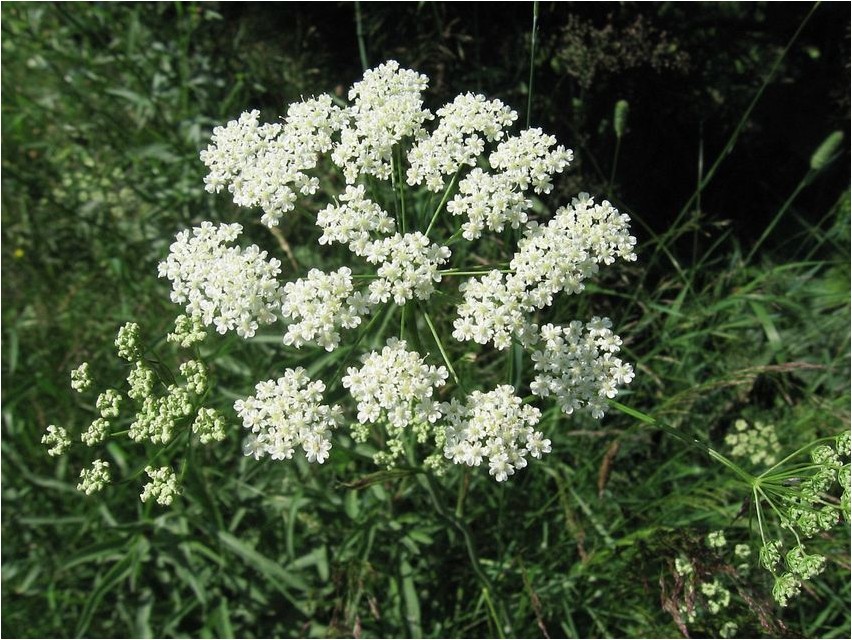
Great berednets is one of the plants of the family called Umbellaceae. In Latin, the name of this plant is as follows: Pimpinella major.
Description of the thigh
Great berednets is a perennial herbaceous plant. The root of this plant is spindle-shaped, branched, and its root collar is covered with the fibrous remains of those leaves that have already died off. The stem of the large femur at the base is endowed with a rosette of basal leaves; the height of this stem can be about fifteen to sixty centimeters. The stem will be round and finely ribbed.
The leaves of the large femur are pinnate, while the lower leaves together with the petioles will be about ten to twenty centimeters in length, they will be endowed with ovoid-shaped blunt and coarsely toothed leaves in the number of three to five pairs. The middle leaves will be endowed with more deeply dissected leaflets, and the upper leaves will be endowed with a simple pinnate or tripartite rather small plate. Umbrellas have six to twenty-one thin naked rays, the length in diameter will be about five to eight centimeters, and the wrapper will be completely absent. The petals of the plant are painted white, sometimes they are pinkish, and do not exceed one millimeter in length. The fruits of the plant are glabrous and short-ovate, about two and a half millimeters long and about two millimeters wide.
The flowering of the large femur occurs in the period from July to August. Under natural conditions, this plant is found in Ukraine, Belarus, Moldova, as well as in the European part of Russia, namely in the following regions: Karelo-Murmansk, Ladoga-Ilmen and Baltic. The plant grows in forests and bushes.
Description of the medicinal properties of the femur

For medicinal purposes, it is recommended to use the juice of the plant, its roots and leaves. The roots of the great femur contain a fairly significant content of essential oil, phenols and their derivatives, coumarins, terpenoids, as well as polyacetylene compounds. The fruits of the large femur contain phenols and their derivatives, as well as terpenoids.
As for traditional medicine, a decoction prepared from the roots of the plant is used for urolithiasis as an expectorant and an appetite stimulant. An aqueous extract of the roots should be used for conjunctivitis, and also as a rinse for gingivitis and stomatitis. An infusion of the leaves of the great femur is recommended for use as a lactogenic agent. The juice of this plant can be used to remove age spots from the face. It is noteworthy that the basal leaves of the large femur can be used to prepare various salads.
To gargle for coughs, inflammation of the upper respiratory tract, as well as for kidney stones, it is recommended to use a special decoction of half a glass four times a day before meals, warm. The decoction is prepared as follows: pour one glass of boiling water into one tablespoon of crushed rhizomes with the roots of the great femur, and then infuse for four to six hours. After this, the resulting broth must be filtered.
For gastrointestinal diseases and kidney stones, it is recommended to take another decoction of two tablespoons three to four times a day. To prepare this decoction, you will need to take two tablespoons of crushed rhizomes with roots and one glass of boiled water, which should be at room temperature. This mixture is infused for eight hours and then filtered.





