Senecio congestus
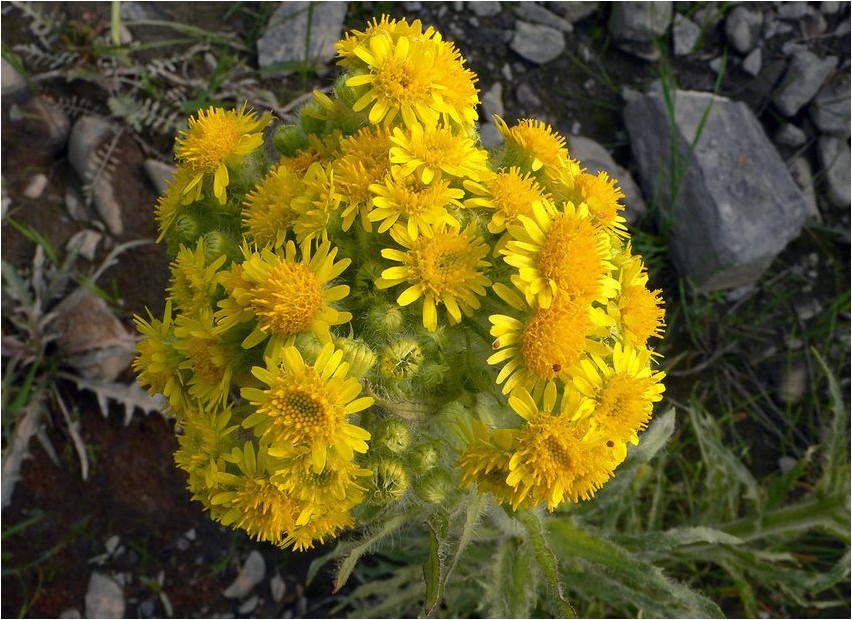
Senecio congestus is a member of the Asteraceae or Compositae family. Its Latin name is Senecio congestus (R. Br.) DC.
The Latin name for the Senecio congestus family is Asteraceae Dumort or Compositae Giseke.
Description of Senecio congestus
Senecio congestus is an annual or biennial herbaceous plant, growing between twenty and one hundred centimeters in height. Its roots are fibrous, and the entire plant is glandular, downy, and hairy. The stem of Senecio congestus is hollow, and it may be either simple or branched at the top, with dense foliage. The leaves of this plant are lanceolate or oblong in shape, approximately five to fifteen centimeters long and one to five centimeters wide. These leaves are sessile and almost entire, while the upper leaves are smaller. The flower heads of the Senecio serrata are borne in a corymbose inflorescence, which can be either dense or loose. The ligulate florets of this plant are light yellow, one to two and a half millimeters wide, and have either two or three blunt teeth or may be entire. The achenes of the Senecio serrata are finely ribbed and glabrous, and are one and a half to two millimeters long.
The flowering period of the Senecio serrata begins in July and ends in August. In the wild, this plant is found in Central Asia, Belarus, the Arctic, European Russia, the Far East, the Dnieper region of Ukraine, and Western and Eastern Siberia. It prefers locations near swamps, rivers, and on sandy-clay lake shores.
Description of the medicinal properties of Senecio serpiginosa
Senecio serpiginosa possesses valuable medicinal properties, and its leaves are recommended for medicinal use. These valuable medicinal properties are attributed to the alkaloid, essential oil, sesquiterpenoid petasin, and triterpenoid lupeol found in this plant.
The crowded ragwort is endowed with very valuable sedative, wound-healing, antispasmodic and hypotensive effects. As for the external use of such a plant, the leaves of the crowded ragwort in the form of a maze should be used for panaritiums. It should be noted that this plant is a very valuable honey plant. In addition, crowded ragwort is a fodder or fattening plant intended for deer.

The plant is endowed with a very valuable calming, analgesic, anthelmintic, anticonvulsant, emollient, wound-healing and accelerating the maturation of abscesses effect. It should be remembered that crowded ragwort is also a poisonous plant; for this reason, strict care should be taken when handling this plant.
Agony ragus induces and regulates menstruation. An infusion prepared from the herb of this plant is recommended for use in small quantities for gastrointestinal colic and hysterical colic. In addition, this remedy regulates menstruation. Externally, this plant is used as follows: the herbs of the ragwort are ground with butter or sunflower oil and used for abscesses, hemorrhoidal cones and hardening of the mammary glands.





