Echinopsis
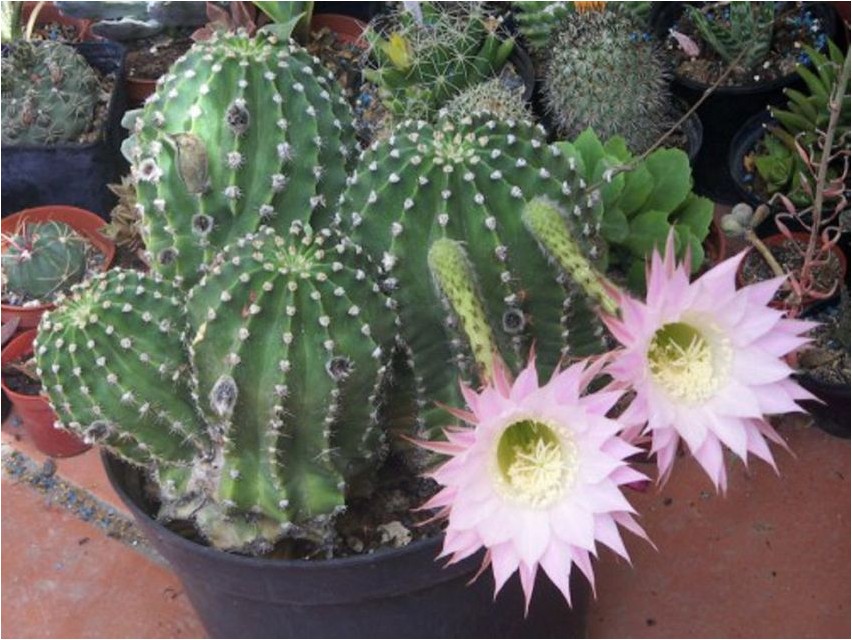
Echinopsis (lat. Echinopsis) is a genus of plants of the Cactus family. Under natural conditions, Echinopsis grows in Brazil, Uruguay, Paraguay, Bolivia and Argentina.
The name was proposed by Carl Linnaeus back in 1737.
Characteristics of culture
Echinopsis is one of the most common types of cacti. Young echinopsis have a spherical shape, with age they slightly elongate and become cylindrical or columnar. The stem is dark green, symmetrical, smooth with shine, and has sharp and even ribs. The areoles are large, with short hair, located at the same distance from each other. The spines are hard, short or medium length.
The root system is powerful and horizontal. The flowers are large, funnel-shaped, reaching 10-15 cm in diameter, with seven rows of petals; most varieties and hybrids have a pleasant aroma. Flower tube pubescent. Flowering is short, a maximum of three days, which completely depends on the temperature of the content. The fruits are ovoid. The seeds are smooth, shiny, black, reaching 0. 1-0. 2 cm in diameter.
Conditions of detention

Echinopsis is a light-loving plant, grows well on window sills and rooms with bright lighting; it has a negative attitude towards direct sunlight, although a small amount is tolerated calmly. The optimal temperature is 22-27C in summer, 10-12C in winter. Air humidity does not play a significant role for Echinopsis; they easily grow and develop in rooms with dry air.
Care
Echinopsis needs rare watering in spring and summer; watering is carried out as the top layer of soil in the pots dries. In winter, when the air temperature is 10-15C, the plants are not watered, or watered extremely rarely. Fertilizing is carried out once a month exclusively during the period of active growth and flowering. For feeding, special fertilizers for cacti are used. Fertilizers should not be applied in winter.
Echinopsis are resistant to diseases and pests. Rarely affected by scale insects, mealybugs and spider mites. If optimal maintenance conditions are not observed, plants are susceptible to the following diseases: rust, root rot, late blight, dry cactus rot and various types of spotting.
Reproduction and transplantation
Echinopsis are propagated by seeds and offshoots formed on older plants. Seeds are sown in the spring in containers filled with a moist substrate consisting of leaf mold, finely crushed charcoal, and well-washed river sand in a ratio of 1:1. 2:1. Before sowing, the seeds are soaked in warm water for several hours. Until germination, the seedlings are kept at a temperature of 17-20°C (63-68°F), ventilated, and regularly sprayed with warm, settled water.
When propagating echinopsis by offshoots, the planting material is separated from the mother plant, dried for several days, and planted in moist, fine-grained sand until rooting occurs.
Echinopsis are repotted in the spring once every 2-3 years. For repotting, it is recommended to use shallow pots filled with a prepared cactus substrate with a pH of 6. The bottom of the pot must have good drainage. Do not water the plants for 6-8 days after repotting to prevent root rot.
Common Species
*Echinopsis oxigona (Latin: Echinopsis oxigona) is a species characterized by plants with spherical stems reaching 5-25 cm in diameter. The ribs are rounded, often tubercled. A single plant can have 8 to 14 ribs. The areoles are slightly recessed and white. The spines are thick, needle-shaped, and white. The flowers can be pink or pinkish-red, up to 22 cm long. The fruits are ovoid, green, up to 2 cm in diameter. *Echinopsis eyriesii (Latin: Echinopsis eyriesii) is a species characterized by dark green stems with 11-18 rounded ribs. The spines are awl-shaped, barely visible due to the fluffy whitish nubs located on the areoles. The flowers are white or soft pink, often with a dark pink stripe along the center of the petal.
*Echinopsis tubiflora (Latin: Echinopsis tubiflora) is a species characterized by green, cylindrical stems with 11-12 prominent ribs. The areoles are white, gray, or black. The spines are yellow with a dark tip. The flowers are funnel-shaped, white, and reach 10 cm in diameter.
*Echinopsis ancistrophora (lat. Echinopsis ancistrophora) is a species with spherical, flattened, green stems. The ribs have prominent tubercles. The areoles are light-colored, bearing 3-10 flexible, spreading, white spines, 1. 5 cm long. The flowers are white, pink, or red, reach 10-15 cm in diameter, and are unscented. The fruits are green or greenish-purple, 1 cm in diameter.
How to make a cactus bloom? Echinopsis. Madrid. Spain.