Six-petalled clematis
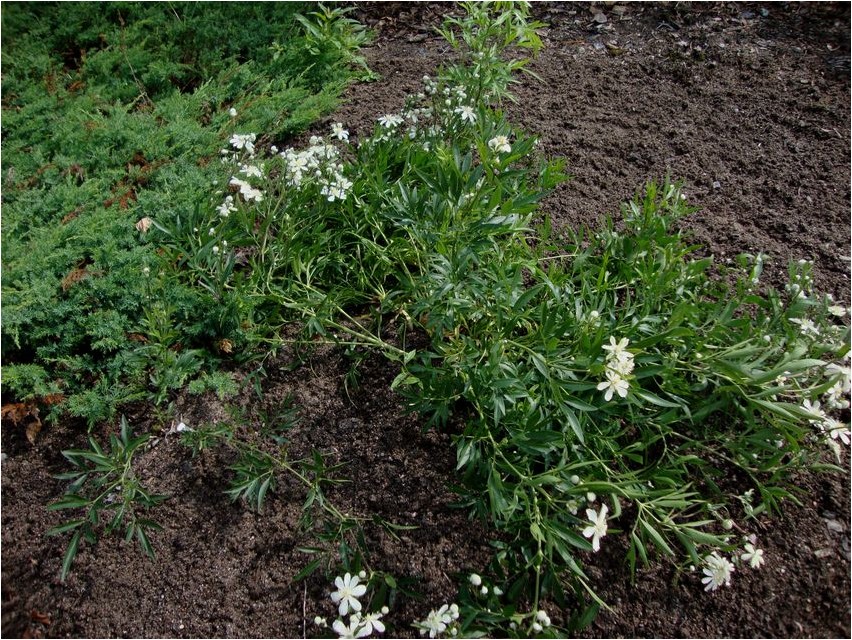
Six-petalled clematis is one of the plants of the family called Ranunculaceae; in Latin the name of this plant will be as follows: Clematis hexapetala Pall.
As for the name of the six-petalled clematis family itself, in Latin it will be: Ranunculaceae Juss.
Description of six-petalled clematis
Six-petalled clematis is a perennial herbaceous plant whose height will vary between thirty and seventy centimeters. The stem of this plant is faceted and straight. The leaves of six-petalled clematis are short-petalled, trifoliate or pinnately dissected into pointed, linear-lanceolate, linear, more or less leathery lobules, which in turn are endowed with sharply protruding veins. Such leaves of this plant will be bare and covered with sparse hairs. The flowers of six-petalled clematis are solitary; in addition, they can be collected at the very top of the stem into a complex corymbose inflorescence. The sepals of this plant will be painted white or yellowish, on the outside they are woolly-tomentose, and the threads of the stamens themselves will be bare.
Six-petalled clematis blooms from June to July. Under natural conditions, this plant is found in the Far East, as well as in the Angara-Sayan and Daurian regions of Eastern Siberia. For growth, six-petalled clematis prefers bushes, alluvial deposits along rivers, dry meadows, abandoned fields, steppe and rocky slopes.
Description of the medicinal properties of six-petalled clematis
Six-petalled clematis is endowed with very valuable healing properties, and it is recommended to use the grass and rhizomes of this plant for medicinal purposes. The term herb includes the flowers, stems and leaves of the six-petalled clematis.
The presence of such valuable healing properties should be explained by the content of essential oil, phytosterols, and organic acids in this plant. Saponins, carotene, protoanemonin, cardenolides, tannins, resins, coumarins, kaempferol and quercetin. The fruits of the six-petalled clematis will contain fatty oil.

Infusion and decoction prepared from the herb of this plant are endowed with very effective hypotensive, choleretic, sedative and anti-stress effects. In addition, such healing agents will further reduce basal metabolism and increase appetite.
As for traditional medicine, an infusion prepared from the herb of this plant has become quite widespread. This infusion is recommended for use for internal bleeding, malignant neoplasms, gout, cystitis, rheumatism, chronic gonorrhea, syphilis, various skin diseases and gonorrheal arthritis. In addition, such a healing remedy based on six-petalled clematis turns out to be effective as a diuretic, analgesic and diaphoretic for exostoses.
A decoction prepared from the roots of this plant is recommended to drink for sore throat, numbness of the extremities, various colds and viral hepatitis. As for the external use of such a healing agent, it is used in the form of lotions for ulcerations of the cornea of the eye and for toothache. Tincture of the six-petalled clematis herb is recommended for use in scurvy, ascites, edema, various cardiovascular diseases, snake bites and wound treatment, and is also used as a very effective anthelmintic.





