Wasabi
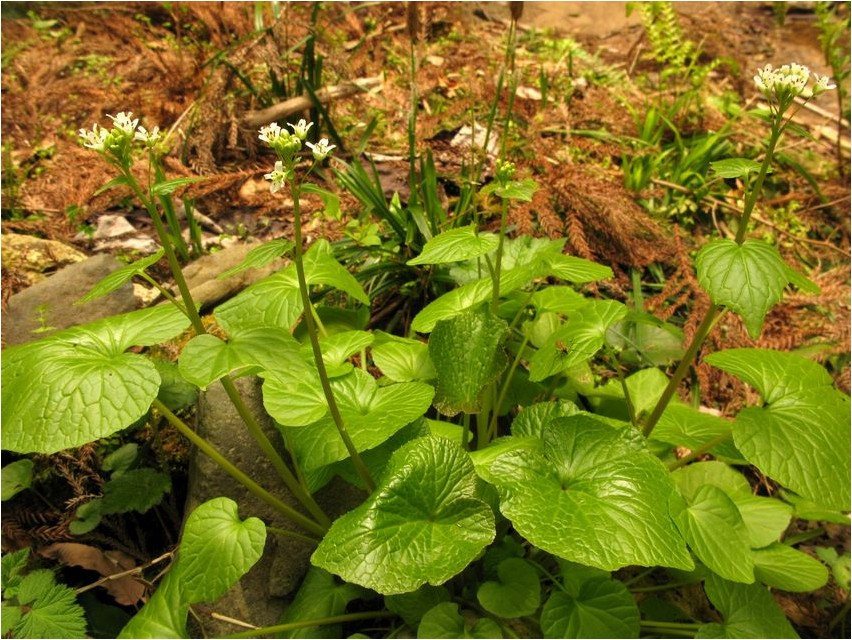
Wasabi (lat. Eutrema japonicum) is a herbaceous perennial belonging to the Brassica family. Its second name is Eutrema japonica, or “Japanese horseradish.”
Description
Wasabi is a herbaceous rhizomatous perennial crop, endowed with leafy simple stems that can be either slightly raised or creeping. The height of the stems can reach forty-five centimeters.
The heart-shaped or round leaves of wasabi are equipped with crenate edges and fairly long petioles. The apical leaves are characterized by division into lobes, and the leaves located in the lower parts of the stems are larger in size.
Miniature white wasabi flowers are endowed with rather pretty bracts and form luxurious apical racemes. And the ovoid petals are equipped with slightly elongated nails. As a rule, wasabi blooms in April or May.
As for the fruits, they are pods filled with eight seeds.
Where does it grow
Wasabi grows mainly along mountain river banks. Currently, it is widely cultivated not only in Japan, but also in New Zealand, Korea, China, as well as in the USA and Taiwan.

Application
In cooking, wasabi is used as a seasoning — its strong antimicrobial properties make it possible to combine this product even with raw fish. Wasabi goes especially well with rolls or sushi. By the way, grated roots were first used back in 1396 in an area called Shizuoka. Nowadays, a rare Japanese dish is complete without this valuable seasoning. Wasabi is often used in combination with soy sauce.
It is noteworthy that in Japanese cuisine, not only wasabi roots are widely used, but also its flowers and stems — a dish called tempura is prepared from them.
Crushed dried wasabi roots are characterized by a fairly strong odor. And the spiciness of this seasoning stimulates mainly not the tongue, but the nasal passages (unlike hot peppers). Wasabi tastes more like mustard. By the way, real wasabi root (or hon-wasabi) can be found exclusively in Japan these days. And since this is a rather expensive product, its imitation, prepared on the basis of horseradish, food coloring and various spices, is most often found on sale.
The isothiocyanates contained in wasabi prevent the gradual decay of teeth by inhibiting the growth of cavity-causing bacteria. These substances also help fight cancer. Furthermore, wasabi is renowned for its anti-asthmatic properties and its ability to prevent the formation of life-threatening blood clots. As for the calorie content of wasabi, it”s a delight for anyone, with only 10 kcal.
Cultivation
People have been cultivating wasabi since the 10th century. Two main cultivation methods are used: either growing it in a garden or cultivating it in a semi-submerged state in cold mountain water. The latter option is undoubtedly the preferred one, as these roots have a more intense and pleasant flavor. The ideal temperature for growing wasabi is considered to be between 10 and 17 degrees Celsius. BORONINA — Wasabi (Video Premiere, 2019)