Orchid
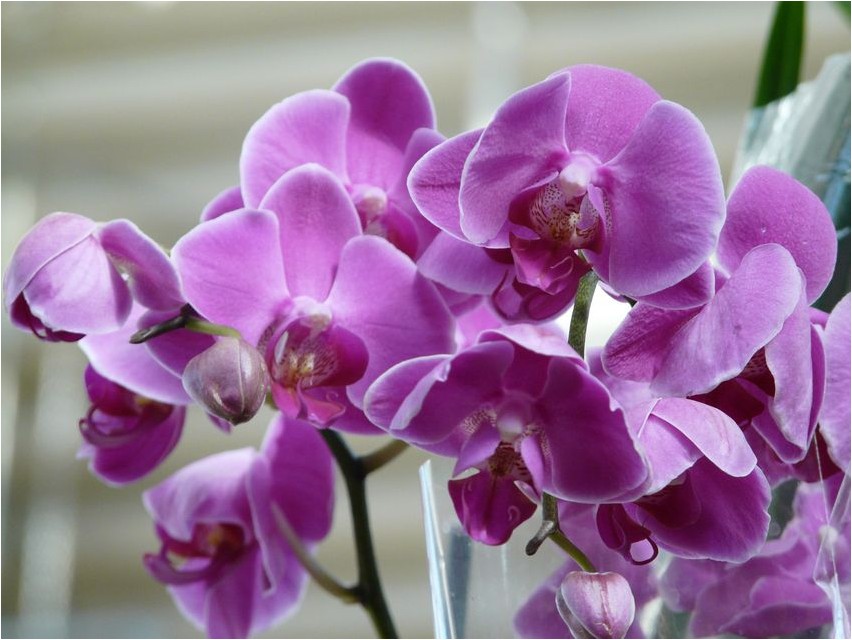
Orchid (Latin: Orchid) is a houseplant; a genus of epiphytic herbaceous plants in the Orchidaceae family. In the wild, it grows in the moist lowland and mountain forests of Southeast Asia, northeastern Australia, and the Philippines.
Cultivated Characteristics
Orchid is a monopodial plant with a very short stem. The leaves are broad, leathery, evergreen, simple, elliptical, 5-30 cm long, and arranged alternately. Some orchid species have leaves with an unusual marbled pattern. The roots are aerial, sometimes flattened, and covered with a thick layer of velamen.
The peduncles are long, rarely branching, axillary, and terminate in numerous, fairly large flowers. The flowers are collected in spike-shaped or racemose inflorescences; some species have solitary flowers. The flowers are tripartite, with a double perianth, and resemble a butterfly in appearance. The sepals are equal in size, and the three upper petals form a lip. The ovary is unilocular, rarely trilocular, consisting of three carpels and containing small ovules.
Orchids can reach two meters in height. They lead a very interesting lifestyle. For example, tropical species grow on trees, using them for support and climbing trunks in the struggle for sunlight. Some species inhabit mountains and cliffs, penetrating the rocks with their roots, feeding on moisture and rotting plant debris.
In Australia, there are subterranean orchid species that never emerge above ground and are pollinated by subterranean insects. A number of orchids grow in the tropics that feed on small spiders and midges that fall into their flowers. Growing Conditions

Orchids prefer shaded areas, particularly west, east, and northeast-facing windows. Direct sunlight can cause damage, including burns. The optimal temperature for orchids is 18-25°C (64-77°F), with short-term increases to 30-35°C (86-90°F). At elevated temperatures for longer periods, plants drop flowers and their leaves lose turgor. The minimum temperature is 12°C (54°F).
Humidity levels of 30-40°C (86-104°F) are recommended. Excessive humidity can cause spots to appear on orchid leaves and root rot. Humidity levels of 20-25% cause leaf turgor loss and flower drop. Fine- and medium-grain bark is used as a substrate for orchids. In rooms with low humidity, sphagnum moss can be added to the substrate.
Medium fraction bark is placed at the bottom of the planting containers, and the rest is filled with fine fraction bark. As you know, dry bark allows water to pass through quite quickly, so before putting it in pots, it is washed and soaked for a couple of days to soak it.
It is advisable to use transparent pots for growing orchids, although opaque plastic and ceramic ones are not prohibited. Some amateur gardeners grow orchids in blocks, but this approach requires increased attention and care. You can place containers with orchids on trays filled with pebbles.
Care
Watering orchids is done after the substrate has completely dried; in no case should the plants be allowed to remain dry for a long time. It is in transparent pots that you can easily determine the condition of the roots. Orchid roots, saturated with moisture, are bright green. There is no need to rely on the substrate drying out from above. Plants must be watered directly onto the substrate or by immersing the pot in a container of water. It is recommended to wipe the leaves dry after watering, especially at low temperatures, otherwise dark brown spots may appear on them.
Orchids are fertilized through watering during the period of active growth and flowering. Kemira Lux fertilizer is perfect for this purpose. An excess of fertilizer should not be allowed, as this can lead to cracking of the leaves.
During flowering, plants should be moved to a cooler place and watering reduced. Under optimal conditions, flowering can last up to six months. At the end of flowering, orchid flower stalks should not be trimmed. Aerial roots that are not immersed in the substrate do not need to be touched. If they die, they are removed to the healthy green part. Leaves must be wiped promptly and kept completely clean.
Transplant
Healthy flowering plants should not be transplanted. Orchids are replanted if the substrate has become unusable and needs to be replaced. As a rule, this happens after 2-3 years, the substrate becomes brittle, brittle and has a rather unpleasant odor. It is advisable to transplant immediately after flowering.
NEW ORCHID KILLER POTS new utilities for orchids REVIEW