Maclura orange
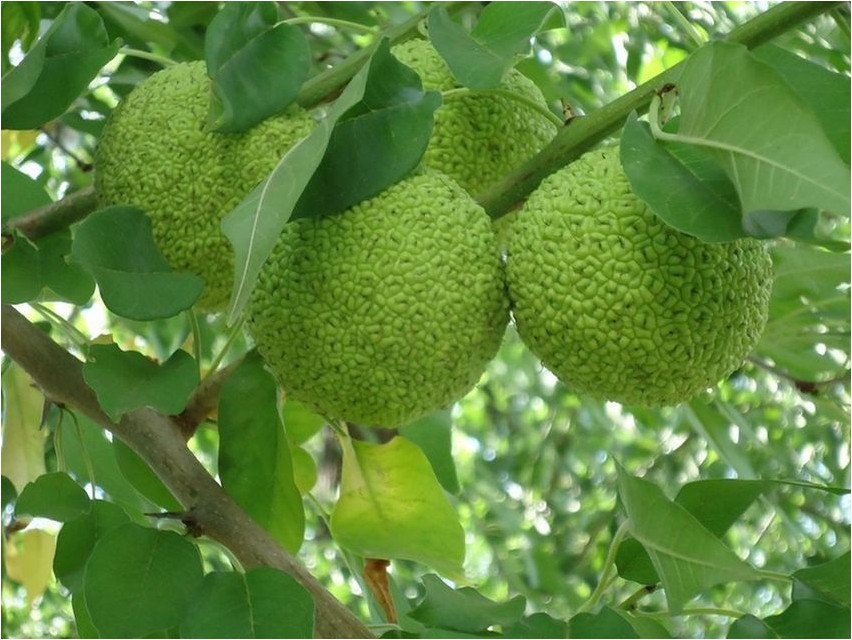
Orange Maclura (lat. Maclura pomifera) is a species of highly ornamental and fruit trees of the Mulberry family. Other names are apple maclura or inedible orange.
The plant”s homeland is considered to be the southeastern part of the United States. Nowadays, orange maclura is cultivated in the Caucasus, Crimea and Central Asia, including Uzbekistan, Tajikistan, Uzbekistan and Kazakhstan. In Russia, maklura is grown in the Stavropol and Krasnodar territories.
Characteristics of culture
Representatives of the species are deciduous trees up to 20 m high with numerous strongly twisted shoots. The crown is dense and spreading. The trunk is slender, covered with fissured dark brown bark. The branches are strongly curved, equipped with thorns; thornless forms also exist. Spines up to 2. 5 cm long, located in the axils of the leaves. The leaves are dark green, entire, ovate, up to 12 cm long. With the onset of autumn, the foliage acquires a golden color.
The flowers are small, greenish, pistillate flowers are collected in spherical capitate inflorescences, staminate flowers — in catkins. The fruits are round, wrinkled, yellowish-green or orange, up to 15 cm in diameter. The shape of the fruits is similar to that of an orange. The fruits are inedible, have a long shelf life, and release milky juice when cut. Large maclura seeds are edible. Orange Maclura is characterized by fast growth, salt tolerance, wind resistance and drought resistance.
Growing conditions
Maclyura has a positive attitude towards light, but light shading will not harm her. The plants tolerate city conditions well, so they are suitable for growing in gardens and parks, as well as on roadsides. Orange mackerel has a negative attitude towards frost; mature trees can withstand short-term frosts. Otherwise, the plants are unpretentious, including soil conditions. Maclure and cold winds are not scary.

Reproduction
Maclura is propagated by seeds, cuttings, root suckers and layering. The seed method is the simplest. It is advisable to sow in the fall, since vigorous shoots can only be obtained by using fresh planting material. Before sowing, the seeds extracted from the fruit are soaked in warm water for 12 hours. Sowing is done in nutrient soil. When two true leaves appear on the seedlings, they are transplanted into separate pots with the same soil. The crop is propagated by cuttings and root suckers in early spring.
Care
Caring for maclura is completely simple and can be done even by a novice gardener. Watering is necessary systematically — as the tree trunk area dries out. The crop needs timely loosening and weed removal. Maclura requires formative pruning, which is carried out once every 2-3 years. Sanitary and thinning pruning is carried out annually.
Usage
Maclura has highly decorative properties; it is promising both in ornamental gardening and in economic terms. The culture is used in single and group plantings, hedges, and also to create a protective strip. From the fruits of orange maclura, various medications are made to stimulate cardiac activity and ointments used to treat rheumatic diseases and heal wounds. Maclura wood is used to make furniture, sports and hunting bows.
Maclura. Adam”s apple. Very effective if your joints/back/neck hurt! A panacea for many diseases.
Maclura orange
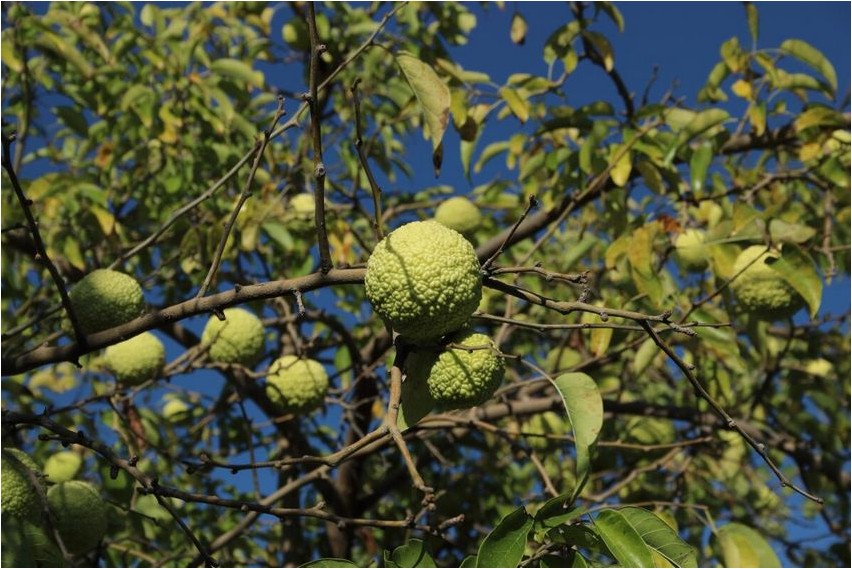
Orange Maclura (lat. Maclura pomifera) is a species of highly ornamental and fruit trees of the Mulberry family. Other names are apple maclura or inedible orange.
The plant”s homeland is considered to be the southeastern part of the United States. Nowadays, orange maclura is cultivated in the Caucasus, Crimea and Central Asia, including Uzbekistan, Tajikistan, Uzbekistan and Kazakhstan. In Russia, maklura is grown in the Stavropol and Krasnodar territories.
Characteristics of culture
Representatives of the species are deciduous trees up to 20 m high with numerous strongly twisted shoots. The crown is dense and spreading. The trunk is slender, covered with fissured dark brown bark. The branches are strongly curved, equipped with thorns; thornless forms also exist. Spines up to 2. 5 cm long, located in the axils of the leaves. The leaves are dark green, entire, ovate, up to 12 cm long. With the onset of autumn, the foliage acquires a golden color.
The flowers are small, greenish, pistillate flowers are collected in spherical capitate inflorescences, staminate flowers — in catkins. The fruits are round, wrinkled, yellowish-green or orange, up to 15 cm in diameter. The shape of the fruits is similar to that of an orange. The fruits are inedible, have a long shelf life, and release milky juice when cut. Large maclura seeds are edible. Orange Maclura is characterized by fast growth, salt tolerance, wind resistance and drought resistance.
Growing conditions
Maclyura has a positive attitude towards light, but light shading will not harm her. The plants tolerate city conditions well, so they are suitable for growing in gardens and parks, as well as on roadsides. Orange mackerel has a negative attitude towards frost; mature trees can withstand short-term frosts. Otherwise, the plants are unpretentious, including soil conditions. Maclure and cold winds are not scary.
Reproduction
Maclura is propagated by seeds, cuttings, root suckers and layering. The seed method is the simplest. It is advisable to sow in the fall, since vigorous shoots can only be obtained by using fresh planting material. Before sowing, the seeds extracted from the fruit are soaked in warm water for 12 hours. Sowing is done in nutrient soil. When two true leaves appear on the seedlings, they are transplanted into separate pots with the same soil. The crop is propagated by cuttings and root suckers in early spring.
Care
Caring for maclura is completely simple and can be done even by a novice gardener. Watering is necessary systematically — as the tree trunk area dries out. The crop needs timely loosening and weed removal. Maclura requires formative pruning, which is carried out once every 2-3 years. Sanitary and thinning pruning is carried out annually.
Usage
Maclura has highly decorative properties; it is promising both in ornamental gardening and in economic terms. The culture is used in single and group plantings, hedges, and also to create a protective strip. From the fruits of orange maclura, various medications are made to stimulate cardiac activity and ointments used to treat rheumatic diseases and heal wounds. Maclura wood is used to make furniture, sports and hunting bows.





