Jujube
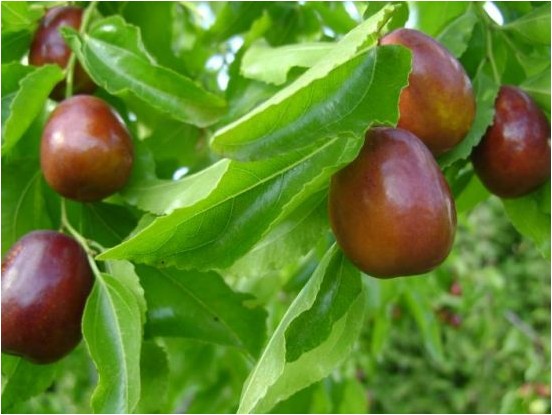
Jujube (lat. Ziziphus jujuba) is a fruit plant from the Buckthorn family.
Description
Jujube is a deciduous shrub plant or a small tree (it becomes a tree in especially favorable conditions), the height of which ranges from five to ten meters. Each tree is covered with fairly thick bark, and its branches are densely strewn with sharp thorns.
The simple, entire leaves of jujube are elliptical in shape and attached to the branches using short petioles.
Flowering and fruiting of this crop occurs from June to October. The greenish-whitish flowers of jujube are very inconspicuous and rather small.
Jujube fruits look like juicy drupes. They are smooth and very fleshy, and their shape can be either ellipsoidal, pronounced ovoid or spherical. Unripe fruits are colored pale yellowish, and as they ripen they acquire a rich reddish-brownish color. However, in cultivated forms, drupes can have completely different colors and shapes, which will be determined by the variety.
The pulp of drupes is very nutritious, incredibly sweet and incredibly tasty, but their taste can also be as varied as desired, because it largely depends on the variety. The nutritional value of these berries simply cannot be overestimated!

Where does it grow
In Russia, this culture first appeared during the time of Peter I — in those distant times it was called “French breast berry.” However, the history of domestication of this tree goes back several thousand years — even in the pre-biblical era it was incredibly popular among South Asian and East Asian peoples. Long before the advent of our era, it began to be cultivated in the Mediterranean — jujube is grown there to this day.
Now jujube is cultivated in some Central Asian countries, as well as in Japan and distant Australia. And in Russia, this culture can be seen in the Caucasus. In total, there are about four hundred varieties of jujube in the world.
It is noteworthy that jujube can still be seen in the wild — as a rule, it prefers to grow on sunny, dry slopes of mountains and hills.
Application
These fruits are most often eaten fresh, but they are often dried to ensure better preservation.
Jujube is a valuable medicinal plant, because all its parts without exception can be used for medicinal purposes. The bark removed from the roots, as well as leaves and seeds with fruits, are actively used in Chinese folk medicine — this is due to their powerful diuretic and hypotensive, as well as a pronounced tonic and excellent sedative effect. And jujube seeds are an excellent tonic for the entire gastrointestinal tract. As for the bark removed from the roots, it will serve well for diarrhea.
Not so long ago, jujube began to be used for the production of various dietary supplements, because it is very rich in all kinds of useful substances, and it contains twenty times more vitamin C than lemon.
These fruits also contain a lot of carotenoids — it is from them that the human body synthesizes vitamin A, which is vital for maintaining the health and beauty of nails, hair and skin. These fruits are also very useful for expectant or nursing mothers.
It is noteworthy that jujube leaves contain a special anesthetic substance — if you chew them, this substance blocks a person’s perception of two tastes at once: sweet and bitter. Even if you put a large piece of sugar in your mouth at this time, its taste will seem exactly the same as the taste of chalk. At the same time, the sensation of salty and sour tastes is completely preserved, that is, sweet pineapple or fragrant strawberries at such a moment may well resemble pickled cucumbers.
Contraindications
Jujube can sometimes provoke allergic reactions, so everyone who wants to eat it should be guided by individual intolerance.





