Crimean ironclad
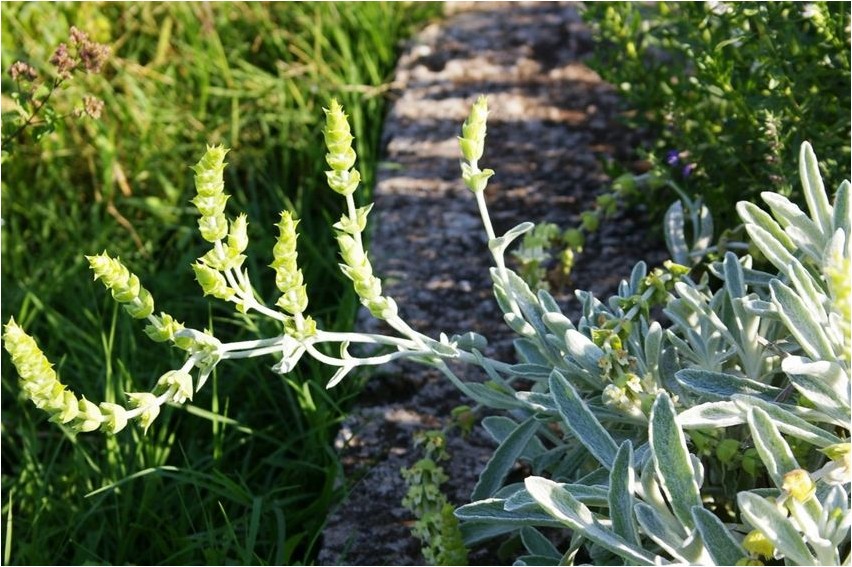
Crimean ironweed is one of the plants of the family called Lamiaceae; in Latin the name of this plant will be as follows: Sideritis taurica Steph.
As for the name of the Crimean ironweed family itself, in Latin it will be like this: Lamiaceae Lindl.
Description of the Crimean railway
Crimean ironweed is a perennial herbaceous plant that is gray, which is caused by very dense tomentose pubescence. The stem of this plant will become woody from the very base. There are only a few flowering shoots, and in addition to them there are also shortened non-flowering shoots. The leaves are about three centimeters long; such leaves can be either oblong or oblanceolate. These leaves are either sharp or blunt, and also vaguely crenate-serrate. The inflorescence of this plant will be spike-shaped and elongated, such an inflorescence is dense or discontinuous in the lower part. The bracts are either triangular or heart-shaped, they are pointed, and can be either yellowish or grayish-green. The corolla is pale yellow in color.
Crimean ironweed blooms in the summer. It should be noted that this plant is found in the Crimea. For growth, the plant prefers scree, limestone outcrops, pastures and rocky steppe slopes. Crimean ironweed is also an ornamental plant.
Description of the medicinal properties of Crimean ironweed
Crimean ironweed is endowed with very valuable medicinal plants, and it is recommended to use the inflorescences and grass of this plant for medicinal purposes. The term grass includes leaves, stems and flowers. The presence of such valuable healing properties is explained by the content of flavonoids, iridoids and essential oils in the plant. The seeds of this plant contain fatty oil, and it contains the following acids: linoleic, linolenic, palmitic, oleic and stearic.
As for traditional medicine, infusion and decoction of this plant is used as an antifever. An infusion of the Crimean ironweed herb is used for vomiting and nausea, and an infusion of flowers turns out to be quite effective in the treatment of lung diseases. It should be noted that the amount of flavonoids in this plant in the experiment is endowed with hypotensive properties.

The leaves and inflorescences of the Crimean ironweed can be used as a substitute for tea: this drink will be endowed with a very noticeable lemon aroma.
For nausea and vomiting, a very effective herbal remedy based on the Crimean ironweed can be used: to prepare this remedy, take three tablespoons of crushed dried herb per half a liter of boiling water. It is recommended to steep this remedy for one hour, after which the resulting mixture is thoroughly strained. Take half a glass of this herbal remedy two to three times a day, sipping slowly.
For bronchitis and pneumonia, a very effective herbal remedy based on this herb is recommended: to prepare this remedy, take one teaspoon of Crimean ironweed flowers per one glass of boiling water. The resulting mixture should be steeped for thirty to forty minutes, after which it is thoroughly strained. Take this herbal remedy, one-third of a glass or half a glass, three to four times a day. To achieve the desired effectiveness, it is important to strictly follow both the preparation instructions and the dosage guidelines for this remedy. Crimean ironweed (shepherd’s tea, lemongrass, Tatar tea)





