Aralia
Aralia (Latin: Aralia) is a genus of deciduous shrubs and trees in the family Araliaceae. The genus includes 35 species. Aralia is native to subtropical and tropical regions of Southeast Asia, North and Central America, and Australia.
In Russia, the most popular cultivated species is the Manchurian Aralia. This species is an excellent honey plant, highly ornamental, and grows easily in temperate climates.
Cultural Characteristics
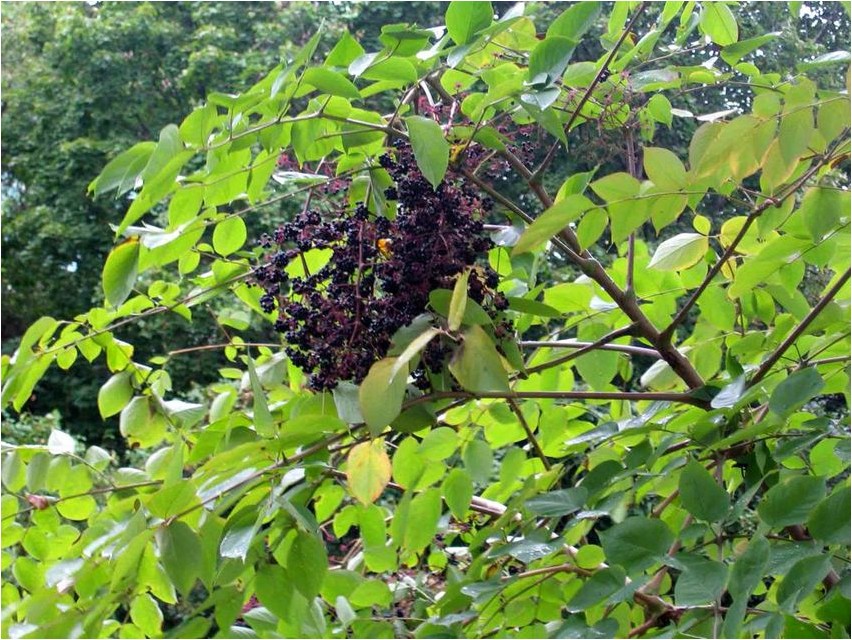
Aralia is a deciduous shrub or tree up to 20 meters tall with slender branches and a thorny trunk. The leaves are large, compound, odd-pinnate, bipinnate, or tripinnate, alternate, and concentrated at the top of the trunk, giving the plant a palm-like appearance. The flowers are small, pentamerous, gathered in umbels and then in lush paniculate or racemose inflorescences, possessing a pleasant, distinct fragrance. The calyx has imbricated petals and is equipped with small teeth. The fruit is a juicy, five-seeded drupe, berry-shaped, spherical, five- or six-sided, and dark purple in color. The seeds are compressed laterally.
Growing Conditions
Aralia loves the sun and grows well in brightly lit areas, although it also thrives in partial shade. Fertile, well-drained, and moderately moist soils are preferred. Aralia does not tolerate saline, clayey, or waterlogged soils, nor lowlands with stagnant meltwater.

Propagation and Planting
Aralia is propagated by seeds, cuttings, and root suckers. Seed propagation is labor-intensive and ineffective, as the seeds germinate very slowly. The seeds require preliminary stratification with variable temperatures and a 24-hour treatment with gibberellin. Stratification lasts 3-4 months at 15-20°C, followed by 4 months at 2-5°C. Sow the seeds in open ground in the fall under cover; seedlings appear only after 7-8 months.
Fresh seeds are recommended for sowing; they have the best germination rate and can be sown without prior preparation. Planting depth is 1. 5-2 cm. Aralia is most often propagated by cuttings and root suckers. The planting material is cut in the spring and planted in the ground at a depth of 5-6 cm until rooting occurs. Once the cuttings and suckers have taken root, they are transplanted to a permanent location.
Care
The main tasks for caring for crop seedlings are weeding and watering. You should be very careful when loosening the stem zone. With mature plants everything is much simpler. They need feeding with nitroammophos and slurry. Fertilizing is carried out in early spring and during budding. The growing clump is directed in the desired direction, periodically removing the resulting shoots. Old shoots of the aralia are also trimmed. Sanitary pruning is carried out every spring.
Application
Aralia is considered an original plant; it attracts the attention of others with its large leaves and lush inflorescences. With its appearance, Aralia gives landscape design an exotic look. The crop is used in single and group plantings, as well as to create hedges.
Aralia is widely used in medicine. Preparations from it are used for hypertension or asthenia, schizophrenia, impotence, nervous disorders, amenorrhea, post-traumatic depression and other diseases. A decoction of aralia roots is effective for colds, diabetes, enuresis, inflammation of the oral mucosa, etc.
Guests from the Far East. Aralia Manchurian or sister of Ginseng.