Clematis Manchurian
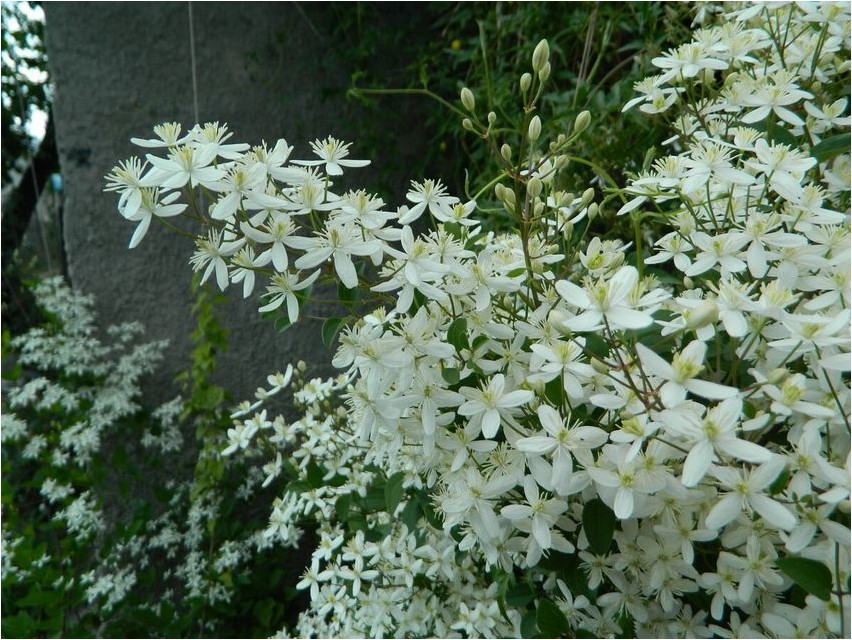
Manchurian clematis is one of the plants of the family called Ranunculaceae; in Latin the name of this plant will be as follows: Clematis manschurica Rupr.
As for the name of the Manchurian clematis family itself, in Latin it will be: Ranunculaceae Juss.
Description of Clematis Manchurian
Clematis Manchurian is a perennial plant with stems that are recumbent or ascending and clinging to the branches of all surrounding shrubs. The petioles of the leaves of this plant are curved. The stems of Clematis Manchurian will be herbaceous, ribbed and branched. The leaves of this plant are pinnately dissected and they are endowed with spaced primary lobes, which can be either trifoliate or whole. The lomonas of Manchurian clematis will be either petiolate or sessile, they will also be slightly leathery and they are endowed with a heart-shaped or wedge-shaped base, and the lobules themselves will be lanceolate-ovate. The upper leaves of this plant can often also be trifoliate. The flowers of Manchurian clematis are quite small in size, they are numerous and are collected in terminal and axillary inflorescences. The sepals of this plant are painted white, they are oblong, and their length is about one and a half centimeters. Towards the very base, such sepals are more or less narrowed, and on the lower sides along the edges such sepals will be densely white pubescent. The anthers of Clematis Manchurian are linear, endowed with a thickened edge and glabrous, and the length of the styles reaches three centimeters. This plant blooms from July to August.
Under natural conditions, this plant is found in the territory of Primorye and Amur region in the Far East. As for the general distribution, this plant is found in Korea and China. For growth, Manchurian clematis prefers thickets of bushes, dry slopes, forest edges, sandy river banks and sparse deciduous forests.
Description of the medicinal properties of Manchurian clematis
Manchurian clematis is endowed with very valuable healing properties, and it is recommended to use the entire aerial part and roots of this plant for medicinal purposes. It is recommended to harvest such raw materials throughout the entire flowering period of this plant.
The presence of such valuable healing properties should be explained by the content of clematosides A, A1, B1 and C in the roots of this plant, while traces of quercetin and vitamins C and P were found in the leaves. The flowers of this plant contain quercetin, kaempferols and vitamin C. Manchurian clematis is endowed with very valuable hypotensive, analgesic, diuretic, anti-stress and hypoglycemic effects.

As for traditional medicine, a decoction prepared from the roots and rhizomes of this plant is quite widespread. Such healing agents are used as painkillers for rheumatism and neuralgia. In addition, a decoction based on Manchurian clematis is used for contusions, pain from bruises, and also paralysis of the facial nerve. Also, such a decoction is effective for sore throat, viral hepatitis, colds, and externally this healing agent is used as a lotion both for ulcerations of the cornea and for toothache.
As a painkiller, infusion and decoction of the Manchurian clematis herb is used for gout, rheumatism and arthritis. In addition, there are also cases where people took a steam bath with fresh herbs of this plant for rheumatism. Baths made from an infusion of the Manchurian clematis herb are used for thrombosis of the extremities that arise as a result of blockage of the venous vessels.





