Cedar
Cedar (Latin: Cedrus) is a genus of trees in the Pinaceae family. It is native to the western Himalayas, the eastern and southern Mediterranean, and Crimea.
The genus comprises only four species, three of which are used in landscaping in Russian parks, gardens, and roadsides.
Cultural Characteristics
Cedar is an evergreen tree up to 60 m tall with a broad, spreading, pyramidal, or umbrella-shaped crown. The bark of the trunk is dark gray and fissured, while the bark of young shoots is smooth. The root system is shallow, making the plants susceptible to windfall. The needles are blue-green or dark green, sometimes silvery-gray, stiff, needle-shaped, spiny, three- or four-sided, and sit on leaf pads in a spiral arrangement.
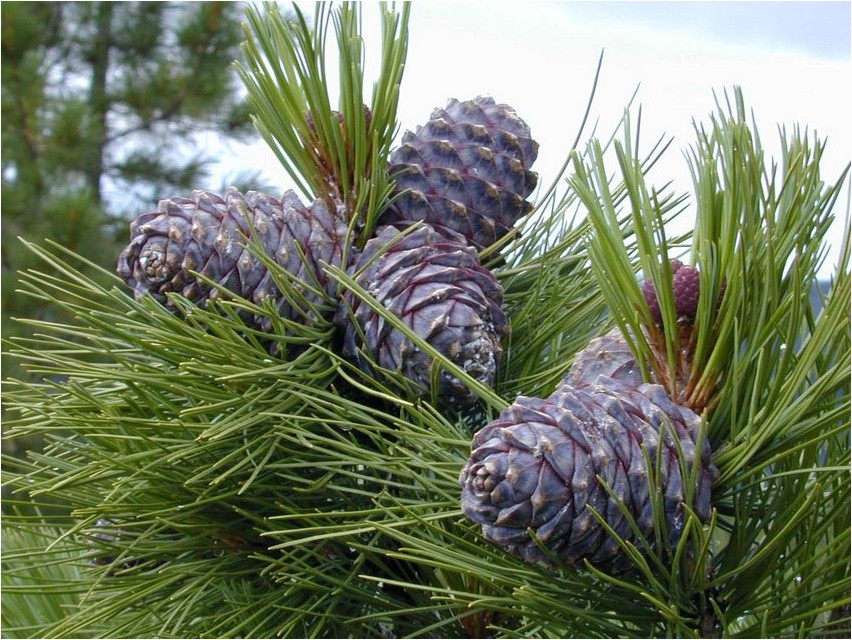
The flowers are borne in spikelets at the ends of shortened shoots. The female spikelets are equipped with numerous spirally arranged stamens, varying in length from 3 to 6 cm. The cones are elongated-ovate or barrel-shaped, solitary, covered with imbricated, appressed scales with seed pits at the base. The cones ripen in the second or third year. The resinous seeds are triangular in shape, and have large wings on the upper surface.
The cedar is a long-lived tree, with a lifespan of 2, 000-3, 000 years. Cedars are often confused with certain species of pine, which are popularly known by the same name. These include: Siberian cedar pine, Korean cedar pine, European cedar pine, and Siberian dwarf cedar pine.
Growing Conditions
Generally, cedars are undemanding in terms of growing conditions. However, they thrive in loose, permeable, moderately moist, fertile soils. Loamy, clayey, and sandy loam soils are optimal. Cedars do not tolerate compacted, saline, highly calcareous, or waterlogged soils.

In dry, calcareous soils, all four cedar species suffer from chlorosis, eventually dying. The plants are sensitive to stagnant water. A sunny location is preferable; light shade will do no harm. The trees have a powerful root system, which can damage the foundations of houses and other buildings, so planting them closer than 3-4 meters is not recommended.
Propagation and Planting Tips
Cedars are propagated by seed and vegetatively; grafting onto Scots pine is also possible. Cedar seeds should be sown in the fall—in late September or early October. Sow the seeds in pre-prepared and fertilized beds. The seedlings need protection from mice and other rodents. Seedlings emerge the following spring and also require covering with plastic film, but only initially. Once the weather becomes consistently warm, remove the covering.
Spring sowing is less successful. In this case, the seeds undergo stratification. First, the seeds are soaked in room-temperature water for 5-6 days, changing the water periodically. Then, the seeds are mixed with peat chips or coarse river sand and moistened. Once the seeds have sprouted, they are placed in a cool place (0°C) and kept there until sowing. The seeding depth is 3-4 cm. Thinning begins when the seedlings develop 2-3 true leaves. Later, the seedlings are pricked out using a spacing of 20 x 10 cm or 20 x 20 cm. If the seedlings are not strong enough, pricking out is postponed until the following year. Typically, the survival rate of seedlings is 90-95%, but this requires careful care.
The seedlings are planted in their permanent location after 2-3 years. The soil under the cedar is fertilized with peat, humus, or rotted manure, along with mineral fertilizers. The addition of forest litter is encouraged. The seedlings are planted in holes the size of which depends on the development of the root system. The root collar should be level with the soil. After planting, the soil around the trunk is thoroughly compacted, watered, and mulched.
Care
Caring for the plant is not difficult. Plants require occasional watering during drought, annual fertilization with nitrogen, potassium, and phosphorus fertilizers, loosening of the soil around the trunk, and mulching with sawdust or peat. Cedars do not require pruning, but under one condition: young plants aged 3-5 years should have their lateral buds removed from the main shoot. This procedure increases growth, and eliminates the need to prune lateral shoots.
HOW TO GROW A CEDAR FROM A WALNUT AT HOME — IT”S VERY EASY!!!
https://www. youtube. com/watch? v=Eaa779PXqPM