Cinquefolia
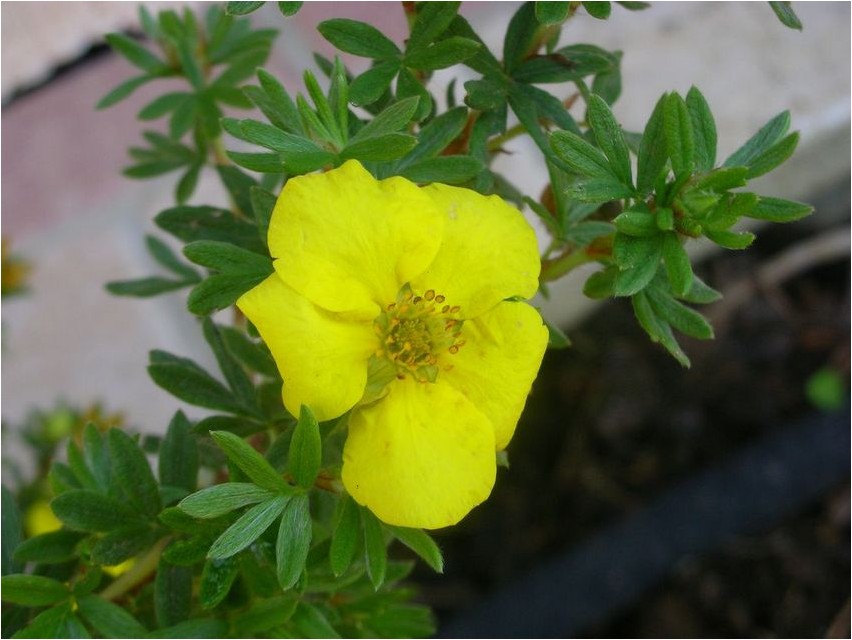
Potentilla tanacetifolia is one of the plants of the family called Rosaceae; in Latin the name of this plant will be as follows: Potentilla tanacetifolia Willd. ex Schlecht.
As for the name of the cinquefoil family itself, in Latin it will be: Rosaceae Juss.
Description of cinquefoil
Cinquefolia is a perennial herbaceous plant endowed with a very powerful rhizome. The stems of this plant are erect, their height will be ten to fifteen centimeters, such stems will be very leafy. The leaves of the cinquefoil are quite large and pinnately dissected. The flowers of this plant will be numerous, they are collected in a dense corymbose-paniculate inflorescence, such flowers are endowed with yellow rounded petals. The fruits of the cinquefoil are smooth and oblong-ovate nuts.
This plant blooms from June to August. Under natural conditions, this plant is found in Altai, Western Siberia, the Angara-Sayan region of Eastern Siberia, as well as in the Amur region, Primorye and the Okhotsk region of the Far East.
Description of the medicinal properties of cinquefoil
Cinquefolia is endowed with very valuable healing properties, and it is recommended to use the roots and grass of this plant for medicinal purposes. The term herb includes the flowers, stems and leaves of the cinquefoil plant.
The presence of such valuable healing properties should be explained by the content of tannins, coumarin, catechin, epicatechin and epigallocatechin in the rhizomes, as well as the following flavonoids: kaempferol, quercetin, quercitrin and astragalin. The aerial part of the cinquefoil will contain essential oil, coumarins, catechins, tannins, and phenolcarboxylic acids. It is noteworthy that the flowers of this plant will contain ellagic acid.

As for Tibetan medicine, a decoction prepared from the roots and rhizomes of the cinquefoil is quite widespread here. This healing decoction should be used for pulmonary tuberculosis, gastrointestinal diseases, atherosclerosis, various colds, and this decoction will also be part of the remedies used for diabetes. Externally, the roots of this plant are recommended for use as rinses and lotions. A decoction prepared from the herb cinquefoil is used for dysentery. An infusion of the flowers of this plant is used for diabetes.
For atherosclerosis, it is recommended to use the following remedy based on this plant: to prepare such a healing remedy, it is recommended to take ten grams of crushed roots and rhizomes of cinquefoil per three hundred milliliters of water. It is recommended to boil the resulting mixture over low heat for five minutes, after which the mixture is left to infuse for two hours, then this healing mixture based on this plant should be filtered very carefully. Take the resulting healing remedy based on cinquefoil three times a day, one-third or one-fourth of a glass.
For dysentery, the following remedy is used: take one tablespoon of crushed dry cinquefoil herb per glass of water. The resulting mixture should be boiled for five minutes, then infused for an hour and filtered very carefully. Take this remedy two to three times a day, half a glass or one third of it.





