Potentilla aureus
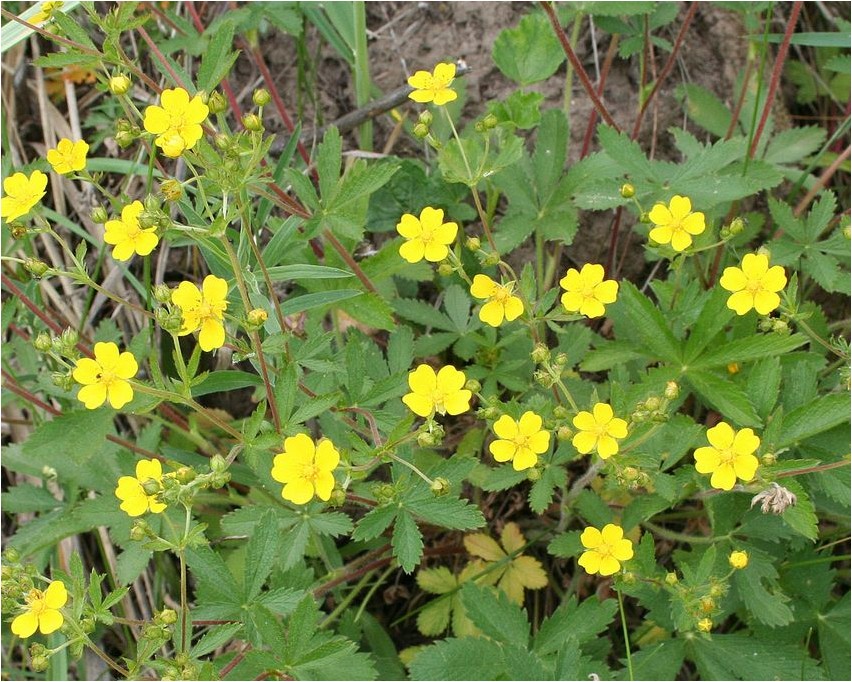
Potentilla goldenflower is one of the plants of the family called Rosaceae; in Latin the name of this plant will be as follows: Potentilla chrisantha Trev.
As for the name of the golden-flowered cinquefoil family itself, in Latin it will be like this: Rosaceae Juss.
Description of Potentilla aureus
Potentilla goldenflower is a perennial plant whose height will vary between fifteen and forty centimeters. The stems of this plant are thin, sparsely leafy, erect, and dichotomously branched. Such stems will be covered with rather short fluff and protruding hairs, which are longer. The root and lower stem leaves of the golden-flowered cinquefoil are quintuple, long-petiolate, while the middle leaves will also be quintuple, while the upper leaves are trifoliate, erect-pilose, they can be either almost sessile or short-petiolate. The leaves of this plant are colored green. The flowers of this plant are quite numerous, they are found in inflorescences, and can be either quite small or large. The petals of the golden-flowered cinquefoil are painted in golden-yellow tones.
Flowering of the golden-flowered cinquefoil occurs during the period from May to July. Under natural conditions, this plant is found in the Dzhungar-Tarbagatai region of Central Asia, in the Urals in the Volga-Kama region of the European part of Russia, as well as in the Ob, Altai and Irtysh regions of Western Siberia, the Daur and Angara-Sayan regions of Eastern Siberia. For growth, the plant prefers meadows, meadow slopes, sparse forests and edges.
Description of the medicinal properties of Potentilla aureus
The golden-flowered cinquefoil is endowed with very valuable healing properties, and it is recommended to use the entire above-ground part of this plant for medicinal purposes.
The presence of such valuable healing properties should be explained by the content of tannins in the roots of this plant, while the herb contains tannins, flavonoid glycosides of kaempferol, isorhamnetin and quercetin, phenol carboxylic acids and their following derivatives: ellagic, gallic and methyl ester of gallic acid. The leaves contain phenolcarboxylic acids, the hydrolyzate contains p-coumaric, ferulic and caffeic acids, quercetin, kaempferol, kaempferol C-glucoside, and the flowers contain flavonoids.

In Altai, a decoction prepared from the aerial part of this plant is used for fever. Potentilla aureus is endowed with antifibrinolytic, thromboplastic and antibacterial activity.
The aerial part of this plant is very often used as a substitute for tea, and the golden-flowered cinquefoil itself turns out to be suitable for tanning leather.
To prepare a very effective remedy based on Potentilla aureus, it is recommended to take three tablespoons of the flowers of this plant in two glasses of water. The resulting healing mixture should be boiled for about three to four minutes over fairly low heat, then left to brew for one hour, after which this healing mixture based on Potentilla aureus should be filtered very carefully. Take the resulting remedy three to four times a day, one-third of a glass, in slow sips, rather warm. It is noteworthy that in order to achieve the greatest effectiveness when taking such a remedy, it is recommended to carefully follow all the rules for taking it, and also follow all the rules for preparing such a remedy based on Potentilla aureus.





