Celandine
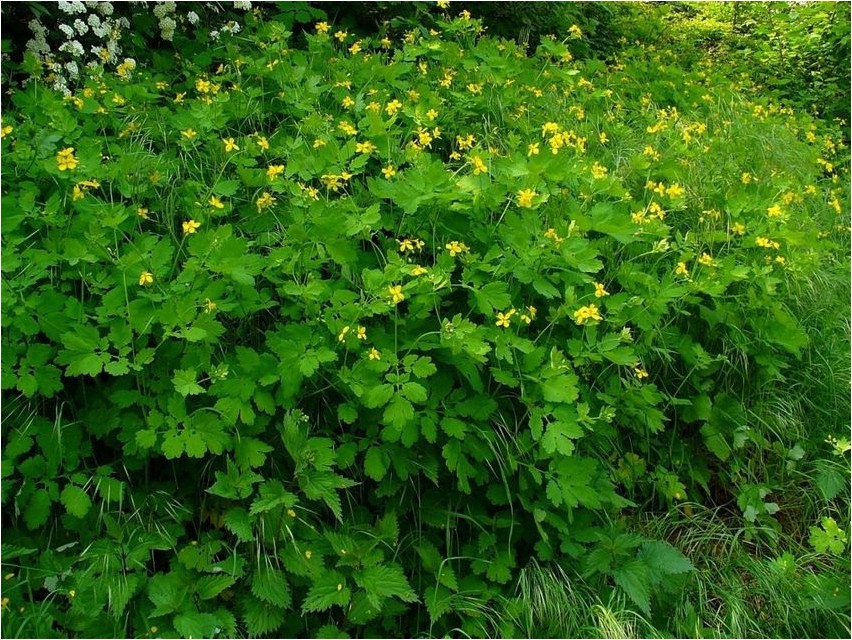
Celandine (lat. Chelidonium) is a herbaceous shrub belonging to the Poppy family.
Description
Celandine is a herbaceous and fairly tall erect perennial shrub, endowed with powerful brownish rhizomes and rounded stems, from which, when cut, a milky sap is released.
This juice contains toxic substances that can cause burns on human skin. And the height of celandine often reaches one meter.
The ovoid and slightly pointed leaves can be either basal or stem. The basal leaves are collected in small rosettes, and their shape varies from lanceolate to obovate-oblong. And the stem leaves are always arranged alternately.
The four-petaled numerous flowers are collected in fancy umbrella inflorescences and boast a rich yellow color. And the fruits look like bare, narrow-cylindrical boxes containing a truly incredible number of shiny tiny seeds.
At the moment, the genus includes two varieties of celandine: greater celandine and Asian celandine.

Where does it grow
Celandine grows in almost all areas characterized by a temperate climate, from Japan to Europe.
Application
Celandine has a lot of useful properties, which is why it is highly valued as a medicinal plant. It has proven itself especially well in the treatment of all kinds of skin ailments. It contains a huge amount of alkaloids, while in the roots their volume is twice as high as in the leaves. In addition, this plant is very rich in citric, malic and beneficial succinic acids, various valuable microelements, carotene, vitamins, tannins, all kinds of essential oils and alcohols.
The main healing properties of celandine are concentrated in its juice, endowed with powerful wound healing, as well as excellent anti-inflammatory and pronounced analgesic properties. In addition, it is an excellent anticonvulsant and diuretic and is endowed with the ability to expel bile from the body and relieve spasms.
Just like a great many other poisonous plants, celandine is endowed with the ability to restrain tumor processes developing in the body – this ability makes it an indispensable assistant in the treatment of both benign neoplasms and malignant tumors.
For treatment, mainly the above-ground parts of celandine are used, usually harvested during the flowering period. And they can be used in various forms – these can be infusions and decoctions, as well as oils or vodka and alcohol tinctures. A decoction of this medicinal plant is usually used externally for dermatitis, psoriasis and eczema, and for internal use an infusion is almost always prepared to help cope with oncology, neuroses, cholecystitis and paralysis, as well as epilepsy, fungal infections and polyps of various internal organs, gynecological diseases, colitis, gastritis, tuberculosis, pancreatic diseases, inflammation of the gallbladder and hepatitis.
Since celandine is poisonous, its dosage must be strictly observed, and large dosages of this plant can only be taken under the supervision of a doctor.
In its pure form, the juice of the plant is used to quickly cure dry calluses or warts, as well as psoriasis, various fungal skin infections, extremely unpleasant herpetic rashes and papillomas.
Contraindications
Absolute contraindications are childhood, individual intolerance, breastfeeding and pregnancy.





