Siberian threadfoil
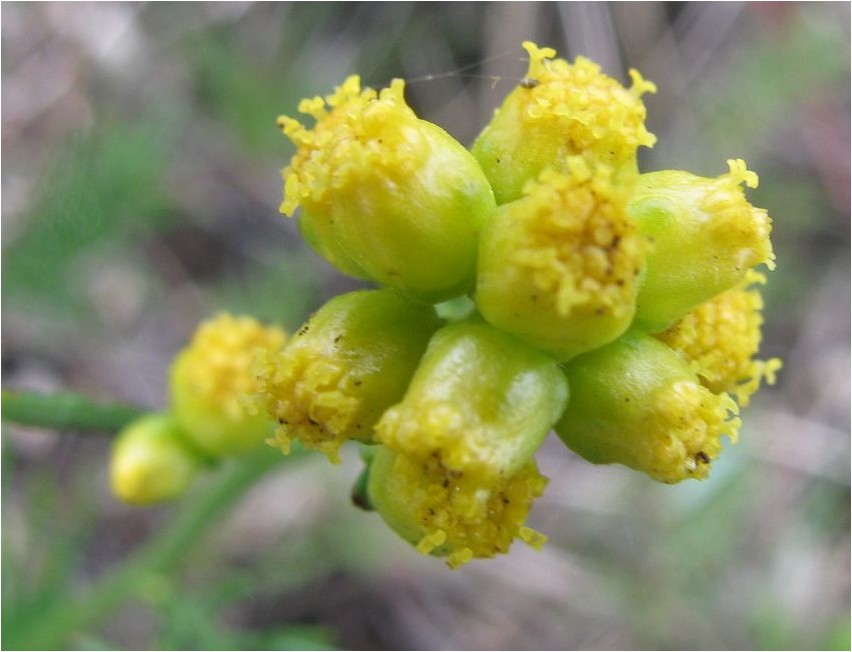
Siberian threadwort is one of the plants of the family called Asteraceae or Asteraceae; in Latin the name of this plant will be as follows: Filifolium sibiricum (L). Kitam. (Tanacetum sibiricum L.).
As for the name of the Siberian threadfoil family itself, in Latin it will be like this: Asteraceae Dumort.
Description of Siberian threadfoil
Siberian threadwort is also known as Siberian tansy. Siberian threadwort is a perennial herbaceous plant endowed with a thickened oblique rhizome, the height of which will fluctuate between twenty and sixty centimeters. The stems of this plant will be bluntly ribbed and erect; at the tops of the inflorescence itself, such stems are branched; they can be either few or solitary. At the very base, the stems of Siberian threadfoil will be covered with a thick layer of coarse fibrous remains of leaf petioles. The leaves of this plant will be basal and dull green in color, their length will reach twenty centimeters, and the width will be approximately five to six centimeters. Such leaves of this plant will be on long petioles, the plates in their outline can be from obovate to linear-oblong, they can be double or triple pinnately dissected. The terminal lobules are lily-thread-like, their width reaches one millimeter and their length is four centimeters. They will have edges that are more or less rolled up on the underside, and the edge will be pointed at the top. There are only one to five stem leaves of Siberian threadfoil; they will be similar to the basal leaves, but will be on more or less short petioles: up to almost sessile and entire upper ones. There will be from one to fifteen baskets, they are assembled into a simple or complex thick shield, the diameter of the wrapper will be about four to five millimeters, and the width will be similar. In bisexual flowers, the corollas will be colored in yellowish tones; the fruits of Siberian threadfoil are light brownish achenes, the length of which will be a maximum of two and a half millimeters, and the width will be equal to two millimeters.
This plant blooms from July to September. In the wild, it is found in the Daurian and Angara-Sayan regions of Eastern Siberia, as well as in Western Primorye and the Amur region of the Far East.
Description of the Medicinal Properties of Siberian Filiphyllum
Siberian Filiphyllum has very valuable medicinal properties, and its herb is recommended for medicinal purposes. The herb includes the leaves, flowers, and stems of this plant. This raw material should be harvested throughout the flowering period of Siberian Filiphyllum.
The presence of such valuable medicinal properties can be attributed to the vitamin P and ascorbic acid it contains.

In folk medicine, a decoction made from Siberian Filiphyllum herb is recommended for palpitations, high fever, neurasthenia, menstrual irregularities, insomnia, and heavy menstruation. An infusion of this plant’s herb is used as an anticonvulsant and also for asthma. It’s worth noting that this herb also has a slight beneficial effect on cholecystitis and hepatitis.
In the form of an ointment, powder, and decoction, Siberian threadwort is used externally for various purulent inflammations.