Wolfsbane
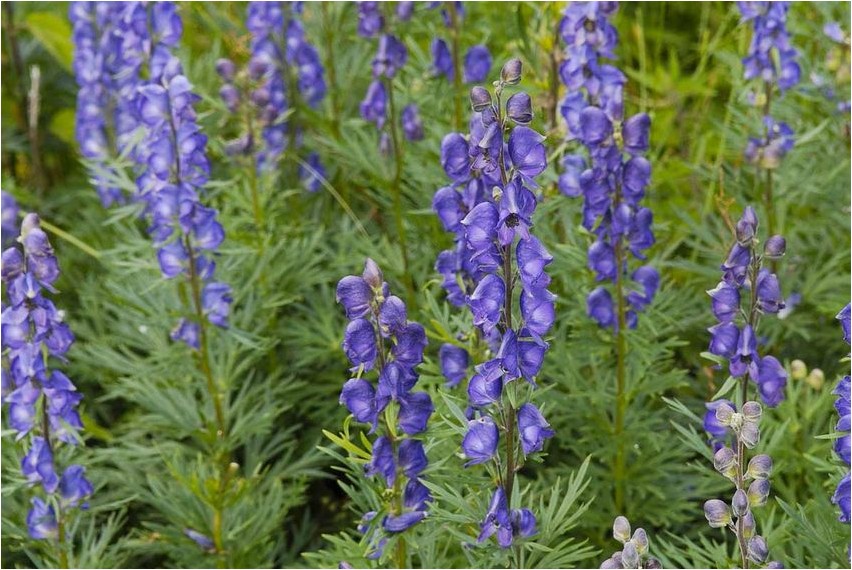
Aconite (lat. Aconitum) is a numerous genus of herbaceous perennial flowering plants, most of which are extremely toxic in all their parts.
Such abilities somehow do not agree with the cute name of the family to which the genus is classified – Ranunculaceae (lat. Ranunculaceae). However, when communicating with the plant, you should be extremely careful and use protective equipment.
What’s in your name
Anything that can speed up a person’s departure from this wonderful world has always been surrounded by many legends and fables. This fate did not escape the poisonous plant, Aconite, whose deadly abilities Mankind has used throughout its presence on planet Earth.
The plant was associated with the underground kingdom of shadows, from which a person who fell into it had no way back to our world. After all, the exit was guarded by a terrible, evil and poisonous monster with three heads (apparently, the antipode of the three-faced Christian god, which people did not yet know about in those legendary times). But man is not so simple. There was one brave man (Hercules, although he was half-man, half-god) who managed to defeat the monster and throw him out into the world.
Out of habit, Cerberus (that was the name of the monster) felt sick, and he splashed out his poison on the ground. What was the earth to do? She endured such an attack, collected the monster’s poison into a pile and showed the world a tall, powerful plant, all parts of which were filled with this poison.
Since this whole story happened near the town of Akoni, the poisonous plant was given the name of an innocent city.

Description
Aconite has powerful roots, tall growth, a lush bush, large dissected beautiful leaves and unusual flowers. For its heroic appearance and flowers with a helmet-like petal, the plant is popularly called “Fighter”.
During its long presence on Earth, the perennial plant managed to create more than three hundred species, slightly different from each other in the shape of the roots (a taproot formed by the interweaving of numerous thin roots, or a root on which poisonous tubers are formed); the shape and color of zygomorphic flowers, which are not entirely correctly called “irregular”, that is, not having the symmetry of their elements. Despite the unusual shape of the flower, it still has symmetry along one axis.
The choice of colors for flower petals is small. They come in white, pale yellow, dirty lilac, and purple in different shades. The main highlight is not the color of the flower, but its shape with a crowning protective helmet covering the reproductive organs. An inflorescence-brush of large flowers is crowned with a tall, powerful peduncle.
Nature skillfully cut the huge palm-shaped leaves into pointed “fingers,” as if repeating the pattern of winter snowflakes. But the beauty of the leaves is combined with their toxicity. Although all parts of the plant contain toxic substances, their highest concentration is observed in the leaves and roots of Aconite, which should be remembered when planting or replanting an ornamental plant in your own garden.
Growing
Risky people are not afraid of the toxicity of Aconite, and therefore it is often planted in summer cottages, recharging itself with energy and power.
Aconite feels more comfortable in partial shade, but will not be capricious if it gets a sunny place, since it is tolerant of any temperature and easily tolerates both heat and cold.
Aconite is not picky about soil, but on moderately moist loams it demonstrates all its advantages much more successfully. If it gets other soil, the plant should be watered regularly.
To propagate his species on the planet, Aconite created several options: sowing fresh seeds; planting root tubers; separation of leaf rosettes. When man-made reproduction, do not forget about protective gloves.
Pests
Like Achilles’ heel, the weak point of powerful Aconite is its roots. Microscopic soil fungi, not afraid of the plant’s poison, attack the roots, causing them to rot. From the roots, rot is transmitted to the stem, leading to the death of a powerful bush.
Aconite can also be affected by ubiquitous mites.





