Sapota white
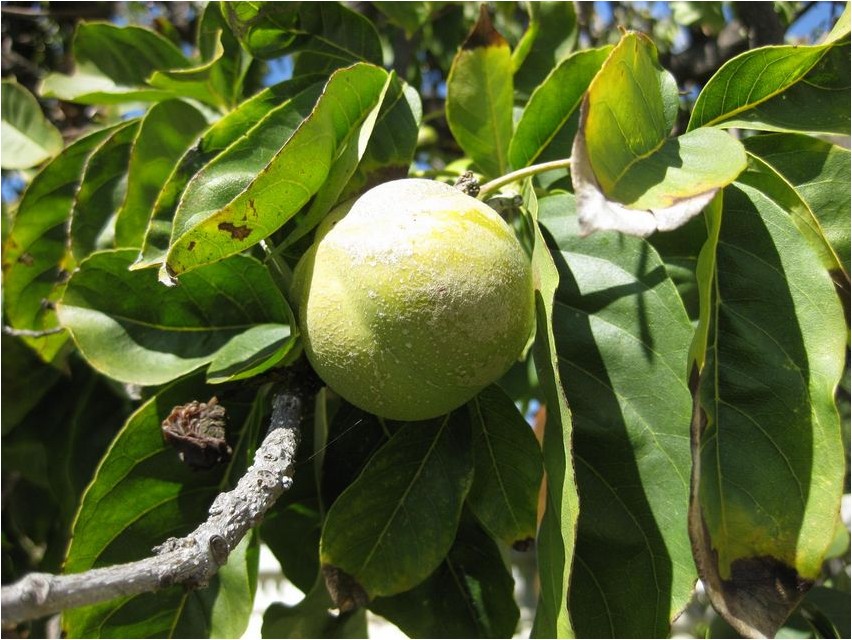
White sapota (lat. Casimiroa edulis) is a fruit tree that is a member of the Sapotaceae family.
Description
White sapota is a woody evergreen plant reaching twenty meters in height and endowed with ash-gray warty bark. The leaves of this culture are palmate and very large — all of them are formed by three to seven leathery leaves, which are characterized by a lanceolate shape. The leaves are arranged alternately, and their length can reach sixty centimeters.
The inconspicuous small flowers of white sapota are painted in modest greenish-yellowish shades — they are all collected in compact paniculate inflorescences both in the leaf axils and at the tips of the branches.
The fruits of white sapota are oval or round, and their size rarely exceeds the size of an average orange (about twelve centimeters in diameter). All of them are covered with a very thin peel, which is instantly damaged when pressed or scratched. For this reason, all fruits are collected exclusively by hand, along with the petioles, since damaged fruits spoil almost instantly. However, even very carefully picked fruits will not last more than two weeks in the refrigerator. And since overripe fruits are absolutely inedible, they are picked slightly unripe and allowed to “ripen” in a dark place.
During the ripening period, the fruits change their color from standard green to yellowish-greenish, yellow or light green. And the flesh can be colored red, pink, cream or white — in this case, the color depends entirely on the variety being grown. Its texture is slightly fibrous, almost like that of pears. As for the taste of the pulp, it boasts a delicious banana-peach hue. Inside all the fruits you can find one or several oval poisonous white seeds.
Where does it grow
In the wild, white sapota can be seen in Mexico, as well as in Central America, where it forms entire tropical forests. And it is cultivated in both tropical and subtropical zones (in the Bahamas, America, South Africa, the Philippines, the Mediterranean, the distant Antilles, as well as in the vast expanses of New Zealand and India).

Application
Most often, white sapota is eaten fresh. However, it is also used quite actively in cooking — wonderful marmalade, jelly or halva are made from its pulp, and very tasty juice is also squeezed out of it. And to preserve it as long as possible, the pulp is frozen.
In a number of Central American countries and Mexico, the local population actively uses these fruits in folk medicine — they are an excellent painkiller for arthritis and rheumatism, which causes a lot of trouble. The leaves, as well as the bark and seeds, are no less actively used for medicinal purposes — since ancient times, Mexicans have extracted from them extracts used as sedatives, sedatives and sleeping pills, and in Costa Rica, decoctions and infusions used in the treatment of diabetes are prepared from such raw materials.
Contraindications
White sapota has no contraindications as such. The main thing is to avoid eating its seeds, because they contain toxic substances that are hazardous to health.
Growing and care
White sapota can easily withstand minor frosts (down to about minus three degrees). And under particularly unfavorable conditions, it simply sheds its leaves. White sapota will feel best in direct sunlight, as it is very photophilous.
The main feature of white sapota is that some of its forms may be inedible, even despite the fact that the parent tree produced completely edible fruits. That is why, in order to get a guaranteed result, this crop is bred not from seeds, but with the help of grafting — grafted specimens delight with the first harvest after three to four years.