Schubert bow
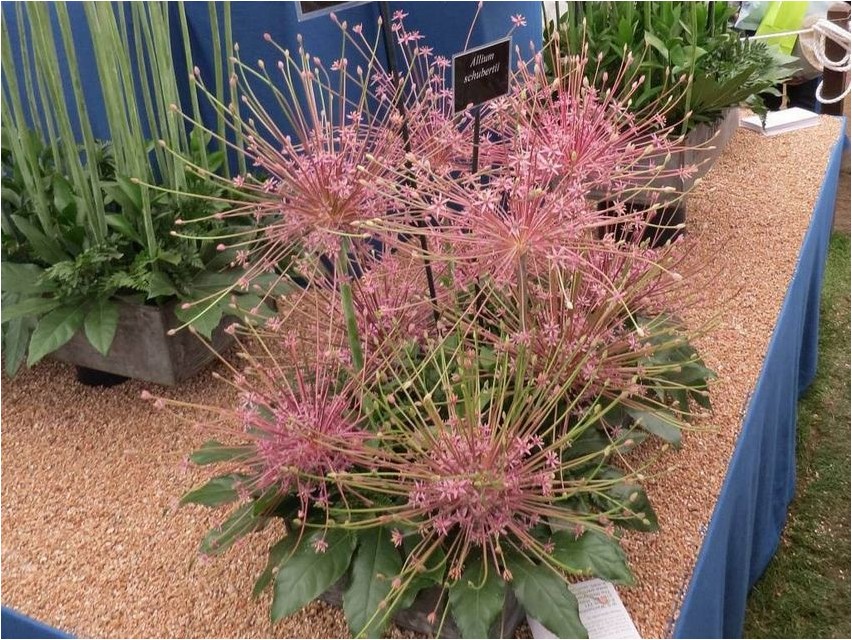
Schubert”s onion (lat. Allium schubertii) is a representative of the Onion genus of the Onion family. It is a highly decorative crop, widely used in landscaping gardens and personal plots.
In nature, Schubert”s onion is found in Western Asia. Typical growing areas are gravelly slopes and sands.
Characteristics of culture
Schubert onion is a perennial herbaceous plant with a spherical or ovoid bulb, reaching 2-3 cm in diameter. The bulb shells are papery, blackish or brown in color. The leaves are linear-lanceolate, green with a bluish bloom, rough along the edges, up to 2-3 cm wide.
The flowers are collected in spherical or hemispherical, multi-flowered, loose umbrellas. The perianth is star-shaped, whitish or pink. The tepals are equipped with a dirty purple or greenish vein. Flowering stems are tubular, hollow, up to 60 cm long. The fruit is a capsule. Schubert”s onion blooms in mid-early May. Flowering lasts 10-16 days. In culture since 1896.
Subtleties of cultivation
Schubert”s onion is photophilous and prefers sunny areas. The crop is undemanding to soil conditions and can grow on both rocky clay soils and sandy soils. Does not accept waterlogged, swampy and saline soils. Negatively relates to dull shadows. Needs good drainage. Relatively frost-resistant, adult plants can withstand frosts down t o-12C.
Schubert onions are propagated like all representatives of the Onion genus: by seeds and vegetatively. Seeds are sown in early spring or autumn under cover in the form of organic material (peat, humus, sawdust, pine needles). Specimens grown by sowing seeds bloom only in 3-7 years.

The vegetative method of propagation involves planting bulbs or children that are formed during the development of the crop. As a rule, children appear in the third year after the mother’s bulb is planted. The division of children is carried out in the fall. The planting depth directly depends on the size of the bulb. The distance between plants should be about 10-15 cm, which also depends on the size of the bulb.
Caring for Schubert onions consists of moderate and regular watering, removing weeds and loosening the rows. Fertilizing with mineral and organic fertilizers is not prohibited. The first feeding is carried out in early spring, the second — in the budding phase.
Application
Schubert”s onion is a frequent visitor to rock gardens and other rocky gardens. The plant fits perfectly into landscape compositions and is often used to decorate borders and mixborders. In conjunction with other decorative onions, they create gardens of continuous flowering that delight their owners throughout the entire gardening period.
Schubert”s onion also harmonizes with other crops, for example, delphinium, poppy, aquilegia, iris, salvia and lupine. Schubert”s bow looks good in compositions composed of herbs and grains. The inflorescences of the plant are suitable for creating bouquets, both live and winter.