Quinoa Tatarian
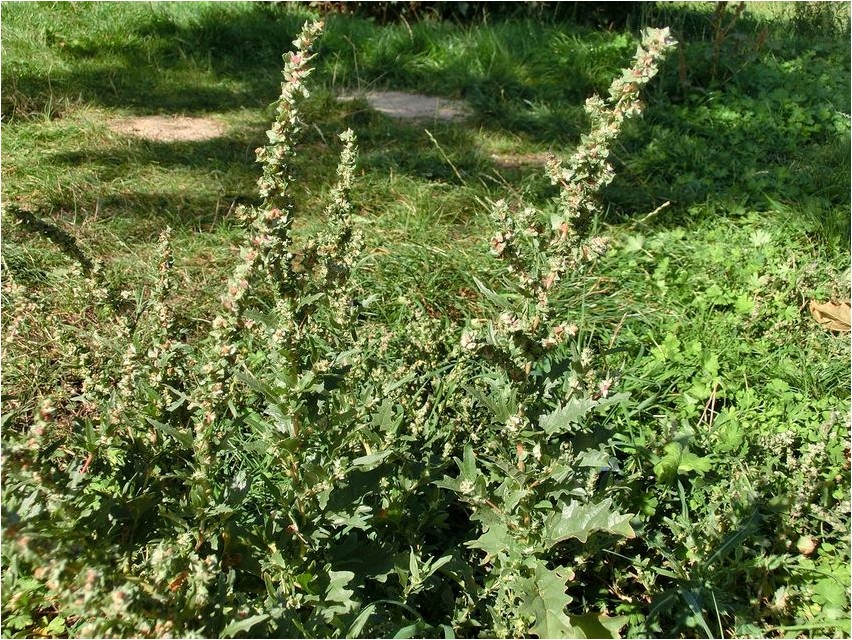
Tatarian quinoa is one of the plants of the family called goosefoot; in Latin the name of this plant will be as follows: Atriplex tatarica L.
As for the name of the Tatarian quinoa family itself, in Latin it will be: Chenopodiaceae Vent.
Description of Tatarian quinoa
Quinoa Tatarian is an annual herbaceous plant, the height of which will fluctuate between ten and one hundred centimeters. The stem of this plant can be either straight or ascending, and is also branched. All leaves of Tatarian quinoa will be notched-toothed, alternate, they can be either oblong-ovate or triangular-ovate. Such leaves can sometimes be almost three-lobed, often along the very edge they are hairy, on both sides or only on the bottom they will be silvery-powdery. The glomeruli of quinoa tartare consist of male flowers and they are collected in dense ears, which will be leafy only in the lower part. The female flowers of this plant are collected in small numbers in the axils of the leaves. The bracts of Tatarian quinoa will be fused and rhombic-arrow-shaped up to the middle. This plant blooms at the end of summer.
Under natural conditions, this plant is found in the Crimea, Belarus, Ukraine, Moldova, Central Asia, the Caucasus, in the south of the Obsky, Irtysh, Verkhnetobolsky and southwest Altai regions of Western Siberia, as well as in the European part of Russia, with the exception of only the Ladoga-Ilmen, Karelo-Murmansk and Dvina-Pechora regions. To grow, this plant prefers the banks of rivers, ditches, canals, salt marshes, solonets meadows, garbage areas, rocky slopes, thus forming thickets.
Description of the medicinal properties of Tatarian quinoa
Tatarian quinoa is endowed with very valuable healing properties, and it is recommended to use the grass and seeds of this plant for medicinal purposes. The term herb includes the flowers, stems and seeds of Quinoa Tartarian.
The presence of such valuable healing properties should be explained by the content of coumarins, alkaloids and flavonoids in the composition of quinoa, while the seeds contain saponins.

As for Turkmenistan, a decoction prepared from the leaves of Tatarian quinoa is quite widespread here. This remedy is used for jaundice and as a very effective diuretic. A decoction of the seeds of this plant has an emetic and diuretic effect. It should be noted that the leaves of Tatarian quinoa can be used for preparing necks, various vegetable dishes, marinades, and also for pickling.
For jaundice and as a diuretic, it is recommended to use the following remedy based on Tatarian quinoa: to prepare such a healing remedy, it is recommended to take twenty grams of dry crushed leaves of this plant per two hundred milliliters of water. The resulting mixture should be boiled over fairly low heat for about three to four minutes, after which this mixture is left to infuse for about two hours, and then this healing mixture based on Tatarian quinoa should be very carefully filtered. Take the resulting healing remedy based on Tatarian quinoa about three to four times a day, one to two tablespoons. It is important to remember that in order to ensure the greatest effectiveness when taking a medicinal product based on Tatarian quinoa, it is recommended not only to strictly follow all the rules for preparing such a medicinal product, but also to carefully follow all the rules for taking this remedy based on Tatarian quinoa.





