Mango
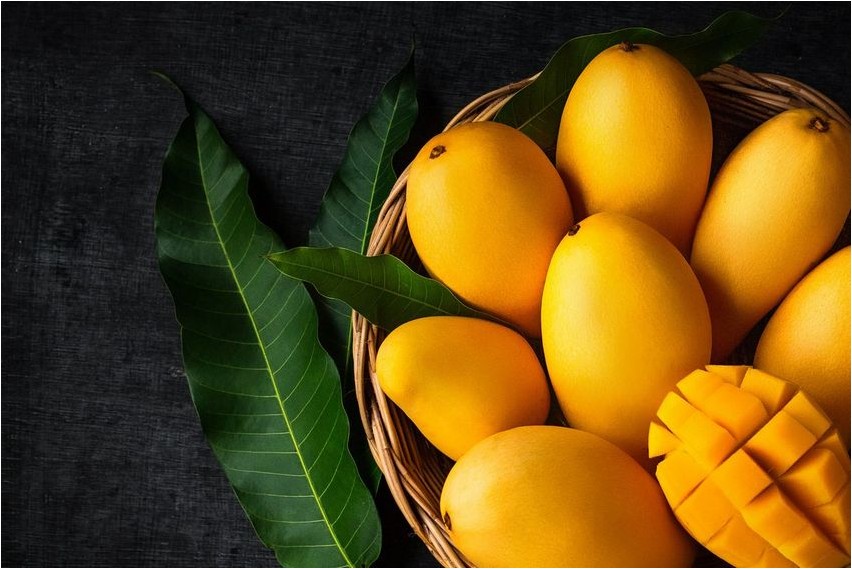
Mango (lat. Mangifera indica) is an evergreen tree belonging to the Sumacaceae family and is one of the most valuable agricultural crops.
History
Mangoes have long grown wild in tropical rainforests located in Myanmar (in the border zone) and in the distant Indian state called Assam. And in the 16th century, active Portuguese colonists also brought it to Africa and Brazil.
Today, mangoes are cultivated in many regions with a favorable climate around the world: in China, Mexico, the Caribbean Islands, Central and South America, tropical Africa (Côte d”Ivoire and Kenya), Cuba and the United States, as well as in Australia and many Asian countries (Vietnam, the Philippines and Thailand).
Description
Mango is an evergreen tree with a fairly dense crown, the height of which reaches from ten to forty-five meters. The leaves of this crop are very large — their width is on average about ten centimeters, and their length is about forty centimeters. Young leaves are usually colored in reddish shades, while mature leaves are a rich dark green color.
Tiny yellowish mango flowers form rather long panicles. Each panicle can contain from several hundred flowers to several thousand.
Mango fruits are yellowish drupes covered with a smooth, waxy skin. Their taste can vary from sour to sweet. It is also important to know that mango fruits can cause allergic reactions in some people — both the fruits themselves (especially unripe ones) and their peel contain all sorts of toxic components. And the main irritant is considered to be the easily volatile essential substance. Depending on the variety, mangoes ripen between June and August, and some varieties ripen only in December.

Currently, there are about three hundred varieties of mangoes. One of the most popular is the Alfonso variety.
Usage
Mangoes are eaten not only fresh, but also canned. The pulp of its fruit contains not only sugars, but also xanthones (the main one being mangiferin) and organic acids.
Mango is also used quite widely in popular Indian medicine — not only the fruits and seeds with flowers are used there, but also gum from the bark.
The wood of mango trees is characterized by truly incredible strength, due to which the range of its applications is very wide: it is used in shipbuilding, construction, as well as in the production of sports equipment, all kinds of crafts, plywood with veneer and even shoes.
Mango is also one of the national symbols of Pakistan and India.
Growing mango from seed
Mangoes are quite easy to grow from a flat and fairly large ovoid seed removed from the fruit. The fruit, of course, must be ripe. To extract the seed, it is best to take even a slightly overripe soft fruit. By the way, in such fruits you can sometimes find already burst seeds with tiny sprouts peeking out.
Immediately before planting, the pit is freed from the pulp as much as possible — this is necessary so that after planting mold does not form on it. The opened seed can be planted immediately, placing it as close as possible to the soil surface with the root down. And the unopened bone is first dipped in a glass of water at room temperature for a week or two. The water should be changed every two days. Only after this time can the seed be planted. You can do it differently — let the seed swell in a wet towel (similar to germinating zucchini or pumpkin seeds). It is important to ensure that the bone does not dry out.
The soil intended for planting should be as light as that for planted succulents. Ideally, it should be mixed with pebbles or expanded clay. In addition, the pot must have a drainage hole. And on top they set up a miniature “greenhouse” made from a cut-off plastic bottle. Periodically, the plug must be removed to allow the plant to ventilate.
Mango
https://www. youtube. com/watch? v=epGcS1pJtgc