Pomegranate
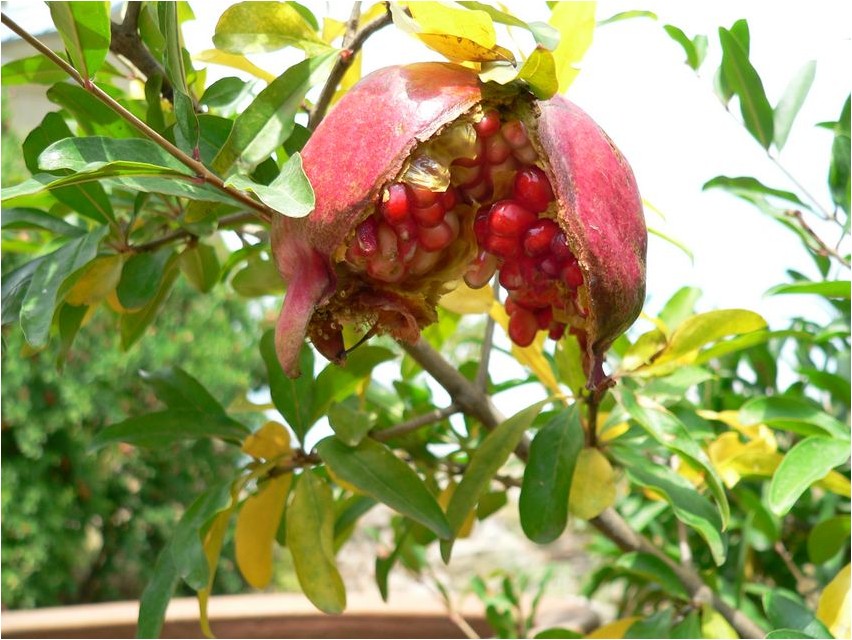
Pomegranate (Latin: Punica) is a genus of shrubs and low trees in the family Lythraceae. Other names include pomegranate tree or pomegranate.
Distribution
The common pomegranate species is found in the wild in Western Asia and Southern Europe, while the Socotra pomegranate (or protopunica pomegranate) grows on the island of Socotra, located in the Arabian Sea. Currently, only one species, the common pomegranate, is cultivated.
Pomegranate is widely cultivated in Afghanistan, Iran, Italy, Spain, Greece, the Middle East, Portugal, France, Tajikistan, and the Caucasus (Azerbaijan, Georgia, and Armenia). In Russia, pomegranate is grown in the Krasnodar Krai and in the southern regions of Dagestan.
Crop Characteristics
Pomegranate is a deciduous shrub or tree up to 5-6 m tall with thin, thorny branches. The leaves are glossy and green. The flowers are orange-red, funnel-shaped, and up to 4 cm in diameter. There are two types of flowers: the first are bell-shaped, while the second are bisexual, pitcher-shaped, and fruit-forming. Flowers of intermediate shapes are less common. The calyx is 5-7-lobed, leathery, and colored.
The fruits are spherical, large berries with a dense pericarp. The skin can have a wide range of colors, from orange-yellow to brownish-red. Fruit size depends on the variety; some varieties bear fruits up to 18 cm in diameter. Pomegranate seeds are numerous, up to 2, 000 in a single fruit, and are arranged in 6-12 locules or chambers.
Growing Conditions
Pomegranates are sun-loving, requiring bright light without shade. If there is insufficient sunlight, the plants will not bloom and, consequently, will not produce fruit. In general, warmth and light are the main conditions for fruit ripening, so in Russia, pomegranates are grown only in the Krasnodar Krai. The growing season begins at an average daily temperature of 11-12°C, with budding occurring at 16-18°C. Winter temperatures should not fall belo w-12°C.

Fruit formation occurs in 120-160 days, depending entirely on weather conditions and the variety. In some regions, to successfully grow pomegranates, plantings are covered with plastic during the last few weeks of the growing season. Pomegranates have no special soil requirements, but they grow best in rocky, sandy loam, gravelly, and alkaline soils. They do not tolerate saline and waterlogged soils. Pomegranates do not tolerate waterlogged soils; under such conditions, the fruit produced is of very poor quality.
Propagation
Pomegranates are propagated by seeds, cuttings, and root suckers. Seeds remain viable for only six months. Seed stratification is not necessary, although some agronomists consider this procedure essential. Seed propagation is rarely used, as the quality of the fruit from the mother plant is not preserved. Propagation by root suckers is carried out in the spring. The rooted suckers are separated from the mother plant and planted in a permanent location or in a nursery for further growth.
Propagation by cuttings is the most common and effective method. Cuttings are prepared in the fall, taken from lignified, productive shoots. Only the middle portion is cut, never the top. The cuttings should be approximately 20-25 cm long, with the lower cut made near a bud. Cuttings 35-40 cm long can be used, but they are not convenient for planting. Cuttings are planted in the soil in the spring and stored in moist sand at a temperature of 3-5°C (3-5°F) during the winter.
After planting, the cuttings are watered generously. Watering significantly improves the survival rate of the cuttings. Loosening the soil and fertilizing with nitrogen fertilizers are also important. By autumn, low-growing bushes form from the cuttings, which are transplanted to their permanent location the following spring. For the winter, the immature bushes are bent to the ground and covered.
Care
Pruning is considered one of the most important procedures in pomegranate care. Pruning can be done in early spring or autumn before covering the plants for the winter. Sanitary pruning involves removing frozen, diseased, and broken branches. Three small stems are left on each bush; more than this will significantly reduce the yield of the plant. Three or four primary branches are planted 30-40 cm from the base of each small stem. Most of the fruit is concentrated on third- to fifth-tier branches, so they are regularly thinned.
Some branches older than three years are pruned; this procedure prevents exposed branches and promotes the formation of new fruiting shoots. Watering, fertilizing, loosening the trunk area, and, of course, good winter cover are also important for the pomegranate”s normal development, especially in regions with cool winters. Growing the plant as a houseplant has recently become popular. Caring for them is not difficult; the main thing is to follow all the necessary conditions; otherwise, the plants will not bloom and, consequently, produce high-quality and tasty fruit.