Sonkoya
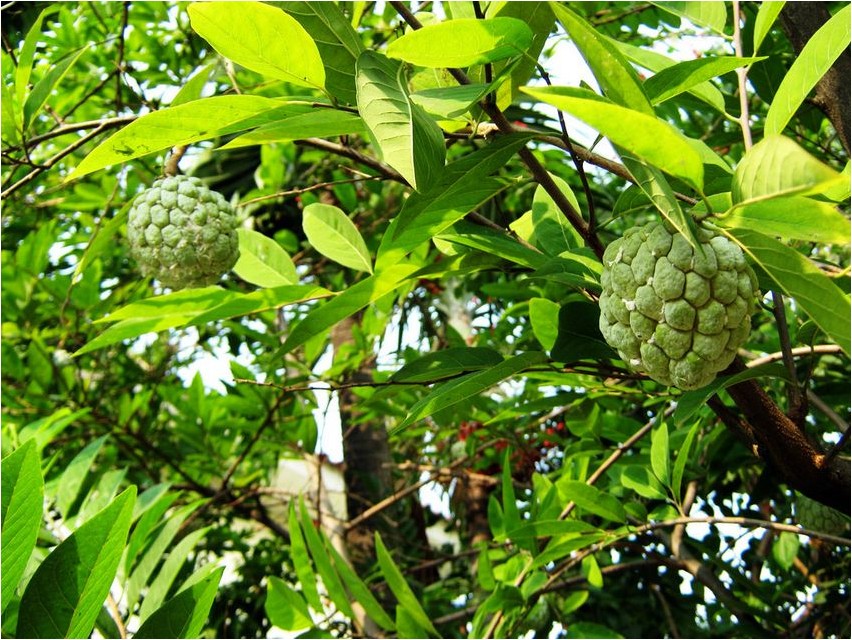
Sonkoya (lat. Annona purpurea) is a fruit tree belonging to the Annonaceae family, scientifically called Annona purpurea.
Description
Sonkoya is a small deciduous tree whose height can reach from six to ten meters. The tree trunks are short, and the oblong leaves of sonkoya are characterized by a two-row arrangement. The width of the leaves ranges from ten to fourteen centimeters, and the length — from twenty to thirty centimeters. And the rust-colored twigs of sonkoya are covered with tiny hairs. However, miniature reddish-brown hairs cover both sides of the leaves.
The fragrant flowers of this plant are characterized by fairly large sizes and grow singly from young leaf axils of trees. The corollas of the flowers are formed by three thin inner creamy-white petals and three outer yellow fleshy petals.
Sonkoya fruits are almost round or oblong in shape, and their diameter can vary from fifteen to twenty centimeters. On the outside, all fruits are covered with conical and rather hard growths. The fibrous and very aromatic pulp of sonkoya is colored orange or yellow and includes many elongated dark brown seeds. And the sweet and sour taste of the fruit is somewhat reminiscent of the taste of mango.
Where does it grow
The coastal lowlands of Venezuela, Colombia and Central America are considered to be the birthplace of soncoya. In these countries, this crop is grown in home gardens. True, these fruits, alas, are not particularly popular — and their excessively hard outer parts are to blame. However, in the Philippines (it is worth noting that this plant arrived there relatively recently) and Thailand, soncoya has managed to gain unprecedented popularity — in local markets during the season, these bizarre fruits can be seen literally everywhere. But in Costa Rica and Guatemala, soncoya is considered an “unhealthy” and bad fruit.
Application
The pulp of the Sonkoya fruit is eaten fresh, and various non-alcoholic and alcoholic drinks are prepared from it, or juice is squeezed out of it. This juice is an excellent remedy for colds and fever. Sonkoya seed extract is an excellent remedy for getting rid of fleas (by the way, the seeds of this plant are poisonous), and a decoction of the bark of this plant is drunk for dysentery, as it has disinfectant and astringent properties. If you make tea from the inner part of the sonkoya bark, you can get rid of swelling quite quickly.

The fairly high content of minerals and vitamins in sonkoya fruits determines its excellent antimicrobial and antiviral properties.
Sonkoya cannot boast of high calorie content — 100 g of fruit contains only 47 kcal.
Contraindications
There are no special contraindications to the use of Soncoya, although individual intolerance is sometimes possible. It is also not recommended to use soncoya if you have diabetes, since the fruit contains a lot of sugar.
When consuming soncoya, you must try to avoid getting its seeds into the body — they contain toxins that can seriously harm your health.
Growing
Sonkoya is a very heat-loving crop, so it can grow exclusively in the tropical zone. By the way, it can often be seen growing at an altitude of up to 1200 meters above sea level. A warm and fairly humid climate is the best conditions for the full development of Sonkoya.
Before planting sonkoya, its seeds are soaked for a day or two, after which they are planted in a moderately moist and well-drained soil mixture. And the seeds are germinated in a small greenhouse or in a bag at a temperature of twenty-four to twenty-six degrees.