Brussels sprouts
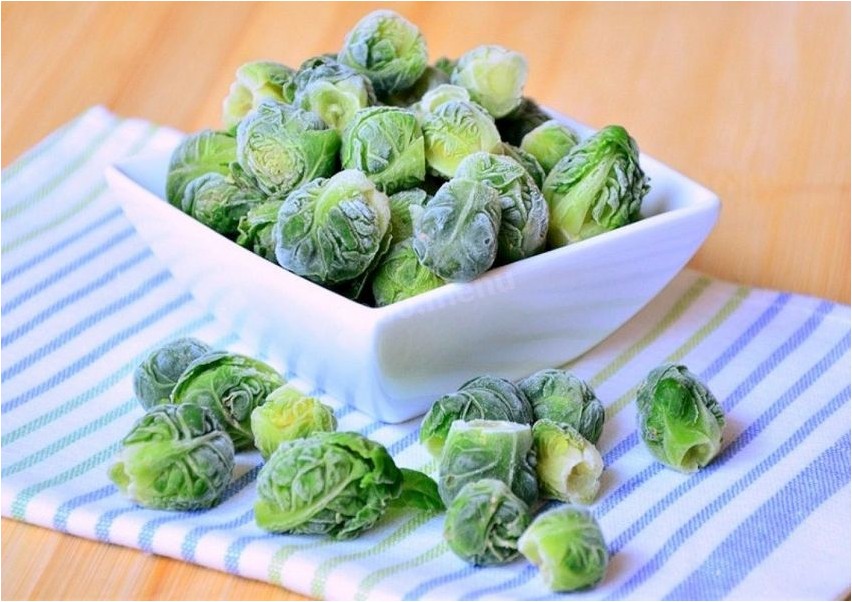
Brussels sprouts (lat. Brassica oleracea L. var. gemmifera) is a vegetable crop; biennial plant of the Cruciferous or Brassica family.
Brussels sprouts were first cultivated in the 18th century, but the exact origin of the plant is still unknown. Brussels sprouts are grown in large quantities in Western Europe and the USA. In Russia, the crop is grown mainly in the Non-Black Earth zone.
Characteristics of culture
Brussels sprouts are a biennial plant; in the first year of life, it forms a thick cylindrical stem up to 60 cm high with lyre-shaped small or medium-sized leaves located on thin petioles. The leaf blades are grayish-green or green, have a slight waxy coating, and the edges are slightly curved or spoon-shaped. In the axils of the leaves, as they grow, small heads of cabbage (the size of a walnut) are formed, up to 70 on one plant. The weight of heads collected from one plant is 0. 3-0. 5 kg.
In the second year, the plant develops strong branched flowering stems and flowers. The flowers are yellow, with raised petals, collected in racemes. The fruit is a multi-seeded pod. The seeds are very small, smooth, black or dark brown, and remain viable for 4-5 years. The growing season of Brussels sprouts lasts 120-140 days. The culture is cold-resistant, adult plants can easily withstand frosts down t o-7C.
Growing conditions

Sites for growing Brussels sprouts are preferably well-lit; even with the slightest shading, the plants develop poorly and produce a poor-quality harvest. The crop is not demanding regarding soil conditions; it grows without problems in poor and slightly acidic soils. The secret to growing Brussels sprouts is temperature. The optimal temperature for the formation of a good harvest is 18-20C. At temperatures above 25C, plants stop growing. Brussels sprouts react negatively to thickening and strong winds.
Reproduction and planting
Brussels sprouts are propagated by seeds. The crop is grown exclusively by seedlings. Seeds are sown in mid-March in special seedling boxes. When 2-3 true leaves appear on the seedlings, the seedlings are planted in separate pots. Seedlings are transplanted into open ground at the end of May; it is advisable to carry out this procedure in the evening or in cloudy weather.
The soil for growing Brussels sprouts is prepared in the fall: the soil is dug up, compost and mineral fertilizers are added; In the spring the ridges are loosened. Seedlings are planted in shallow holes, deepening to the cotyledon leaves. The distance between plants should be 40-50 cm, and between rows — 60-70 cm. For the first 2-3 days, young plants are shaded.
Care
Brussels sprouts need regular and moderate watering; the soil should not be allowed to dry out. The culture responds positively to fertilizing with organic fertilizers, for example, humus and wood ash, as well as mullein solution or nitroammophoska.
Brussels sprouts grow very slowly, so early tomatoes and other vegetable crops can be planted between the rows. At the end of August — beginning of September, when the heads of cabbage reach the size of a pea, the tops of the plants are broken off. This agrotechnical technique allows the crop to direct all the necessary substances to the development of heads of cabbage, and not to the growth of the plant as a whole.
Harvesting and storage
Harvesting occurs when the lower heads of cabbage reach the size of a walnut and acquire a specific shine, and the leaves turn yellow, as a rule, this happens at the end of September. The heads of cabbage are harvested in 2-3 terms; they begin to be broken out from the bottom. Store Brussels sprouts in baskets or wooden boxes at a temperature of 0-1C and a humidity of 80-90%. The heads of cabbage can also be frozen. To obtain seeds, plants are dug up by the roots, planted in containers and stored in a cellar or basement until spring.





