Geneva’s tenacious
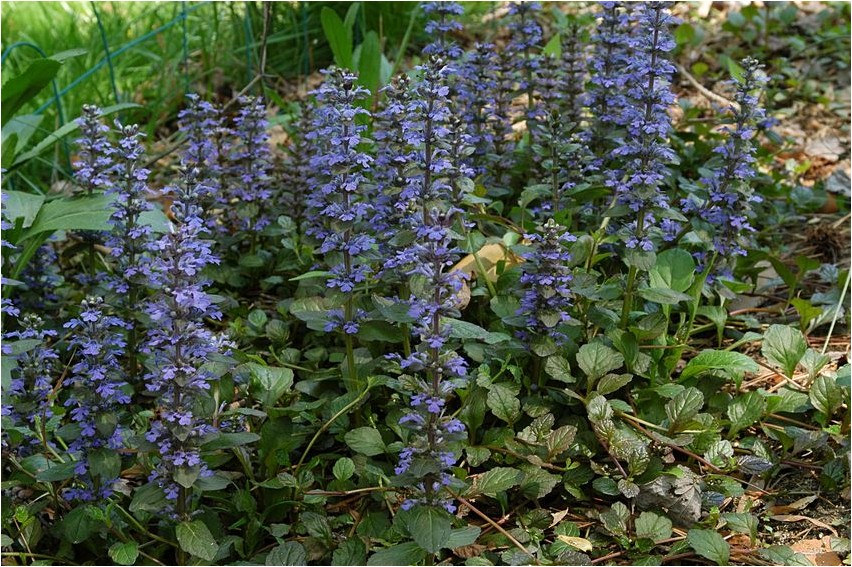
Geneva’s tenacious is one of the plants of the family called Lamiaceae; in Latin the name of this plant will be as follows: Ajuga genevensis L.
As for the name of the Geneva tenacious family itself, in Latin it will be like this: Lamiaceae Lindl.
Description of the Geneva survivor
Geneva’s tenacious plant is a herbaceous plant whose height can reach fifty centimeters. The basal leaves of this plant will be either obovate or spatulate in shape; they can be either coarsely crenate-toothed or distantly crenate-toothed, sometimes such leaves can be entire. The lower stem leaves are oblong, and in the upper part they are separately crenate-toothed. The bracts of this plant are large, three-toothed or three-lobed; in shape they can be broadly ovate or ovate. The flowers of the Geneva plant are colored blue. The fruits are nuts, the length of which reaches only three millimeters. Such fruits will be hairy, sharply net-wrinkled and dark brown in shape.
Flowering of the Geneva tenacious occurs during the period from April to July. Under natural conditions, this plant can be found throughout the entire European part of Russia, with the exception of the Dvina-Pechora, Lower Volga and Karelo-Murmansk regions. The plant is also found in Moldova, Belarus, the Caucasus, Ukraine and Central Asia in the Syrdarya region. As for the general distribution, the plant is found throughout Europe, with the exception of the Arctic, as well as in the Mediterranean, Asia Minor, Armenia, Iran, China, Afghanistan and the Balkan Peninsula.
Description of the medicinal properties of the Geneva survivor
The Geneva plant is endowed with very valuable medicinal properties, and it is recommended to use the leaves and grass of this plant for medicinal purposes. The concept of grass includes flowers, leaves and stems. The presence of such valuable healing properties is explained by the content of essential oil, aucubin, flavonoids, tannins, harpagide and phytol in the plant.
The plant can be used as a hemostatic, wound-healing, anti-inflammatory agent, and is also used for malaria and metrorrhagia. It is noteworthy that both the extract and the juice of the Geneva tenacious are endowed with hemostatic properties, which can not only activate the contractile activity of the myometrium, but will also increase intestinal motor activity.

An infusion of the herb of this plant is used in the treatment of stomach ulcers, diarrhea, hemoptysis, bronchitis, epididymitis and rheumatism. The plant is also used for ulcers, burns, wounds, sore throats and stomatitis. As for the decoction of the leaves, it is recommended to drink it for fever, pulmonary tuberculosis and dysentery. Externally, this decoction is used to enhance hair growth, and baths are used for asthenia.
In folk medicine, such an external remedy, as a decoction prepared from the grass of the Geneva plant, is used for bone fractures, as well as for injuries, for heat from carbuncles and poisons, and also for painful tumors from blows.
For all the above diseases, as well as to enhance hair growth, the following remedy is used: to prepare it, take three tablespoons of dry crushed leaves per two glasses of water. The resulting mixture is boiled for three to four minutes, and then infused for two hours and filtered very carefully. For illnesses, take this remedy half a glass or one third of a glass three times a day. To enhance hair growth, the product is used externally.





