Vriesia
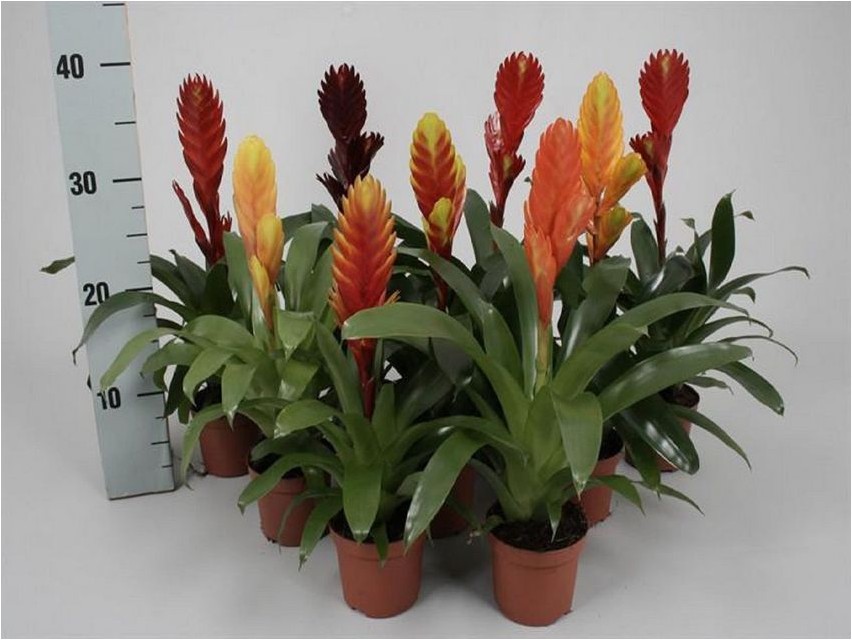
Vriesea is a fairly popular plant that belongs to the bromeliad family. The genus itself contains about 250 plant species.
Under natural conditions, such plants can be found in the tropics of South and Central America. These plants are both terrestrial and those that grow on tree trunks and snags.
Today, more than one hundred and fifty different types of Vriesia are available for cultivation indoors. These plants are particularly impressive; they have rather hard leaves, the length of which varies between twenty and eighty centimeters. These leaves form a kind of rosette, in the center of which there is a funnel. These leaves can be colored in different tones: pale green, marbled, spotted or red-brown.
During the flowering of the plant, in the center of the rosette you can notice a peduncle, endowed with an inflorescence-spikelet, which will be surrounded by red or yellow bracts. Vriesia inflorescences can be varied: both single-colored and multi-colored, both simple and branched. Actually, the flowers of this plant themselves are not particularly decorative, and also fade quite quickly. However, the bracts of Vriesea are particularly attractive in appearance.
The flowering of the plant begins in winter, which is explained by the fact that summer reigns at this time in the homeland of this plant. After the flowering period ends, the plant itself dies, leaving behind shoots that should be planted in separate pots. Flowering of young plants will begin approximately in the third year of their development.
Growing and caring for Vriesia

As for lighting, you will need a well-lit place, but in the summer the plant should be protected from direct sunlight. The optimal solution would be to place the vriesea on the eastern and western windows, however, northern windows may also be suitable.
Actually, being a tropical plant, Vriesea needs warm and humid air. In summer, the temperature should be kept between twenty-two and twenty-seven degrees Celsius, but in winter the thermometer should not fall below eighteen degrees Celsius. Temperature changes and drafts can cause significant harm to this plant, which should not be forgotten. In winter, it is not recommended to keep the plant on a cold windowsill, otherwise the vriesia may simply die.
So, Vriesia will require high air humidity. For this reason, in the summer, the plant should be sprayed with water at room temperature. In the case when the plant has already formed a peduncle, it should be sprayed very carefully, while avoiding contact of water and the peduncle. In winter, the pot with the plant should be located at a very significant distance from the battery, and air humidification should also be provided. The optimal solution would be a tray filled with small pebbles and water.
Watering should be done directly into the leaf funnel itself. The water should not contain even a minimal amount of lime and should not be cold. In summer and spring, when the temperature is above twenty degrees Celsius, a constant presence of water in the rosette of leaves will be required. However, as soon as the cold weather sets in, there should not be such stagnation of water. Once a month, the water from the funnel should be changed and fresh water added.
The soil for this plant needs to be moist, but in no case should the soil be wet. In winter, watering will be required infrequently as the soil dries out. It is also important to remember that excessive amounts of moisture can be detrimental to this plant.