Japanese cabbage
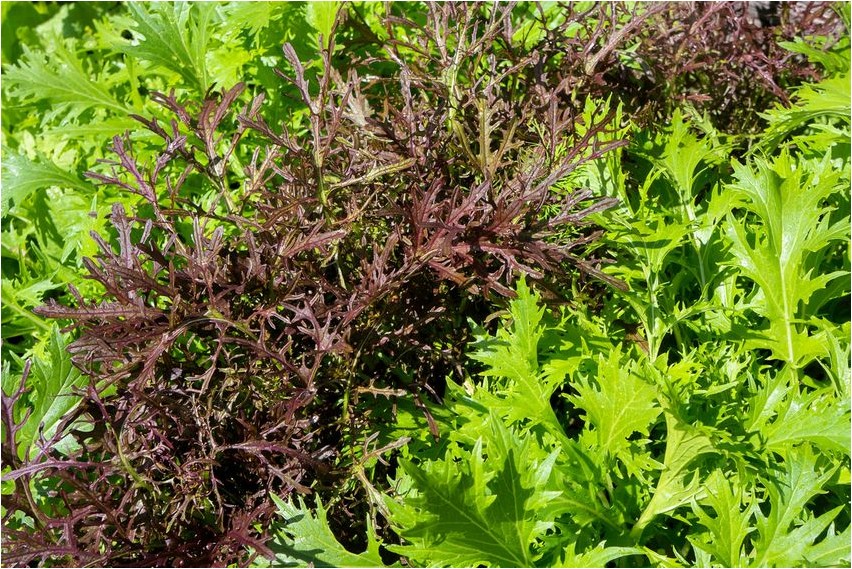
Japanese cabbage (lat. Brassica rapa var. Japonica) is a valuable vegetable crop; herbaceous plant of the Cruciferous or Brassica family.
Widely used in cooking and ornamental gardening. Cultivated mainly in China and Japan, in Russia it is grown on personal plots. The chemical composition of the crop is similar to Chinese cabbage and Chinese cabbage, the difference lies in the lowest content of mustard oils.
Characteristics of culture
Japanese cabbage is an annual or biennial plant, which during the growth process forms a rather large spreading leaf rosette, reaching a diameter of up to 90 cm. Thanks to the awakening of the apical buds, the plant is able to grow back even after cutting. Currently, there are two forms of Japanese cabbage — Mizuna and Mibuna. Mizuna is represented by plants with leaves cut into lobes, the length of which varies from 15 to 30 cm. Externally, the leaf blade is similar to celery. Mibuna is distinguished by its lanceolate-shaped leaves. Both species produce dark green or green, smooth, petiolate flowers. Most often, Japanese cabbage is grown as an annual crop, but the plant is prone to forming roots (subject to a two-year cycle). The fruits are conical and large, up to 7 cm in diameter. The pulp is tender and resembles rutabaga in taste.
Among the varieties of Japanese cabbage, one can note the Little Mermaid; this variety is popular among Russian gardeners and gardeners. The variety is mid-season, represented by plants with green, smooth, lyre-pinnate, serrated along the edges, leaves collected in a slightly raised or horizontal rosette. The variety is cold-resistant and easily tolerates heat. The first harvest of leaves is harvested after 50-55 days. Tastes good. Suitable for cultivation in open ground, resistant to flowering, sowing can be carried out throughout the entire gardening season. No less interesting is the early ripening variety Pidzhon, from the emergence of seedlings to the harvesting of leaves in only 30-35 days. Represented by plants with highly dissected leaves, collected in a horizontal rosette. Suitable for both open and protected ground.
Subtleties of cultivation
In Russia, the crop is grown primarily from seedlings, although a good harvest can also be obtained by sowing seeds in open ground. Japanese cabbage seeds are sown at several stages. The seeds germinate at temperatures of 3-5°C. The optimal growth and development temperature is 18-20°C. Young plants are resistant to short-term spring frosts. Soils for Japanese cabbage are preferable: fertile, loamy, well-drained, well-moistened, loose, and rich in organic matter and mineral fertilizers. A sunny location with filtered light is recommended. Dense shade is undesirable. The best predecessors are tomatoes, onions, cucumbers, beets, legumes, potatoes, and perennial grasses. It is not recommended to grow cabbage after members of the Cruciferae family. Sow seeds in row strips, spacing them at least 70 cm apart, and 40 cm between rows. Standard seedbeds with a 60 x 40 x 40 cm pattern are also suitable (this method is also successful for planting Japanese cabbage seedlings). Seedlings emerge in 3-4 days. Thin out densely packed rows when the seedlings reach 3-4 true leaves. Care consists of fertilizing, watering, loosening the soil, and weeding. Two fertilizing sessions per season are sufficient, but only if humus or compost, superphosphate, and potassium sulfate are added during digging. Be very careful with nitrogen fertilizers, as the plants tend to accumulate nitrates. Watering should be regular, as plants wilt when they lack moisture. Overwatering is unacceptable. Like all cruciferous plants, Japanese cabbage is often affected by flea beetles, which requires immediate treatment.
Uses

Japanese cabbage is rich in vitamins, macro- and microelements, and is used in vegetable salads, sandwiches, and other dishes. Fresh cabbage leaves pair harmoniously with feta cheese, various types of meat, and fish. The leaves are eaten both fresh and pickled. In ornamental gardening, the plants are used to decorate flower beds and borders.
Japanese Cabbage