Walnut
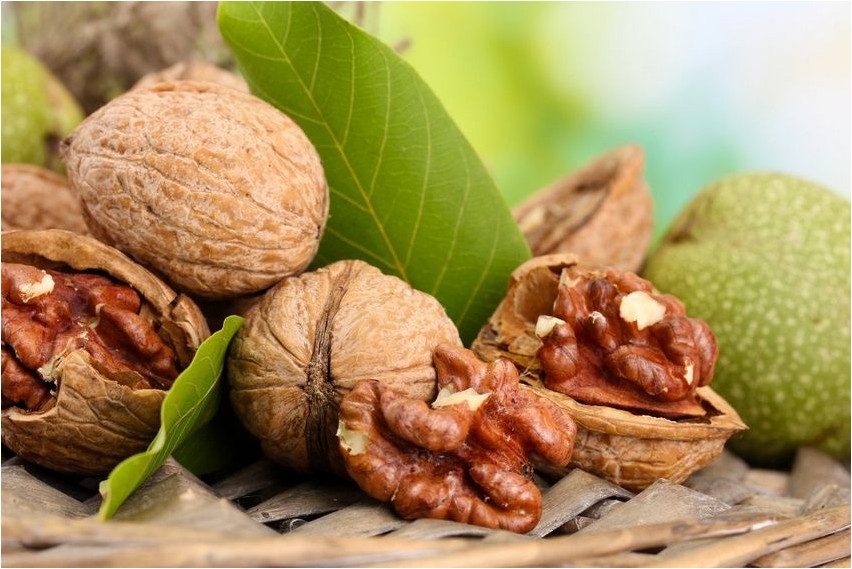
Walnut (lat. Juglans regia) is a species of trees of the genus Walnut of the Walnut family. The plant is known under the names of royal nut, Voloshsky nut, mahogany, and Greek nut.
In nature, walnuts are found in Northern China, the Tan Shan, Transcaucasia, India, Iran and Greece. Walnuts also grow in some Western European countries. In Russia, the plant is cultivated in small quantities, which is associated with cold winters. For example, in St. Petersburg, walnuts do not freeze completely, but you rarely see them in the form of a real tree. The main suppliers of walnuts are the USA, Türkiye and China, as well as Ukraine and Moldova.
Characteristics of culture
Walnut is a tree from 4 to 25 m high with a dense, wide-rounded crown and gray bark. The leaves are compound, alternate, imparipinnate, consist of 4, 6 and 8 pairs of elongated ovoid leaflets; the leaves bloom simultaneously with the flowers. The flowers are small, monoecious, light green. Staminate flowers are collected in pendant catkins, and pistillate flowers are single or in groups on the tops of annual branches. The fruit is a large single-seeded drupe with a thick leathery-fibrous skin and a strong stone.
Growing conditions
It is not recommended to grow walnuts on heavy, damp, swampy and saline soils. Deeply cultivated, loose, sandy-stony soils rich in lime are optimal. Other soils are also suitable, the main thing is to provide them with good drainage and sufficient moisture. The beautiful spreading crown of walnuts and high-quality fruits are formed exclusively in sunny areas. Plants develop worse in the shade. The culture has a negative attitude towards thickening; the distance between plants should be at least 5 m. When planting trees on slopes, you can limit yourself to an interval of 3. 5 m.
Site preparation
The further development of the crop depends on the preparation and cultivation of the soil in the area where it is planned to grow walnuts. Improperly tilled or poorly prepared soil will affect the quality and quantity of the harvest. In areas with a shallow fertile layer, the soil is replaced or additional fertilizer is applied. To do this, a large amount of rotted manure, ash and superphosphate mixed with the top layer of soil is added to the bottom of a planting hole 80 cm deep. In the future, the top layer of soil is changed annually along the width of the tree crown.
Reproduction and planting
Walnuts are propagated by seeds, winter budding and grafting. Seeds are sown in spring or autumn. Planting depth is 8-10 cm. It is better to purchase seeds in specialized stores or nurseries. In the first year, walnut seedlings grow very slowly and by autumn reach a height of 30-35 cm. Such specimens are also suitable for grafting; only one thing is important: the thickness of the trunk near the root collar should be at least 12-15 mm. Seedlings are stored in damp sawdust in a room with a temperature of about 2-5C. Vaccination is carried out from December to March. Before carrying out the procedure, the root system of the rootstock is thoroughly cleaned of soil and sawdust.

It is possible to grow high-quality walnut seedlings, which will subsequently produce good fruit yields, using winter grafting, carried out in three stages. Budding in nurseries gives best results in areas with humidity around 65-70%. Spring budding is not prohibited. For this purpose, buds taken from annual shoots of the previous year are used. Budding is carried out using a ring-tube or shield. In general, for beginners in gardening, it is advisable to use the seed method; it is simpler, but no less effective. Plants grown by sowing seeds bloom in 8-12 years, at which time they produce their first fruits. Grafted seedlings begin to bloom at the age of three. Walnuts bear fruit for up to 500 years.
Care
Walnut is unpretentious in care. Watering is carried out in the spring-summer period (at least 2 times a month, 30 liters of water per square meter), watering is especially important during a long drought. Trees 4-5 meters high can be watered more intensively. The crop does not need formative prunings, but sanitary prunings will not do any harm. In spring, pruning is not recommended, since the plants lose a lot of juice, which will subsequently negatively affect growth and development. It is better to prune in two stages in the summer, for example, in early June. In the first year, part of the damaged branch is cut off, leaving a twig 6-7 cm long, and the next year the twig itself is removed, and the cut is covered with garden varnish.
Fertilizing for the crop is vital; two feedings per season are enough. In early spring, walnuts are fed with nitrogen fertilizers, in the fall — with potassium and phosphorus. The amount of fertilizer used depends on the age of the tree, for example, a nut aged 20-50 years needs 5-7 kg of ammonium nitrate, 2-3 kg of potassium salt and 7-10 kg of superphosphate. In the first 2-3 years of walnut fruiting, it is better to avoid applying nitrogen fertilizers.