cucumber
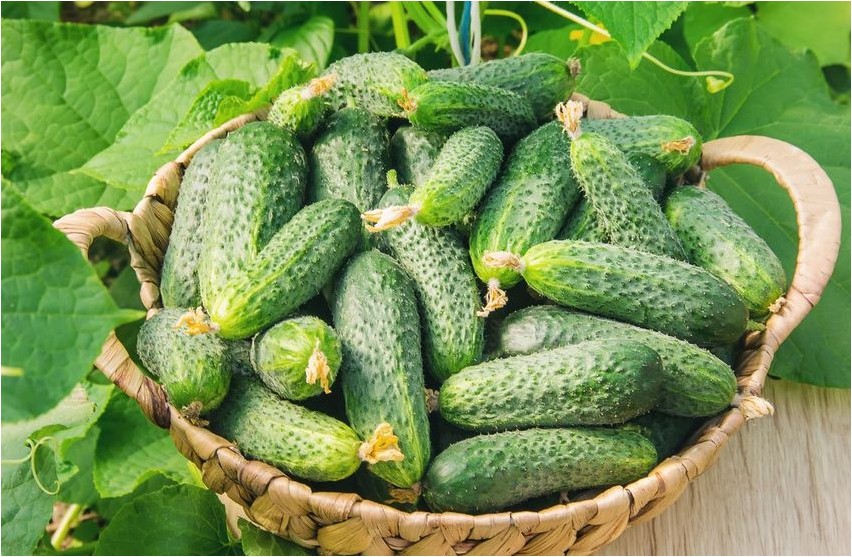
Cucumber (Cucumis sativus) is a popular vegetable, an annual herbaceous plant that belongs to the extensive Cucurbitaceae family.
History
People have been growing cucumbers for thousands of years. It was first cultivated in Southeast Asia. Then the cucumber, like other pumpkin plants, came to America and Europe. Since those distant times, the popularity of the vegetable has not diminished at all. It is actively used in cooking in different countries of the world on different continents.
General characteristics
Cucumber is one of the cross-pollinating plants. It is distinguished by a developed, branched root system. In this case, most of the roots are located at a depth of twenty to forty centimeters. Most varieties have a liana-like, highly branched stem. Cucumber has petiolate leaves with different shaped blades. Flowers are axillary, dioecious. Cucumber is a monoecious plant. There are varieties in which more than 50% of the plants have almost only male or female and bisexual flowers. Many parthenocarpic hybrids produce seedless fruits.
The length of the fruit varies — on average from five to thirty or more centimeters. Cucumbers have white seeds. If the seeds are stored correctly, they do not lose their viability for about a decade.

The popularity of the vegetable has led to the emergence of numerous varieties. They differ in many characteristics — purpose, ripening time, duration of the growing season, etc.
Rules of care
Cucumbers are quite demanding on growing conditions — the degree and nature of illumination, watering, temperature, soil nutrition, etc.
Temperature For successful seed germination, a soil temperature of approximately 12-15°C is required. However, this is not the most favorable temperature. The most optimal temperature for cucumbers is 25-30°C. But when frosts occur, even small and short-term ones, cucumbers have almost no chance to survive. Even at a temperature of 10°C, they stop growing, get sick and do not bear fruit. So the best temperature for cucumbers will be 25-31°C for air and 21-25°C for soil.
Humidity . However, cucumber is demanding not only in terms of temperature, but also in terms of humidity. When growing crops in open ground, the optimal humidity is 76-80%, in protected ground — about 86-90%. The humidity should not be allowed to fall below 75-80%. A guarantee of a rich harvest of cucumbers is watering evenly in time and amount of water and good soil warming.
As for early ripening varieties, you can count on a good harvest if you plant the seeds in the ground early. The most successful option would be to use frame film shelters, as well as cultivate vegetables on a trellis.
Choosing a location. When choosing where to plant cucumbers, it is important to consider that the place should be well protected from the wind. Sun access is also required. The soil should be nutritious and loose. If there is a large choice, give preference to a place where early vegetables used to grow. Cucumbers should not be sown in the same place. It is necessary to wait a pause of two to three years. The soil after other crops belonging to the pumpkin family, namely melon, watermelon, zucchini, pumpkin, and squash, is also considered unfavorable. This is explained by the fact that pumpkin plants often get sick, and the “infection” continues to remain in the ground.
Sowing. For sowing, it is recommended to take two-year or three-year-old seeds. Plants produce more female flowers, and this happens quite early. Seeds need to be prepared as follows. First of all, they need to be heated at a temperature of 60°C for two hours. Next, you should select the seeds according to their specific gravity in a solution of table salt (3-5%). When the seeds fall to the bottom, the solution must be drained, and the seeds should be washed with running water and dried a little. It is important to carry out disinfection in advance, using a solution of potassium permanganate (1 liter of water — 10 g) for this purpose, and then rinse with plain water.
Fertilizers. Cucumbers respond well to the use of organic fertilizers. In the autumn, during digging, you need to add humus or rotted manure (approximately 6-9 kg/m2). It is important to remember that if you do this in the spring, and even in significant doses, you can lose part of the harvest — the plant will bear less fruit, the quality of the cucumbers will deteriorate, and voids will appear in the greens. So compost, humus, and half-rotted manure will be more favorable.
It is better to sow cucumbers early — at a depth of four to five centimeters. The soil should be moist. The seeding rate is 0. 3-0. 5 g/m2. During sowing, you need to maintain a distance of 25-40 cm. It is recommended to loosen the soil between the seedlings quite deeply (about 10 cm deep).
It is recommended to hill up the crop, as they quickly form adventitious roots, which increase plant nutrition. You need to loosen the soil (6-8 cm) and weed as the soil compacts and weeds appear.
Watering. Cucumbers love moisture, so they need to be watered about once a week. If the weather is hot, it can be done daily. Cucumbers require plenty of water during the fruiting period. Watering is best done in the morning and afternoon. After morning dew and rain, it is recommended to spray the plant with water. The water should be at room temperature; cold water is best avoided. Cucumbers need to be watered generously. It is recommended to use up to 20 liters per meter, but the water should be applied gradually. When the cucumber”s third true leaf appears, it is recommended to apply fertilizer (liquid potassium and nitrogen fertilizers). This will improve the plant”s protection against fungus.
It is best to harvest cucumbers in the morning or evening. To do this, gently press the stem with your finger.
It is important to promptly remove diseased and defective fruits.
To obtain seeds, wait until the cucumbers are fully ripe. The seeds are collected by hand, along with the juice, left in a container to ferment for a couple of days, then washed and dried. https://www. youtube. com/watch? v=UdVq_Irsn_8
Cucumber cucumber