Meadow salsify
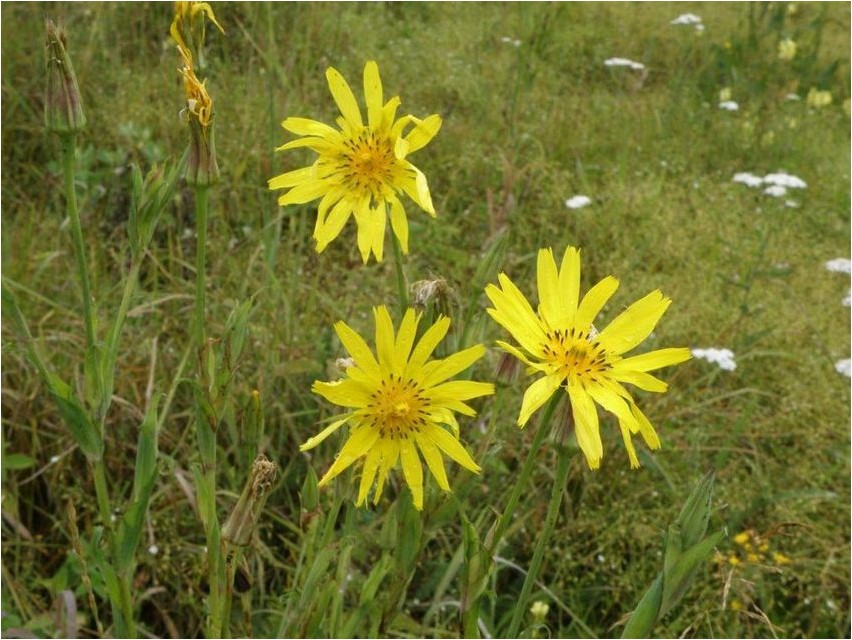
Meadow salsify is one of the plants of the family called Asteraceae or Asteraceae; in Latin the name of this plant will be as follows: Tragopogon pratensis Scop.
As for the name of the meadow salsify family itself, in Latin it will be like this: Asteraceae Dumort.
Description of the meadow salsify
Meadow goatbeard is also known by the following popular names: milkman, devil’s beard, Kozlov’s beard, kakish, goby, cochet, kosmatik, kudryavka and many others. Meadow salsify is a biennial herbaceous plant. The stem of this plant will be erect and weakly branched, its height will be about thirty to one hundred and twenty centimeters. Such a stem will be endowed with one tap root. The leaves of salsify are sessile and stem-encompassing; they can be either linear-lanceolate or linear. The leaves are also pointed and entire. The flowers of this plant are painted in yellow tones, they are endowed with baskets that will be equipped with wrappers. The leaves of the salsify involucre are arranged in one row, and all the flowers of this plant are ligulate. There are only five stamens, the lower ones will be free, the anther is welded into a tube through which the style will pass. The ovary of the meadow salsify is unilocular and inferior; it will be single-seeded, endowed with one stalk and a branched stigma.
The fruit of the meadow salsify is an achene endowed with a feathery pappus. Flower baskets after flowering will form rather large fluffy balls, which will be very reminiscent of faded dandelion baskets. Under natural conditions, this plant is found in the European part of Russia, the Baltic states, Belarus and the Carpathians in Ukraine. For growth, the plant prefers forest clearings, places along roads, meadows and exposed limestone.
Description of the medicinal properties of salsify
Meadow salsify is endowed with very valuable healing properties, and it is recommended to use the roots, milky juice and leaves of this plant for medicinal purposes. The leaves and juice of meadow salsify should be collected from May to July, and the roots are collected in the autumn.
The presence of such valuable healing properties should be explained by the content of triterpenoids, flavonoids, rubber, isoinositol, ceryl alcohol, inositol, vitamin C and D-mannitol in this plant. The flowers of this plant contain lutein, carotenoids, trans-betataraxanthin, xanthophyll, violoxanthin, flavoxanthin and auroxanthin. Salsify seeds contain fatty oil and alkaloids.

Meadow salsify is endowed with wound-healing, anti-inflammatory, antiseptic, diuretic and antiscorbutic effects.
It is noteworthy that this plant is used only in folk medicine. A decoction of the roots and stems of salsify should be used as an antiscorbutic agent, and a decoction of the root is used as an expectorant for bronchitis, catarrh of the upper respiratory tract and cough. In addition, such a decoction of the roots of this plant is used as a diuretic for kidney stones and various skin diseases.
The aerial part of salsify can be used in the form of compresses as a wound-healing and absorbable agent for phlegmon, tumors, as well as purulent wounds and ulcers. It is noteworthy that freshly ground stems and roasted roots of this plant can be used as food, while the roasted roots are also used as a coffee substitute.





