Rapunzel bell
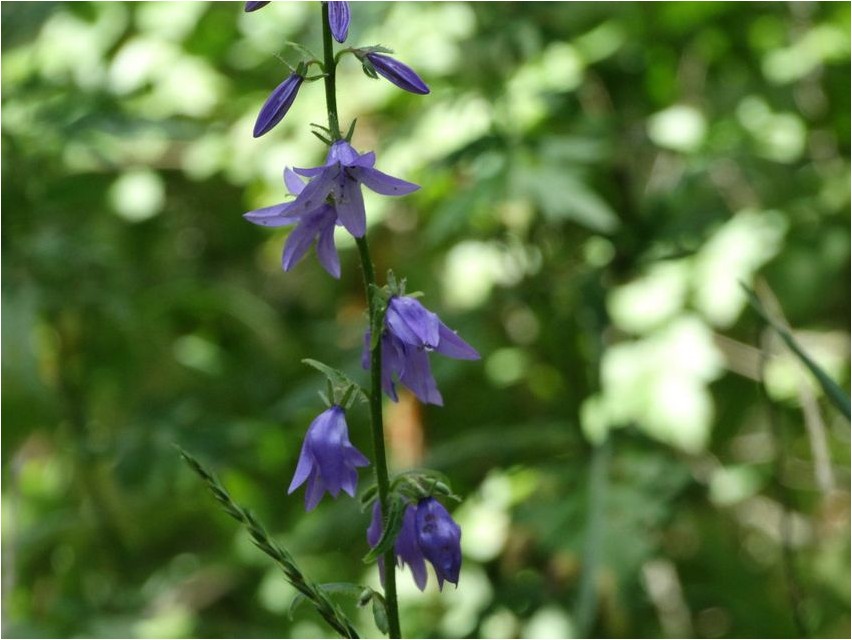
Rapunzel bell is one of the plants of the family called bellflowers; in Latin the name of this plant will be as follows: Campanula rapunculoides L.
As for the name of the bellflower family itself, in Latin it will be like this: Campanulaceae Juss.
Description of Rapunzel bell
The rapunzel bell is a perennial herbaceous plant, the height of which will fluctuate between thirty and one hundred centimeters. The root of this plant is thick and branched, and sometimes it can also be endowed with rather long underground shoots. Most often, the stem of the bellflower is simple and straight, but it will also be slightly ribbed. The inflorescence of this plant will be racemose and quite long, and also one-sided. The length of the rapunzel bell flowers will be about two to two and a half centimeters; such flowers will be on short pedicels. The teeth of the calyx are linear-lanceolate, the flowers will be single, drooping and they are painted in blue-violet tones.
The flowering of the rapunzel bell occurs in the period from June to August. Under natural conditions, this plant is found in the Don and Black Sea regions of the European part of Russia, in Crimea, in the Dnieper region of Ukraine, in the Ciscaucasia and in Moldova. For growth, the plant prefers places along roads, meadows, forest edges, fallow lands and bushes. It should be noted that the rapunzel bell is not only an ornamental plant, but is also a perganos.
Description of the medicinal properties of bellflower
The rapunzel bell is endowed with very valuable healing properties, and for medicinal purposes it is recommended to use the roots and juice of the above-ground part of this plant. The presence of such valuable healing properties should be explained by the content of the following carbohydrates in the roots of this plant: inulin and trisaccharides. The grass contains flavonoids and luteolin, and the leaves contain rubber.
In folk medicine, a decoction made from the roots of this plant is quite common. This decoction of Campanula rapunzelis roots is recommended for oral tumors and throat tumors. The juice of this plant’s herb is used as a lactogenic agent and is also used for ascites. The juice of Campanula rapunzelis leaves is used for a fairly effective wart removal. Young shoots and roots of this plant are edible.

It should be noted that Campanula rapunzelis is also a forage plant; feeding it to animals will increase milk production.
For throat tumors and oral tumors, the following remedy based on this plant is recommended: to prepare this remedy, take three tablespoons of crushed Campanula rapunzelis roots and two glasses of water. The resulting mixture is recommended to be boiled for approximately six to seven minutes and then left to steep for approximately two hours. Afterward, it is crucial to thoroughly strain this herbal mixture. Take the resulting mixture three to four times daily, half a glass at a time, or half a glass at a time. It should be noted that to achieve maximum effectiveness, it is crucial to strictly follow both the preparation instructions and the directions for use.