Maiden grapes
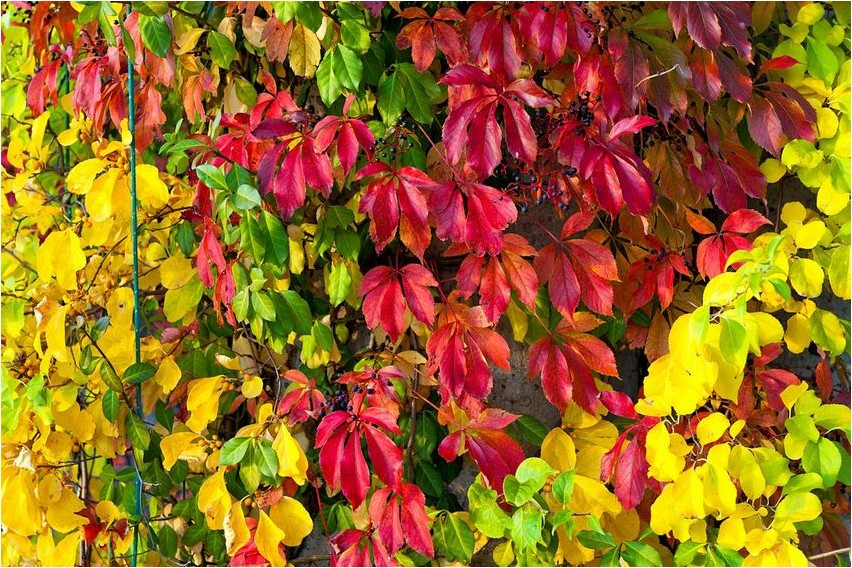
Maiden grape (lat. Parthenocissus) is a genus of deciduous and evergreen vines of the Grape family. The genus has about 12 species, distributed in North America, the Himalayas and Asia.
Some species are used to decorate the walls of houses, outbuildings and fences; their berries are inedible. The most common of them is considered to be the five-leafed virgin grape, or Virginia grape (lat. Parthenocissus quinquefolia). A distinctive feature of virgin grapes is its ability to form berries without pollination.
Characteristics of culture
Maiden grape is a large climbing vine up to 20 m long. The shoots are covered with dense bark over the entire surface. The leaves are compound, palmate, less often three-lobed, and sit on long petioles. In autumn, the leaves acquire a bright and beautiful color, which depends solely on the species. The antennae are highly branched, wrapping around the support; they can be thickened and expanded into oval-shaped suckers, which firmly adhere to the support. The flowers are small, collected in corymbose inflorescences, do not have antennae, and are formed in the axils of the leaves or opposite the leaves. The fruit is a dark blue or blue-black berry with a bluish coating, inedible or inedible.
Growing conditions
Maiden grapes are a highly decorative plant, undemanding to soil conditions, resistant to adverse weather conditions, winter-hardy and shade-tolerant. Despite their unpretentiousness, more decorative vines can only be obtained in intensely lit areas with fertile, loose, moderately moist and neutral soil. Maiden grapes are relatively frost-resistant, but in severe winters the shoots may freeze, but with the onset of warmth they quickly recover. The plant is durable and practically not affected by pests and diseases.
Reproduction and planting
Maiden grapes are propagated by seeds, offshoots and cuttings; the last two methods are the most effective. Cuttings can be carried out from spring to mid-autumn. I cut cuttings from last year”s woody shoots. The optimal length of the cutting is 10-15 cm. And each cutting should have small outgrowths; if they are absent, rooting will be greatly delayed.

Propagation by green cuttings is also not prohibited. The cuttings are planted in pots or any other containers filled with peat-clay substrate. Until a good root system appears, the soil in the substrate in pots is regularly moistened. The rooted material is transplanted into open ground next spring.
When propagating virgin grapes, select a healthy shoot 1. 5 to 3 m long and place it in a groove 3-5 cm deep. It is advisable to add a small amount of peat to the groove. Отводок засыпают и пришпиливают деревянными скобами. The leaves of the layer should not be covered; they should remain on the surface of the soil. For successful rooting, it is important to systematically water. After 1-2 years, the rooted cuttings are separated from the mother plant and planted in a new location.
The seed method is no less effective, but quite labor-intensive. Caring for seedlings takes much more time than caring for cuttings or layering. It is preferable to sow freshly harvested seeds. Planting depth is 1-2 cm. Before planting, the seeds are soaked in water for 24 hours. When sowing in spring, seeds require stratification.
Care
Caring for virgin grapes is simple; it consists of rare watering, weeding and loosening of the stem zone. Fertilizing has a positive effect on crop development. Two feedings per season are sufficient: the first is carried out in early spring, and the second in mid-summer. Due to the fact that virgin grapes are characterized by rapid growth, the gardener”s main assistant will be a pruner.
Formative pruning must be carried out from the first year, otherwise, instead of a beautiful decorative vine, you can get a shapeless green mass that is not particularly attractive. Sanitary pruning is carried out in early spring; it involves removing frozen, diseased and dry shoots. The cut is made over a healthy kidney. Maiden grapes need stable support. Young shoots, as they grow, are manually thrown onto a support, directing them in the desired direction. Crooked and thickening shoots are removed.