Sundew rotundifolia
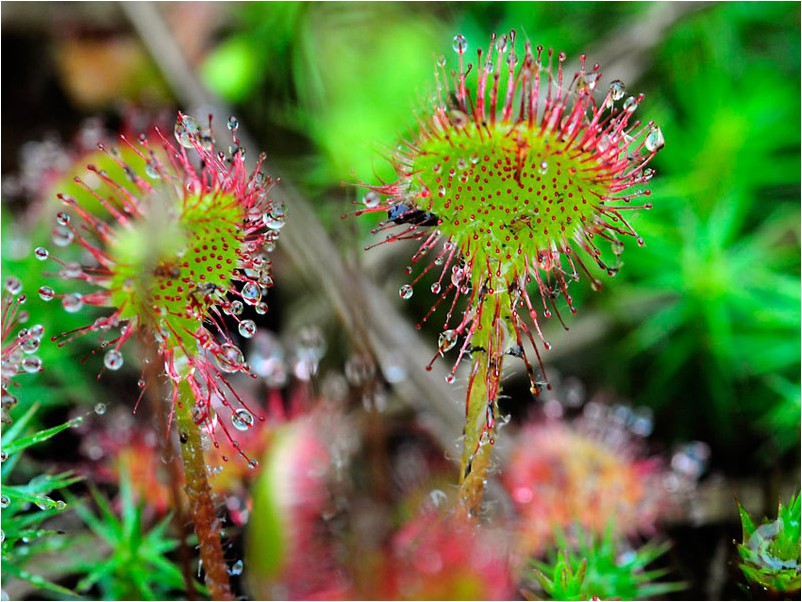
The round-leaved sundew is one of the plants of the family called Sundewaceae; in Latin the name of this plant will be as follows: Drosera rotundifolia L.
As for the name of the round-leaved sundew family itself, in Latin it will be: Droseraceae Salisb.
Description of sundew rotundifolia
Sundew rotundifolia is known by the following popular names: love-grass, crabgrass, sundew, crabgrass and crabgrass. Sundew rotundifolia is a herbaceous insectivorous plant whose height will vary between seven and twenty-five centimeters. The leaves of this plant are basal, prostrate, long-petiolate with a rounded blade, the diameter of which is approximately one centimeter. Such a plate of round-leaved sundew will be covered on the upper side with reddish glands that secrete a sticky liquid. The fruit of this plant is a multi-seeded capsule that will open with three doors.
Round-leaved sundew blooms from the end of July to the end of August. Under natural conditions, this plant is found on the territory of Belarus, the forest zone of Ukraine, the forest zone of Russia, Central Asia and the Caucasus. To grow, round-leaved sundew prefers the banks of forest streams and peat bogs. Notably, this plant is poisonous to cattle and sheep.
Description of the medicinal properties of sundew rotundifolia
The round-leaved sundew is endowed with very valuable healing properties, and for medicinal purposes it is recommended to use the entire above-ground part of this plant along with a rosette of basal leaves. It is recommended to harvest such medicinal raw materials throughout the entire flowering period of this plant. In addition, it is quite acceptable to use roots, which should be harvested during the autumn period.
The presence of such valuable healing properties should be explained by the content of tannins and dyes, anthocyanic acid, organic and phenolcarboxylic acids, ascorbic acid, naphthoquinone derivatives, as well as a proteolytic enzyme, the action of which will be similar to pepsin.

Round-leaved sundew possesses highly effective diuretic, antispasmodic, sedative, antispasmodic, expectorant, anti-inflammatory, bactericidal, and antipyretic properties. Drinks and tinctures made from round-leaved sundew are recommended for pharyngitis, pneumonia, bronchial asthma, laryngitis, whooping cough, fevers, and acute and chronic bronchitis.
In addition, round-leaved sundew has the ability to inhibit the growth of bacteria and fungi. It is noteworthy that before the advent of antibiotics, this plant was used to treat pulmonary tuberculosis. In folk medicine, this plant is quite widespread. Traditional medicine uses this plant as an antiepileptic, mild diaphoretic, and antiemetic. For bleeding and diarrhea, it is recommended to use an infusion made from the rhizomes of the round-leaved sundew. This infusion can also be used as a diaphoretic. For faster healing of both hemorrhoids and wounds, it is recommended to apply crushed round-leaved sundew to the affected areas. For periodontal disease, a decoction made from the herb and rhizomes of this plant is used.
How the sundew catches mosquitoes. Microhistory.





