Weigela
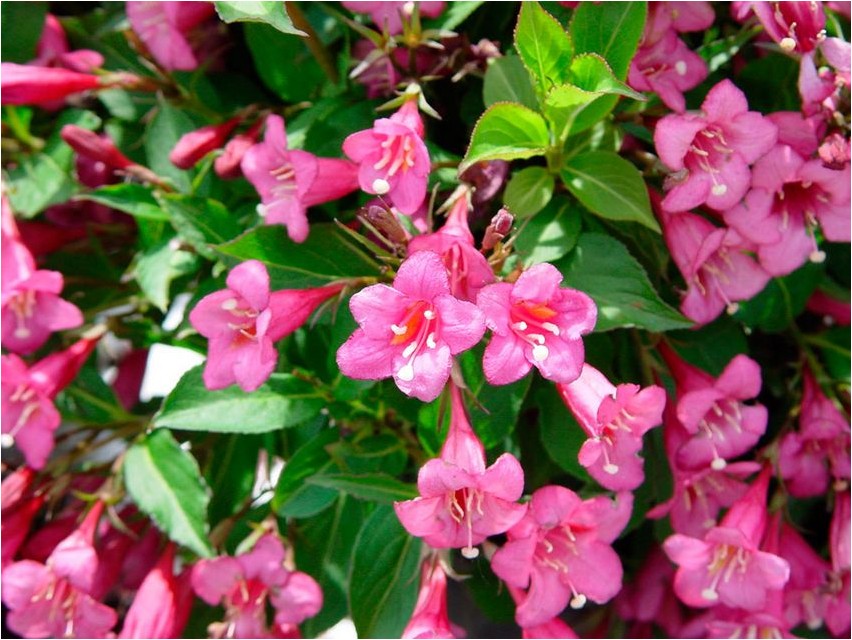
Weigela (Latin: Weigela) is a beautifully flowering ornamental plant; a large genus of deciduous shrubs belonging to the honeysuckle family.
In the wild, weigela grows in eastern Asia, with several species found in the Far East.
Description
Weigela is represented by ornamental, upright shrubs that boast long, abundant, and vibrant blooms. The shrub has densely foliated shoots. The foliage is green, soft and velvety to the touch, and can be elliptical or ovate, with serrated or toothed edges. Petiolate, or less commonly sessile, the leaves lack stipules and are arranged alternately.
The flowers are quite large, and depending on the variety, can be white, cream, yellow, purple, pink, or red. The flowers are small, solitary, or gathered in funnel-shaped or bell-shaped inflorescences. The flowers have a five-lobed calyx, with separate petals, sometimes fused at the base.
The ovary is bilocular and slightly elongated. The fruit consists of many-seeded, woody, ovoid capsules, tapering toward the apex and opening into two valves when ripe. Growing Intricacies
Weigela is a sun-loving plant that blooms well and thrives in well-lit areas, although some species and cultivars tolerate partial shade. The shrub tolerates strong winds poorly and has no special soil requirements. It prefers light, loose, and nutritious soils that are not overwatered or compacted. Most Weigela species are winter-hardy, although annual shoots freeze in cold, low-snow winters.
Propagation Instructions

Weigela is propagated by seed, woody cuttings, and summer cuttings. Sow seeds in spring in seedling trays filled with loose, moist, and nutritious soil. No preliminary seed preparation is required. Cover the seedlings with plastic or glass and place them in a warm location. With proper care, seedlings emerge in 25-30 days.
Green cuttings are taken in June. Propagation using woody cuttings is possible, but considered ineffective. Cuttings are taken at a single internode; their length should be approximately 10-12 cm. The cuts should be straight. Each cutting should have a pair of leaves and one internode.
Before planting for rooting, cuttings are immersed in a solution of growth stimulants for several hours, then a special sand-peat substrate is planted obliquely. Caring for cuttings involves watering and ventilation. As a rule, roots appear on cuttings after 1-1. 5 months. Rooted cuttings are planted in a new place after 1. 5-2 years.
Weigela seedlings are planted in early spring. Planting in the fall is not recommended, since the seedlings do not have time to take root before lasting frosts and eventually die. The planting hole is prepared in 14-20 days, its depth should be about 55-60 cm, and its width should be at least 40 cm.
At the bottom of the pit, a drainage layer of gravel or river sand is formed, on top of which a mound is made of a substrate made up of garden soil, humus or compost and washed fine-grained sand. When planting, the roots of the seedling are straightened and sprinkled with the prepared soil mixture. The root collar of a weigela seedling cannot be buried. Immediately after planting, the soil is thoroughly watered and mulched.
Care
Weigela is a moisture-loving crop; during drought it requires abundant and frequent watering. Fertilizing plays an equally important role; 2 feedings per season are enough (1 in early spring when the snow melts, the second at the time of flowering. The weigel tree trunk area is regularly weeded and loosened, it is advisable to mulch with dry leaves.
With the onset of cold weather, the bushes are carefully pressed to the surface of the soil, covered and insulated with spruce branches. In winter, snow is added to the weigela for additional insulation. Weigela also needs pruning: sanitary — this is carried out in the spring, formative — immediately after flowering. It is necessary to remove faded inflorescences in a timely manner.
Usage
Weigela is a beautifully flowering crop that will decorate any area. Weigela looks good in single and group plantings and is suitable for creating a hedge. Low-growing varieties fit perfectly into rock gardens and rockeries, and are also great on lawns. Weigels can be combined with conifers, such as junipers and spruce, as well as with ornamental shrubs and trees — barberries, viburnum, cotoneasters and spirea.
Flowering shrubs that are not pleasing. Part 3. Weigela