Fluffy alder
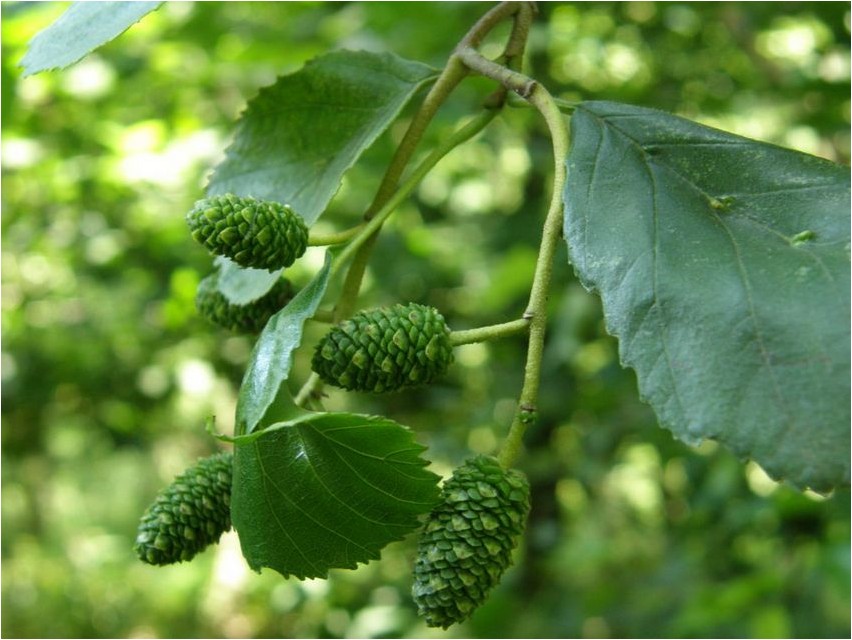
Downy alder is one of the plants of the family called birch, in Latin the name of this plant will be as follows: AInus hirsuta (Spach.) Tutcz. ex Rupr. (A. incana (L.) Moench subsp. hirsuta (Spach.) A. et D. Love).
As for the name of the downy alder family itself, in Latin it will be: Betulaceae S. F. Gray.
Description of downy alder
Downy alder is a large tree, the height of which can reach twenty meters, and the diameter is about sixty centimeters. The bark of this plant is smooth, it can be colored in either dark gray or brownish-brown tones. Young shoots of downy alder are felty and gray, and later they will become bare. The buds will be quite large, they are on stalks, their length is about nine to ten millimeters. The length of the leaves will be approximately twelve centimeters, and the width will be about eleven centimeters; such leaves can be either broadly oval or round. They are doubly or shallowly lobed-toothed; below such leaves will be reddish-velvety, almost bare and can sometimes be bluish. The anther catkins of the downy alder are cylindrical and pendulous, they are painted in dark brown tones, and at the time of flowering their length will be about ten to fifteen centimeters. During flowering, the weeping catkins of this plant are colored in reddish tones; the length of the cones will be about one to two and a half centimeters.
Downy alder blooms at the beginning of April until the leaves bloom. Under natural conditions, this plant is found in the Far East, in the Ob region of Western Siberia, in the Daursky, Yenisei and Leno-Kolyma regions of Eastern Siberia. As for its general distribution, this plant can be found in Japan, Korea and China. For growth, this plant prefers places near roads, edges of swamps, damp meadows, banks of rivers and streams.
Description of the medicinal properties of downy alder
Downy alder is endowed with very valuable healing properties, and it is recommended to use the inflorescences, fruits and bark of this plant for medicinal purposes. The presence of such valuable healing properties should be explained by the content of triterpenoids in the composition of this plant: lupenone, taraxeril, taraxerol, amnincapone, glutinol, beta-amyrin and beta amirenone, as well as phenolic glycosides derivatives of chirsuntenone and chirsuntenonol, as well as the following flavonoids: 3-methyl ester of quercetin, kaempferol, quercetin and kaempferol 4-methyl ester. The leaves will contain essential oil, the fruit will contain tannins, and the pollen will contain the following organic acids: malic, lactic, formic and acetic.
A decoction prepared from downy alder okra is recommended for use in cases of scrofula, while such an infusion is indicated for use in cases of colitis.

In Yakutia, inflorescences or catkins of this plant in the form of a decoction prepared with other plants were used for pneumonia. Dry extract, tincture and infusion are recommended for use as an astringent for various diseases of the gastrointestinal tract, and is also used for coughs and scrofula as a hemostatic agent.
For pulmonary tuberculosis, it is recommended to use the following very healing remedy based on this plant: to prepare such a remedy, it is recommended to take two tablespoons of fluffy alder cones per glass of boiling water. This mixture is infused for two hours and then filtered thoroughly. Take this remedy two to three times a day, one-third of a glass.





