Hathiora saltwort
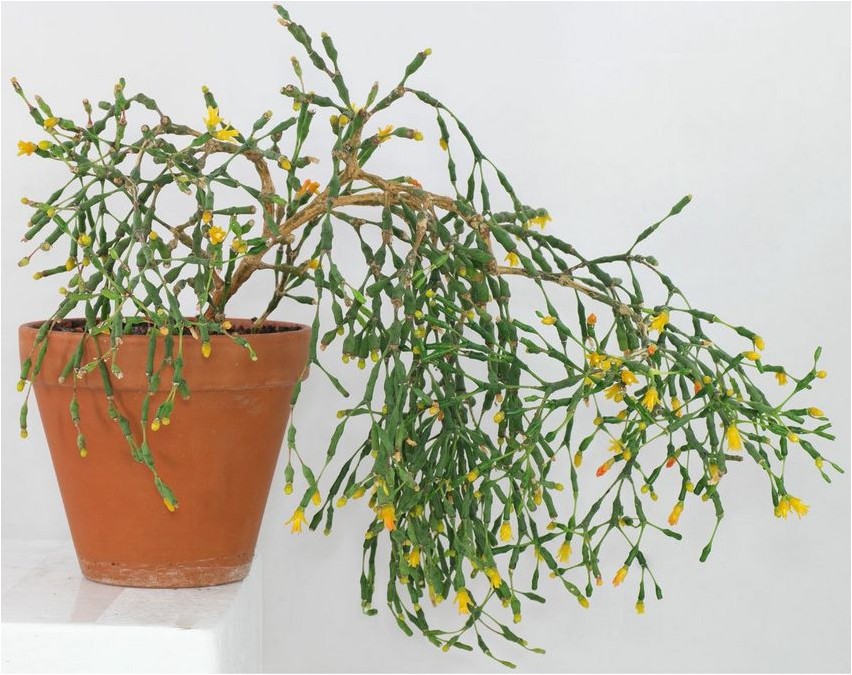
Hatiora salicornioides is a tropical cactus growing as an epiphyte, from the genus Hatiora, which is one of four genera of the tribe Rhipsalideae of the Cactaceae family.
Plants of the genus have many funny folk names. Although it belongs to the Cactaceae family, Hathiora salina is not distinguished by its prickly disposition, but is a compact bush with a succulent succulent stem, yellow or orange pretty flowers, fruits – fleshy berries, and does not have leaves, which most representatives of the plant world of our beautiful planet have.
What’s in your name
As for the Latin name of the genus “Hatiora”, there is a whole semi-detective story of its birth, told in an article dedicated to the genus “Hatiora”. It contains a dedication to one of the botanists, an Englishman by birth, Thomas Harriot, and the use of an anagram of the word “Hariota”, which turned the name into the word “Hatiora” by swapping two letters.
The plant received the specific epithet “salicornioides” (salicornioides) for its appearance, similar to herbaceous plants, which are not morphological relatives, but belong to the genus Salicornia (lat. Salicornia) from the family Amaranthaceae (lat. Amaranthaceae), which received their generic name because they grow on very saline soils, which cannot be said about cacti of the genus Hathiora.
Again, the appearance of the plant gives rise to the most unexpected folk names. For example, the twisted stems of the plant gave rise to the name “Dancing bones cactus” (Cactus – dancing bones), and the shape of the stem segments, reminiscent of a bottle of alcohol, gave rise to the name “Drunkard`s dream” (Drunkard’s Dream).
Since plants of all four genera of the Rhipsalis tribe, at first inexperienced glance, have many externally similar elements, you can encounter all sorts of confusion in the names when Hatiora suddenly turns out to be Rhipsalis, Schlumbergera or Lepismium, or vice versa. But for ordinary flower growers, the name is not always more important than the beauty that all plants of the Rhipsalis tribe give.

Description
The Hatiora salicornia plant consists of numerous branched succulent stems, which can reach 60 centimeters in length. The entire long stem is composed of small segments up to three centimeters long. This means that a single stem can contain up to twenty segments, giving the stem a twisted appearance, creating the impression of a dancing plant. Each small segment is shaped like a miniature bottle. This unique stem gives rise to the various curious common names for Hatiora salicornia, which were discussed above. From the upper part of the areole at the end of the stems, small yellow or orange flowers emerge in winter and spring. These flowers appear to be three-tiered: the first tier consists of elongated oval petals with longitudinal veins, forming a receptacle. In the center of this receptacle sits a flower with smaller, curlier petals, within which are the stamens and pistil. The flower is a very picturesque creation of nature.
After fertilization, the flowers develop into fleshy, translucent berries with a reddish tip.
Uses
In the wild, tropical rainforests of Brazil, Hatiora salicornia is an epiphyte, growing at altitudes ranging from 0 to 1, 850 meters. In countries with warm, humid climates, the plant is grown as an ornamental in open-ground flowerbeds. In climates unsuitable for the heat-loving Hatiora salicornis, the plant is grown indoors, creating suitable conditions for its growth. Hatiora salicornis is often grown as a trailing ornamental plant.
Hatiora – epiphytic cactus “Dancing Bones”