Camelina sativa
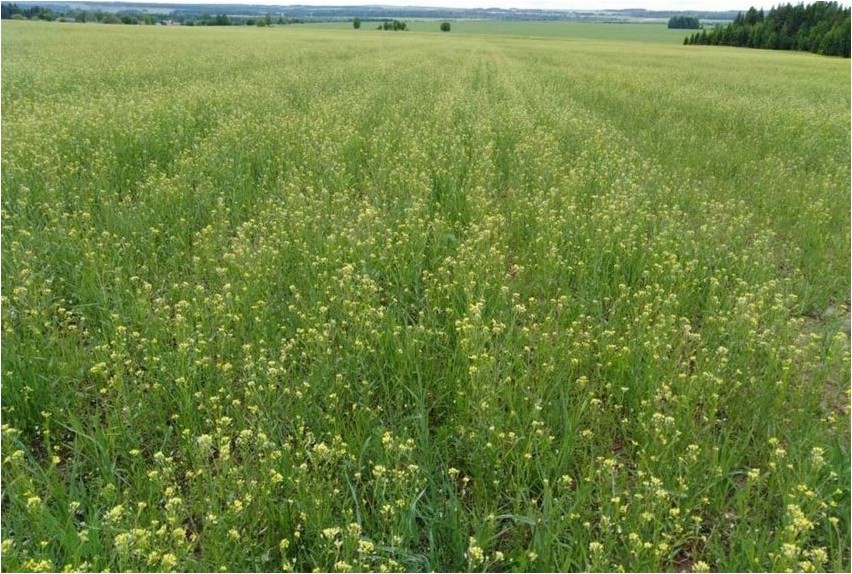
Camelina sativa (L.) Crantz-Burnett is one of the plants in the family called Brassicaceae or Brassicaceae.
As for the name of the camelina family itself, in Latin it will be: Brassicaceae Durnett. (Cruciferae Juss.).
Description of camelina sativum
Camelina sativa is an annual herbaceous plant, the height of which will fluctuate between thirty and eighty centimeters. Such a plant is pubescent, and sometimes it can be almost naked. The stem of Camelina sativa will not branch very much, this will mainly occur in the upper part of the stem. The leaves of this plant are few in number, and the brushes are not long; the length of the petals is about five millimeters, they are colored yellowish. The fruits of camelina sativum will be obovate in shape, their length is seven to ten millimeters, and their width is about four to six millimeters. The valves of this plant are quite hard and highly convex; the length of the seeds is about one and a half to two millimeters, and the width is equal to one millimeter.
Camelina sativa blooms from April to June. Under natural conditions, this plant is found in the Caucasus, Central Asia, Western and Eastern Siberia, Moldova, Crimea, Belarus, Ukraine, as well as all regions of the European part of Russia, with the exception of only the Zavolzhsky, Lower Volga, Lower Don and Volga-Don regions. For growth, this plant prefers foothills, fallow lands, crops on plains and the lower mountain belt.
Description of the medicinal properties of camelina sativum
Camelina sativa is endowed with very valuable healing properties, and it is recommended to use the herb of this plant for medicinal purposes. The term grass includes flowers, stems and leaves. The presence of such valuable medicinal properties should be explained by the content of fatty oil in the seeds of this plant, which contains the following acids: erucic, linolenic, palmitic, eicosenoic, stearic, linoleic and 15, 16-epoxylinolenic.
As for traditional medicine, here this plant is quite widespread. An infusion and decoction prepared from the herb Camelina sativa is recommended by traditional medicine for use in various cancer diseases. For softening poultices, use the herb and seeds of this plant. It is noteworthy that the fatty oil of camelina sativum seeds turns out to be very suitable for both technical and food purposes and is quite widely used in the metallurgical industry, the preparation of paints and soap making.

For cancer diseases, it is recommended to use the following very effective healing remedy based on this plant: to prepare such a healing remedy, you will need to take three tablespoons of crushed dry camelina sativum in about two glasses of boiling water. The resulting medicinal mixture should first be left to infuse for about two to three hours in a warm place, after which this healing mixture based on camelina sativum should be very carefully filtered. Take the resulting medicine based on this plant three times a day, regardless of food intake, half a glass or one third of it for various cancers. If used correctly, such a medicine based on camelina sativus will be quite effective.





