Bedstraw
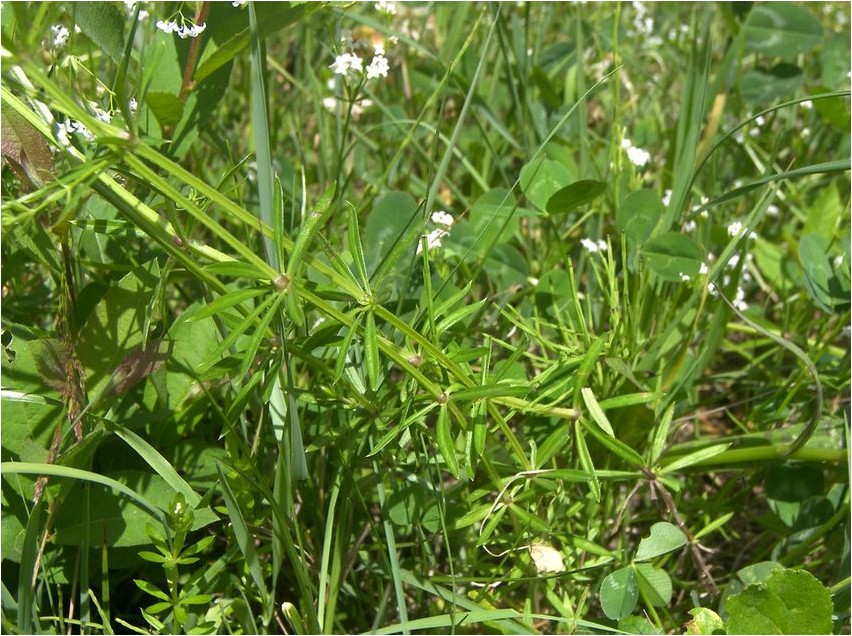
False brook bedstraw is one of the plants of the family called shift plants; in Latin the name of this plant will be as follows: Galium pseudorivale Tzvel. (Asperuga aparine Bieb.).
As for the name of the bedstraw family itself, in Latin it will be like this: Menyanthaceae Dumort.
Description of bedstraw
Bedstraw is a perennial creeping herbaceous plant, endowed with weak and clinging stems, which are tetrahedral and can be either branched or simple. The length of such stems will vary between fifteen and one hundred and fifty centimeters. The leaves of this plant are six to eight in a whorl, they will be oblong-lanceolate, their length is twenty to thirty millimeters, and their width is about four to eight millimeters. The bracts of bedstraw are found in inflorescences; they are much smaller than the stem leaves; such leaves are arranged in six to eight pieces in whorls or in pairs. The inflorescences of the bedstraw are paniculate and loose, it is located at the very ends of the upper branches and stems. The peduncles of this plant are several times longer than the leaves, they are double- or triple-branched, and will also bear three simple half-umbrellas on the last branches. The corolla of the bedstraw is painted in snow-white tones and is tubular-funnel-shaped. The length of the fruits of this plant is one and a half millimeters, and the width is two millimeters; such fruits are double and naked.
Flowering bedstraw occurs during the period from June to August. Under natural conditions, this plant is found in Moldova, Crimea, the Carpathians, Western Siberia, the Caucasus, the European part of Russia and Central Asia. For growth, this plant prefers the edges of swamps, thickets of bushes, clearings, damp meadows, pebbles and juniper woodlands.
Description of the healing properties of bedstraw
Bedstraw is endowed with very valuable healing properties, and it is recommended to use the herb of this plant for medicinal purposes. The concept of grass includes flowers, leaves and stems.
The presence of such valuable healing properties is recommended to be explained by the content of flavonoids, umbelliferone, desacetylasperuloside, phenolcarboxylic acids and their derivatives in this plant.

A decoction prepared from the herb of bedstraw is recommended for use in uteroptosis. It should be noted that the experiment proved that the infusion and decoction of this plant will exhibit similar pharmacological properties of the medicinal forms of Bedstraw jointed, Bedstraw fragrant, and Bedstraw prostrata. In addition, such medicinal agents should be used as very effective antihypertensive agents.
It is worth noting that the rhizomes have the ability to color the skin and fur in red tones, and the leaves themselves will give a green color.
When the uterus prolapses, it is recommended to use the following very effective remedy based on this plant: to prepare such a remedy, take one tablespoon of crushed dry bedstraw grass per glass of water. The resulting mixture is boiled for three minutes, left for an hour and filtered thoroughly. Take this remedy for two to three weeks, three times a day, two tablespoons. If used correctly, such a remedy based on bedstraw will prove to be very effective.





