Langsat
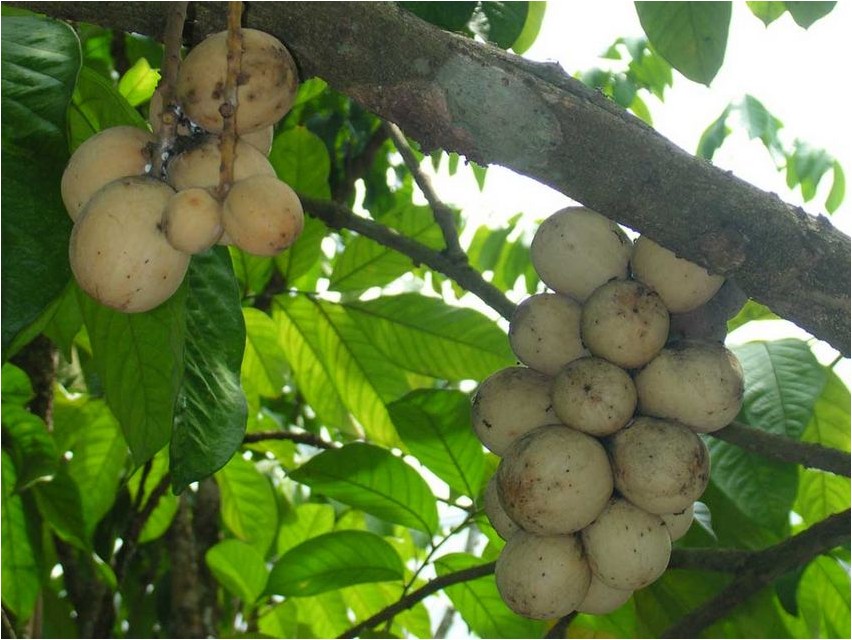
Langsat (lat. Lansium domesticum) is a fruit tree belonging to the Meliaceae family.
Description
Langsat is a slender, upright tree whose height can vary from ten and a half to fifteen meters. The rough bark of trees is usually colored yellowish-brown or reddish-brown. And the pinnate leaves of langsat reach a length of twenty-two and a half to fifty centimeters.
The fleshy flowers of this culture can be either pale yellow or white. All of them are collected in compact inflorescences growing on the main branches and trunks.
The slightly oval or round langsat fruits reach a diameter of two and a half to five centimeters. Each fruit is covered with a velvety pale brownish or grayish-yellowish skin. And the white pulp contained inside is always transparent and aromatic. As a rule, it is divided into five or six separate segments. Also inside the fruit you can find one or two fairly long and large seeds. By the way, langsat fruits are somewhat reminiscent of young potatoes. Despite the fact that the peel of these fruits is very dense, they are quite easy to peel (many people can open them with their hands without much difficulty). And langsat can taste either sweet or sour.
Langsat begins to bear fruit only after fifteen years, but then it will delight you with a harvest twice a year!
Where does it grow
The homeland of this unusual plant is Malaysia. In addition, langsat is quite widely cultivated in the Hawaiian Islands, South India, Vietnam, Thailand, the Philippines and Indonesia. Sometimes single trees can be found on a number of Pacific islands. And the inhabitants of the American continent are not familiar with langsat, although it is still grown in small quantities in Suriname.

It is noteworthy that langsat is one of the many symbols of the colorful Thai province called Narathiwat.
Application
Langsat fruits can be eaten fresh, or can be preserved in syrup or boiled. Moreover, these amazing fruits will perfectly complement almost any dish. And the drinks they make are excellent.
When burned, the dry skin of langsat emits an aromatic smoke that repels harmful insects. And the wood of this culture has found application in the popular furniture industry. But products made from it are quite expensive.
The crushed seeds of the fruit are used as an anthelmintic and antipyretic. A decoction of the bark helps well in curing dysentery and malaria.
In Chinese and Thai folk medicine, the miraculous langsat is actively used to increase strength during illness, as well as to increase overall tone.
The juicy pulp of langsat helps reduce fever and fever, and also helps improve sleep, brain activity and memory.
Contraindications
Langsat is contraindicated for people with diabetes. You should not use it in case of individual intolerance. And excessive consumption of this fruit can lead not only to an increase in temperature, but also to more serious consequences.
Selection and storage
Ripe langsat is always quite firm to the touch and has an even skin. In no case should there be cracks on high-quality fruits.
To peel this fruit, gently squeeze the skin near its stem and slowly remove it, and then divide the pulp into two parts.
As a rule, langsat does not last long — at room temperature it is unlikely to last more than three to four days. And it can be stored in the refrigerator for up to two weeks. These fruits are best preserved at a temperature of twelve to thirteen degrees.