Russian Larch
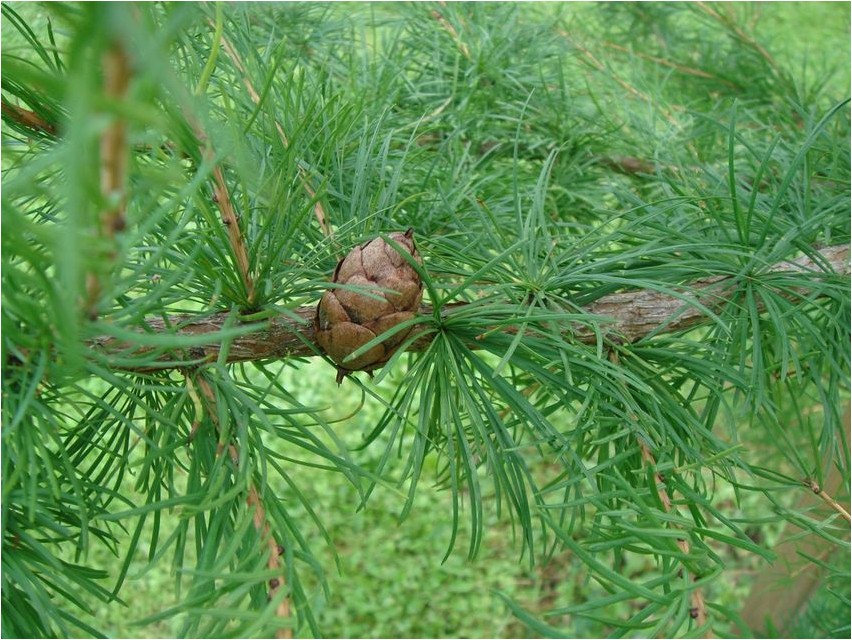
Russian larch is a member of the pine family. Its Latin name is Larix rossica Ilyinsky.
As for the family name of Russian larch, its Latin name is Pinaceae Lindl.
Description of Russian Larch
Russian larch is a tree that reaches a height of approximately twenty-five to thirty-five meters. This plant has a pyramidal crown. The bark of the trunk is grayish, while young branches are smooth and light yellow. Its leaves are narrow and soft, growing in clusters of thirty to forty, and fall off in winter. Male cones of the Russian larch are oval in shape, solitary, and form on one-year-old or older, regular shoots. They are pale yellow in color. Female cones are also oval in shape, reddish in color, and are found on short, leafy shoots. Mature cones are ovoid and ripen in the first year of the plant’s life, but they remain on the tree for quite a long time, even after snowfall.
In the wild, this plant is found in northern European Russia and Siberia. It is noteworthy that native species of this plant grow in the Far East, and Russian larch is also cultivated in urban areas.
Description of the Medicinal Properties of Russian Larch
Russian larch has very valuable medicinal properties. For medicinal purposes, it is recommended to use young shoots, leaves, essential oil, or turpentine from this plant. This plant’s valuable healing properties can be attributed to its ascorbic acid and essential oil, which consists of borneol, bornyl acetate, and pinene. The bark also contains tannins and turpentine. This turpentine is used externally as a distracting and irritating agent for neuralgia, gout, myositis, and rheumatism. It is also used for pulmonary gangrene, bronchitis, abscesses, and catarrh of the upper respiratory tract. Turpentine inhalation is also sometimes used as a highly effective antimicrobial agent.
As for traditional medicine, hot infusions based on the bark and coniferous shoots of this plant are quite widespread. Such medicinal remedies are used for influenza, and an infusion of Russian larch needles is used for hypermenorrhea. Turpentine compresses, which are covered with a hot heating pad, are recommended for use for sciatica and radiculitis. For toothache, it is recommended to apply a turpentine compress to the cheek. For gout and rheumatism, a bath made from an infusion of fresh branches of this plant is effective. It should be noted that Russian larch needles can be collected throughout the summer period, but the most effective use of such means is in the period from the end of June to the end of August. This circumstance should be associated with the fact that at this time the amount of ascorbic acid in the composition of this plant will increase many times over.

It is important to remember that due to the fact that the chemical composition of this plant has not yet been fully studied, it is possible that the use of the healing properties of Russian larch is incomplete and in the near future we can expect the emergence of new ways to use the healing properties of this plant.
https://www. youtube. com/watch? v=UityUeFd_rk
Russian larch





