Chilibukha
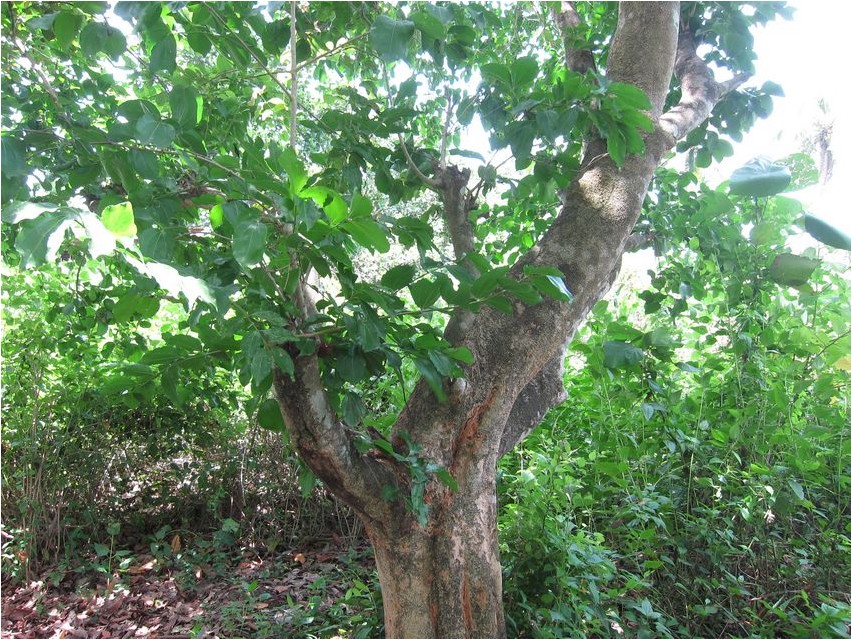
Chillibuha (lat. Strychnos nux-vomica) is a deciduous and very pretty tropical tree belonging to the Loganiaceae family. This plant is popularly called emetic nut.
Description
Chilibukha is an attractive deciduous tree of relatively small size, reaching a height of up to fifteen meters. The leathery, shiny leaves are oval in shape and arranged oppositely.
Greenish-whitish miniature five-membered flowers are folded in the leaf axils into semi-umbrella-shaped inflorescences and are endowed with tubular miniature corollas.
The spherical fruits of chilibuha have a berry-like shape and are characterized by rather large sizes and an orange-reddish color. Their skin is quite hard, and each fruit is equipped with clearly visible intercarplets, which look like gelatinous and completely colorless pulp. And inside this pulp there are disc-shaped seeds in the amount of two to six pieces. The thickness of each seed is about 1. 5 — 2. 5 mm, and their diameter reaches 4 — 5 mm. All of them are slightly curved and painted in yellowish-grayish tones, and their shiny silky surfaces are covered with a huge number of pressed hairs, radiating out from the very center. In the middle of the seeds there are tiny rounded ridges, from which miniature ridges of converging hairs stretch towards the edges of the seeds. And near the edges of each seed, tiny embryos that look like small papillae protrude. By the way, chilibukha seeds are so hard that they can be cut lengthwise only after prolonged boiling.
Where does it grow
Chillibuha grows in northern Australia and in the tropical forests of South Asia (on the island of Sri Lanka, as well as in India, Malaysia, Vietnam, Thailand, Laos and Cambodia). In addition, it is quite actively cultivated in the African tropics.
Application
Chilibuha seeds are considered an excellent medicinal raw material. And in medicine, a nitrate salt called strychnine nitrate is actively used, as well as herbal preparations such as dried fruit extract and tincture from them. By the way, strychnine nitrate is quite widely used as a stimulant for a weakened nervous system, significantly increasing reflex excitability. As for herbal remedies, they are excellent tonics and also stimulating metabolism. By the way, it is necessary to use chilibukha preparations only under the supervision of a doctor.

It is recommended to use chilibukha for rapid fatigue and chronic fatigue, for stomach atony and hypotension, for paresis and paralysis, as well as for a noticeable weakening of cardiac activity as a result of poisoning and all kinds of infections. In case of disturbances in the functioning of the visual apparatus, this culture will also serve well. And brucine contained in chilibuha seeds is widely used as a chemical reagent.
By the way, strychnine was first extracted from chilibukha. This was back in 1818. The bitterness of this unusual substance is felt even if you add a single gram of strychnine to a whole ton of water. And the toxicity of this element is also off the charts. In addition, another poison called curare is isolated from chilibuha. Europeans first became acquainted with it in the 16th century through the arrows of the Indians, who actively defended their fertile lands from the conquistadors. At the same time, local residents who used curare poison in hunting ate with great pleasure the meat of animals killed with the help of this poison. And this did not entail any negative consequences for the body. And later it turned out that curare, if it gets into the digestive tract, is not capable of harming a person, however, only if the mucous membranes of his esophagus and mouth were not damaged.