Cloudberry
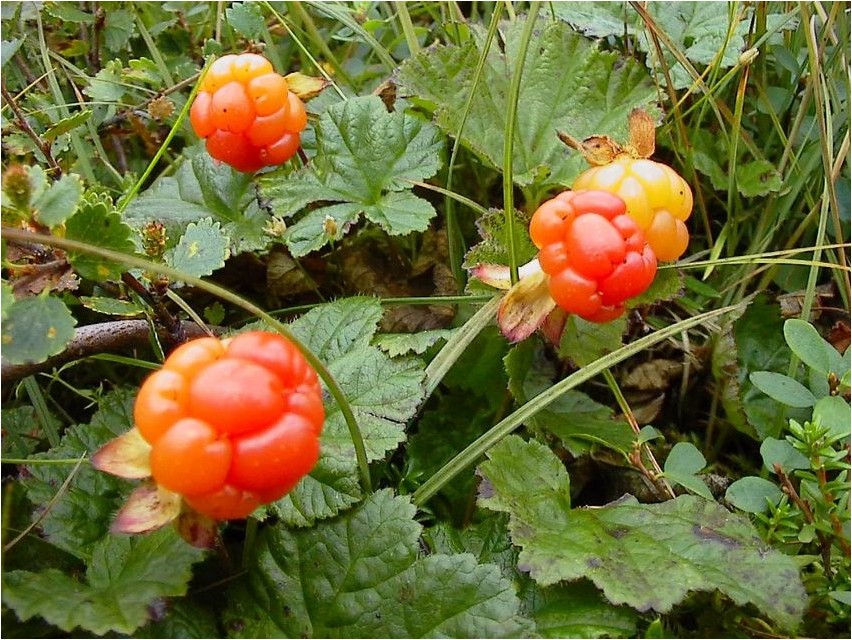
Cloudberry is one of the plants of the family called Rosaceae; in Latin the name of this plant will be as follows: Rubus chamaemorus L.
As for the name of the cloudberry family itself, in Latin it will be: Rosaceae Juss.
Description of cloudberry
Squat cloudberry is known by the following popular names: Glazhenina, Vakhlak, Glazhevina, Vakhlachka, Glaty, Kumanikha, yellow raspberry, moss currant, cloudberry, mohlaki and bearcage. Cloudberry is a dioecious perennial herbaceous plant whose height will vary between ten and thirty centimeters. Such a plant will be endowed with a rather long creeping rhizome. The leaves of cloudberry are five-lobed and rounded, and along the edge they will be crenate. The flowers of this plant will be apical and solitary, as well as unisexual, while the male flowers are larger than the female ones and can reach up to three centimeters in diameter, and the petals of such flowers are painted white. Unripe cloudberry fruits are red, but when ripe they will gradually turn yellow. Ripe fruits are painted in bright yellow tones; they will be translucent and very reminiscent of amber. Cloudberry drupes are large in size and have a large stone. Reproduction of this plant can occur both by seeds and vegetatively through the rooting of creeping vegetative shoots and rhizomes.
Cloudberry blooms from the end of May to the beginning of June, while the fruits ripen after about forty to forty-five days, in the second half of July. For growth, this plant prefers tundra and forest-tundra. Under natural conditions, cloudberry can be found in the Far East, Siberia, the European part of Russia, as well as in more southern regions: Smolensk, Tver, Volgograd, Novgorod and Vladimir.
Description of the medicinal properties of cloudberry
Cloudberry is endowed with very valuable healing properties, and it is recommended to use the fruits, roots and leaves of this plant for medicinal purposes. It is recommended to harvest such raw materials from May to July, while the roots will be harvested in late autumn.
The presence of such valuable healing properties should be explained by the content of aluminum, copper, chromium, glucose, fructose, magnesium salts, carotene, vitamin C, tannins and dyes, citric and malic acid in this plant. The unripe fruits of this plant contain antheroxanthin, rubixanthin and cryptoxanthin. The aerial part of cloudberry will contain flavonoids, mainly glycosides of kaempferol and quercetin, as well as hydrolyzable tannins.

The leaves of this plant are endowed with wound-healing, hemostatic, astringent, diuretic and anti-inflammatory effects. The fruits of this plant have anti-inflammatory, diaphoretic, diuretic and antiscorbutic effects. It is noteworthy that the fruits of this plant are a very effective antiscorbutic remedy. Fruits and infusions prepared from the leaves and roots of cloudberry are a good diuretic. Such drugs are used quite widely for edema of various origins, malignant and scurvy neoplasms. An infusion of the sepals of this plant is indicated for use for pain in the heart and fever.