Kupena
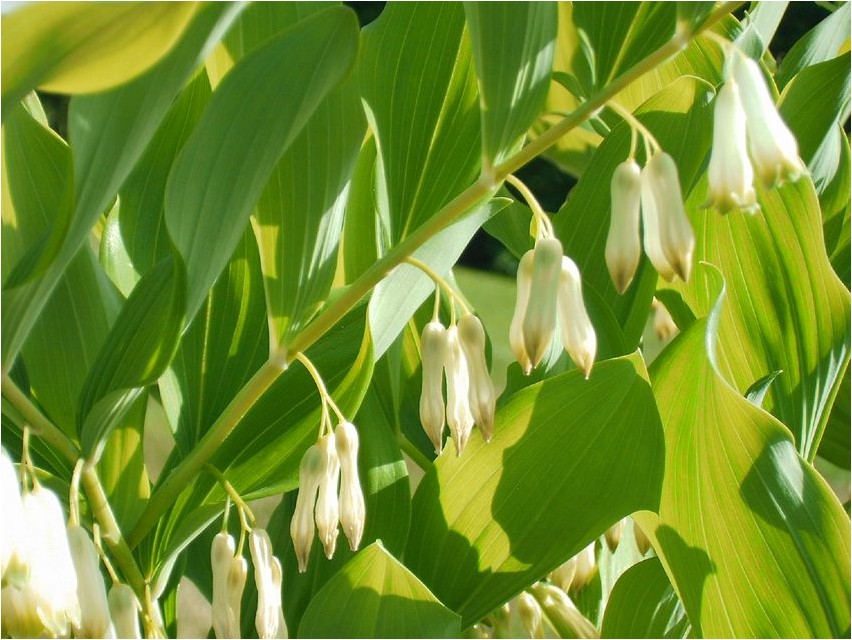
Kupena (lat. Polygonatum) – flower crop; perennial plant of the Asparagus family. Another name for the plant is Solomon’s Seal.
In nature, kupena is found in temperate and subtropical forests of the Northern Hemisphere. In Russia, kupena grows wild in the European part, the Caucasus and the Far East. Currently, about 50 species are distinguished.
Characteristics of culture
Kupena is a herbaceous plant with arched or drooping green stems up to 1 m high. The root system is powerful, the rhizome is thick, horizontal, with depressed traces of dead annual stems, otherwise “seals”. The leaves are sessile, linear, ovate or elliptical in shape, arranged alternately and whorled.
The flowers are bisexual, solitary or collected in few-flowered drooping or tubular racemes. The perianth is greenish-white or pink in color, with six teeth. The flowers are pollinated by bumblebees, and self-pollination is also possible. The fruit is a berry, blue or black in color, containing 1-9 seeds.
Kupena is not distinguished by its bright blooms; it is valued for the special charm of its flowers and discreet beauty. After flowering, the plant retains its decorative appearance thanks to its interestingly shaped stems and emerging fruits. All parts of the plant are poisonous.

Growing conditions
Kupena is considered an unpretentious plant, it grows well in sunny, shaded and damp areas, and grows without any problems under the crowns of tall trees and shrubs. Kupena is not demanding on soil conditions, but moist, drained and fertile substrates are preferable. Plants are susceptible to stagnation of spring waters and often rot and die. Kupenas are durable and winter-hardy; they can grow in the same place for several decades. Some species, for example, roseate and sweet-smelling, are drought-resistant.
Reproduction and planting
Kupena is propagated by seeds and segments of rhizomes with a renewal bud. The seed method is quite labor-intensive and ineffective. Sowing is carried out in late autumn under cover; the kupenas sprout only a year later. The crop practically does not self-sow, with the exception of broadleaf kupena. The second method of propagation is more common; planting material is cut either in the spring or in August, after which the sections are planted in the ground and mulched with a thick layer of peat or humus.
Care
Kupenas do not need any special care, but they respond very positively to fertilizing and abundant watering. During prolonged drought, the volume of water during irrigation is significantly increased. The crop is fed with humus or compost and complex mineral fertilizers; wood ash will not harm the plant.
Fertilizers are applied twice per season: the first time in early spring, the second time during flowering. To retain moisture in the stem zone for a longer period, the soil is mulched with peat or fallen leaves. Under favorable growing conditions, kupena is resistant to diseases and pests. Rarely affected by slugs.
Application
Most often, kupena is used to create shady flower beds. Often used to create mixborders and garden corners in a rustic style. Kupena squat fits harmoniously into rocky gardens – rockeries and rock gardens, as well as large rockeries. The culture is not picky about its neighbors and combines with many annuals and perennials. Despite its inconspicuousness, the kupena is very decorative; as it grows, it forms rather dense clumps.
Kupena is also widely used in folk medicine. Kupena fruits are beneficial for people suffering from cardiovascular diseases. Decoctions from the rhizomes of the plant are used in the treatment of peptic ulcers of the duodenum and stomach, as well as bruises, pustular skin diseases and hernias.





