Berry berry
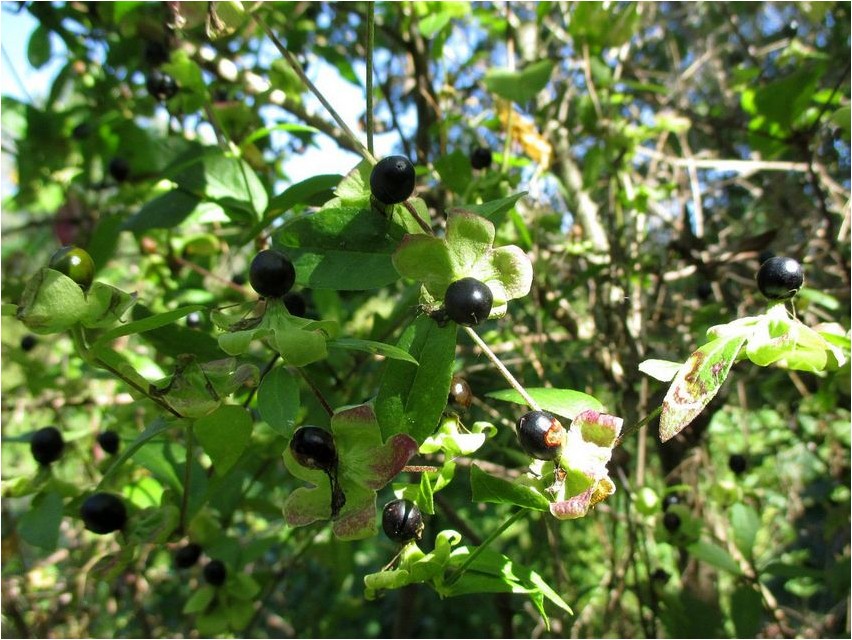
Berry berry is one of the plants of the family called carnation; in Latin the name of this plant will be as follows: Cacubulus baccifer L.
As for the name of the berry blister family, in Latin it will be like this: Caryophillaceae Juss.
Description of berry blister
Berry berry is a perennial herbaceous plant, the height of which can be about eighty centimeters – two meters. It is worth noting that the stems of this plant are rather weak and short-haired, and they can be either erect or recumbent. The leaves of this plant are either lanceolate, ovate, or oblong. The leaves of the berry blister are entire, short-petioled and sharp. The flowers are solitary in the axils of the leaves: they are in rather sparse leafy inflorescences, the calyx is yellow-green in color, it will also be short-bell-shaped. The petals of this plant are colored greenish-white, they will be narrow and two-lobed, there are five of them in total, with ten stamens and three styles. The fruits of Blueberry will be berry-shaped, sessile, unilocular and spherical, while the seeds are shiny, kidney-shaped and black. This plant blooms throughout the summer.
The distribution of blueberry is characterized by the Crimea, the European part of Russia, Ukraine, Belarus, the Upper Tobolsk region of Western Siberia, as well as the Caucasus, Kazakhstan and the Far East. As for its general distribution, this plant can be found in Korea, Japan, Iran, Afghanistan, India, Pakistan, Nepal, Northeast China and Central Europe. For growth, this plant prefers damp places, banks of rivers and lakes, bushes and shady forests.
Description of the medicinal properties of berry blister
For medicinal purposes, it is recommended to use the roots and herbs of this plant: namely, flowers, leaves and stems. The plant contains phenol carbonic acids, saponins and the following flavonoids: apigenin glycosides, isovetixin and vitexin glycosides, as well as carbohydrates: lychnose, sucrose, stachyose, penta-, hexa-, hepta- and octagalactosides of sucrose of the isolychnose and lychnose series.
As for traditional medicine, fresh herb is used as compresses for various blisters, and a decoction of this herb is used as a hemostatic agent for bleeding. It is noteworthy that healers use the herb Berry berry to treat rinderpest.

In China, a decoction made from about nine to fifteen grams of roots is drunk for bruises, rheumatic pain, childhood rickets, fractures, edema, pulmonary tuberculosis, as well as for infectious infection of the urinary ducts. External application of fresh crushed root is used as a plaster to treat abscesses, tuberculous lesions of the lymphatic tract and purulent wounds. It should be noted that in France, young plants are quite often eaten as a vegetable.
For hemorrhoidal and other bleeding, it is recommended to prepare the following remedy: for this you will need to take ten grams of dry crushed herb per glass of water. After this, this mixture should be boiled for about three to four minutes, and then left to infuse for about one hour, after which this mixture should be thoroughly strained. This remedy should be used four times a day, about half a glass or one third of it. If you follow these rules of administration, this remedy will be very effective.





