Snowberry
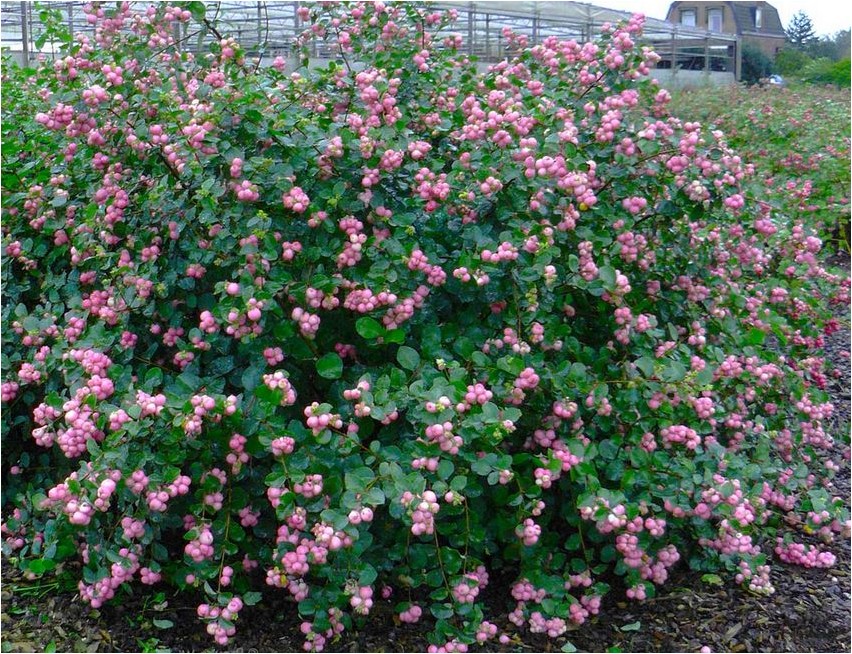
Snowberry (lat. Symphoricarpus) is a deciduous shrub of the Honeysuckle family. Other names: Snezhnik, Snow berry, Wolf berry.
In nature, the snowberry is found in mountain forests, on dry rocky slopes and along river banks in North America. Currently, 15 species have been identified.
Characteristics of culture
Snowberry is an elegant shrub 1-3 m high. The shoots are thin, vertical, often slightly hanging, prostrate. The leaves are simple, entire, rarely notched-toothed, have no stipules, and are arranged oppositely on short petioles. The flowers are regular in shape, collected in axillary or racemose inflorescences.
The fruits are numerous, small or large, spherical or ellipsoidal, contain 1-3 oval or compressed seeds, stay on the branches for a long time, can be white, pink, red-coral or black. The crop blooms in June, the flowers are inconspicuous, partially hidden under the foliage. Snowberry is considered a good honey plant. The plant is highly ornamental, valued for its undemanding nature and resistance to adverse weather conditions.
Growing conditions

The snowberry is not picky about its growing conditions, it grows easily even on poor soils, as well as rocky and calcareous substrates, and adapts without problems. The plant feels good in both open sunny and shaded areas. Some species also tolerate strong shade, for example, white snowberry. The culture is drought-resistant and frost-resistant, but sensitive to soaking, for this reason it needs good drainage.
Reproduction and planting
Snowberries are propagated by seeds, cuttings, suckers and divisions. The seed method is generally not complicated and effective. The seeds are collected with the onset of frost; for this, the berries are crushed and kept warm for three days. Then the berries are poured with water, all the soft particles will float to the surface, and the seeds will settle to the bottom. The seeds are washed, mixed with peat or sand and stored in the refrigerator until spring. Sow seeds immediately in open ground in early spring.
The easiest way to propagate snowberries is division. This procedure is carried out in the fall during leaf fall. The culture is often propagated by root suckers, green and lignified cuttings. Cuttings are cut during the dry period, the lower pair of leaves are removed from the cuttings, and the cut is made obliquely along the node opposite one of the buds. The cuttings are planted in greenhouses quite tightly. Until the cuttings take root, watering, spraying, weeding and loosening the rows are regularly carried out.
Care
Caring for snowberries is not difficult and can be done even by a novice gardener. The crop needs watering during planting and for the next 3-4 days, and then only during a long drought (at the rate of 1 bucket per plant). Snowberries respond well to feeding. Fertilizers are applied in early spring simultaneously with digging up the soil in the tree trunk zone. The following are ideal for feeding: humus or peat compost (4-8 kg), double superphosphate (30 g) and potassium salt (10-15 kg).
The plant requires regular loosening along with weed removal. Sanitary and formative pruning is carried out in the spring, but before the buds swell. Every year, dry, frozen and diseased branches are removed from the bushes, and the cuts are treated with garden varnish. The crop tolerates pruning without problems and recovers quickly. The shape of snowberry hedges is also maintained by cutting out root suckers.
Application
Modern gardeners do not deprive snow berries of attention; not only are the plants not whimsical, they fit quite harmoniously into landscape design, made in a wide variety of stylistic directions. Snowberry is used in borders and mixed plantings, it is often used as tapeworms and hedges, and is often planted in groups on the lawn. In order to highlight and emphasize the beauty of the snowberry, it is planted in groups with mahonia, heathers and coniferous shrubs.





